
14 Days Uganda Birding Safari – Ultimate Birdwatching Tour
The 14 Days Uganda Birding Safari is an immersive two-week birdwatching journey designed to introduce travelers to Uganda’s remarkable variety of bird habitats. The safari travels through tropical forests, papyrus wetlands, open savannahs, lakes, river systems and the mountainous landscapes of the Albertine Rift, giving birders opportunities to search for a wide range of East African species.
This itinerary connects several of Uganda’s important birding destinations, including Mabamba Wetland, Murchison Falls National Park, Budongo Forest, Kibale National Park, Bigodi Wetland Sanctuary, Queen Elizabeth National Park, Bwindi Impenetrable National Park, Mgahinga Gorilla National Park and Lake Mburo National Park.
One of the early highlights is a visit to Mabamba Wetland, where birders explore papyrus channels by canoe while searching for the iconic Shoebill. As the safari continues, the habitats change dramatically—from the savannah and riverine environments of Murchison Falls to the forests of Budongo and Kibale, followed by the wetlands and grasslands of Queen Elizabeth National Park.
The southwestern section of the journey provides opportunities to explore the forests and highlands of the Albertine Rift, particularly Bwindi and Mgahinga. These areas are especially important for travelers interested in regional forest and montane bird species.
The safari is suitable for beginner, intermediate and experienced birdwatchers. The itinerary can also be customized for bird photographers or travelers interested in combining birding with Uganda’s other wildlife experiences. Optional chimpanzee tracking in Kibale and mountain gorilla trekking in Bwindi or Mgahinga can be incorporated with the necessary permits and advance arrangements.
Throughout the journey, birding can be combined with nature walks, boat trips and game drives, allowing travelers to experience Uganda’s birds alongside primates, mammals and diverse landscapes.
14 Days Uganda Birding Safari at a Glance
| Safari Detail | Information |
|---|---|
| Duration | 14 Days / 13 Nights |
| Destination | Uganda |
| Safari Type | Private Birding Safari |
| Starting Point | Entebbe/Kampala |
| Ending Point | Entebbe/Kampala |
| Main Activities | Birdwatching, nature walks, game drives and boat safaris |
| Optional Activities | Gorilla trekking and chimpanzee tracking |
| Suitable For | Beginner, intermediate and experienced birdwatchers |
| Main Habitats | Wetlands, tropical forests, savannahs, woodlands, lakes and montane forests |
| Key Birding Experience | Shoebill and Albertine Rift birding |
The route can be adjusted by Wild Planet Safaris according to the traveler’s target species, preferred birding pace, accommodation category, photography interests and optional primate activities.
Highlights of the 14 Days Uganda Birding Safari
Search for the Shoebill at Mabamba Wetland
A major highlight of the 14 Days Uganda Birding Safari is searching for the Shoebill at Mabamba Wetland, an extensive papyrus wetland near Lake Victoria.
Birding here is generally conducted from a small canoe with a local guide. Moving slowly through the narrow channels allows birdwatchers to explore patches of papyrus, open water and floating vegetation while searching for the Shoebill and other wetland species.
Although the Shoebill is the principal target, Mabamba supports many other birds. Depending on conditions and season, birders may encounter kingfishers, herons, egrets, jacanas, weavers and other wetland-associated species.
The canoe experience also provides excellent opportunities for bird photography because much of the birding takes place close to water level.
The shoebill at Mabamba Wetland
Savannah Birding in Murchison Falls National Park
Murchison Falls National Park introduces travelers to a completely different birding environment. Its combination of open savannah, woodland, riverine vegetation, wetlands and the Nile creates habitat for a diverse bird community.
Early-morning game drives can combine birdwatching with searches for Uganda’s larger mammals. Birders can watch for hornbills, bee-eaters, rollers, kingfishers, raptors and numerous grassland and woodland species.
Birding along the Nile adds another dimension, with opportunities to observe waterbirds and species associated with riverbanks and wetland vegetation.
The combination of birdwatching and traditional wildlife viewing makes Murchison Falls particularly rewarding for travelers who want more than a bird-only safari.
Forest Birding in Budongo Forest
The safari continues into the forest environment of Budongo, where the emphasis shifts from open-country species to forest birds.
Walking slowly through suitable forest trails gives birders time to listen for calls, examine mixed feeding flocks and search the canopy, understory and forest edges for different species.
Forest birding requires patience because birds may be partially concealed by vegetation. A knowledgeable birding guide can therefore be particularly valuable for recognizing calls and locating birds before they disappear deeper into the forest.
Budongo also provides an interesting transition between the savannah landscapes of Murchison Falls and the forest-focused birding experiences encountered later in the safari.
Kibale Forest and Bigodi Wetland Birding
The Kibale region combines tropical forest birding with productive forest-edge, swamp and community-managed habitats.
Kibale National Park is best known internationally for its primates, but its forests also provide rewarding opportunities for birdwatchers. Birding can focus on forest trails and edges while searching for species associated with Uganda’s western forests.
Nearby Bigodi Wetland Sanctuary provides a contrasting birding experience. Its mixture of swamp, forest edge, farmland and community landscapes supports another variety of birds.
This combination allows travelers to experience two different habitats within a relatively small geographical area.
Travelers interested in primates can also add chimpanzee tracking in Kibale to their itinerary, subject to permit availability and the final safari schedule.
Birding in Queen Elizabeth National Park
Queen Elizabeth National Park adds another extensive mixture of habitats to the itinerary, including savannah grasslands, bushland, wetlands, crater landscapes and the Kazinga Channel.
Morning and evening game drives allow birders to search for open-country species while simultaneously watching for mammals.
One of the major birding experiences here is a boat safari on the Kazinga Channel. Birdwatching from the water can produce close views of species associated with shorelines, shallow water and aquatic habitats.
Possible sightings may include African Fish Eagles, African Jacanas, Pied Kingfishers, Malachite Kingfishers, cormorants, pelicans, herons and egrets, among many others.
Because wildlife frequently gathers around the channel, this section of the safari combines bird photography with excellent general wildlife viewing.
Albertine Rift Birding in Bwindi
Bwindi Impenetrable National Park is an essential destination on an itinerary designed around western Uganda’s specialist forest birding.
The park lies within the Albertine Rift, a region recognized for its high biodiversity and restricted-range species. Its elevations and varied forest environments provide habitats that differ significantly from Uganda’s savannah and wetland birding areas.
Birding in Bwindi can involve walking forest trails while searching the canopy, understory, forest floor and clearings. The exact birding locations should be selected according to the traveler’s target species and the sector being visited.
Birders may search for a variety of forest and Albertine Rift species, while serious birdwatchers can provide Wild Planet Safaris with a target-species list before the trip so the itinerary can be planned accordingly.
Bwindi also gives travelers the opportunity to combine birdwatching with mountain gorilla trekking, subject to permit availability.
Suggested image: bwindi-albertine-rift-birding.jpg
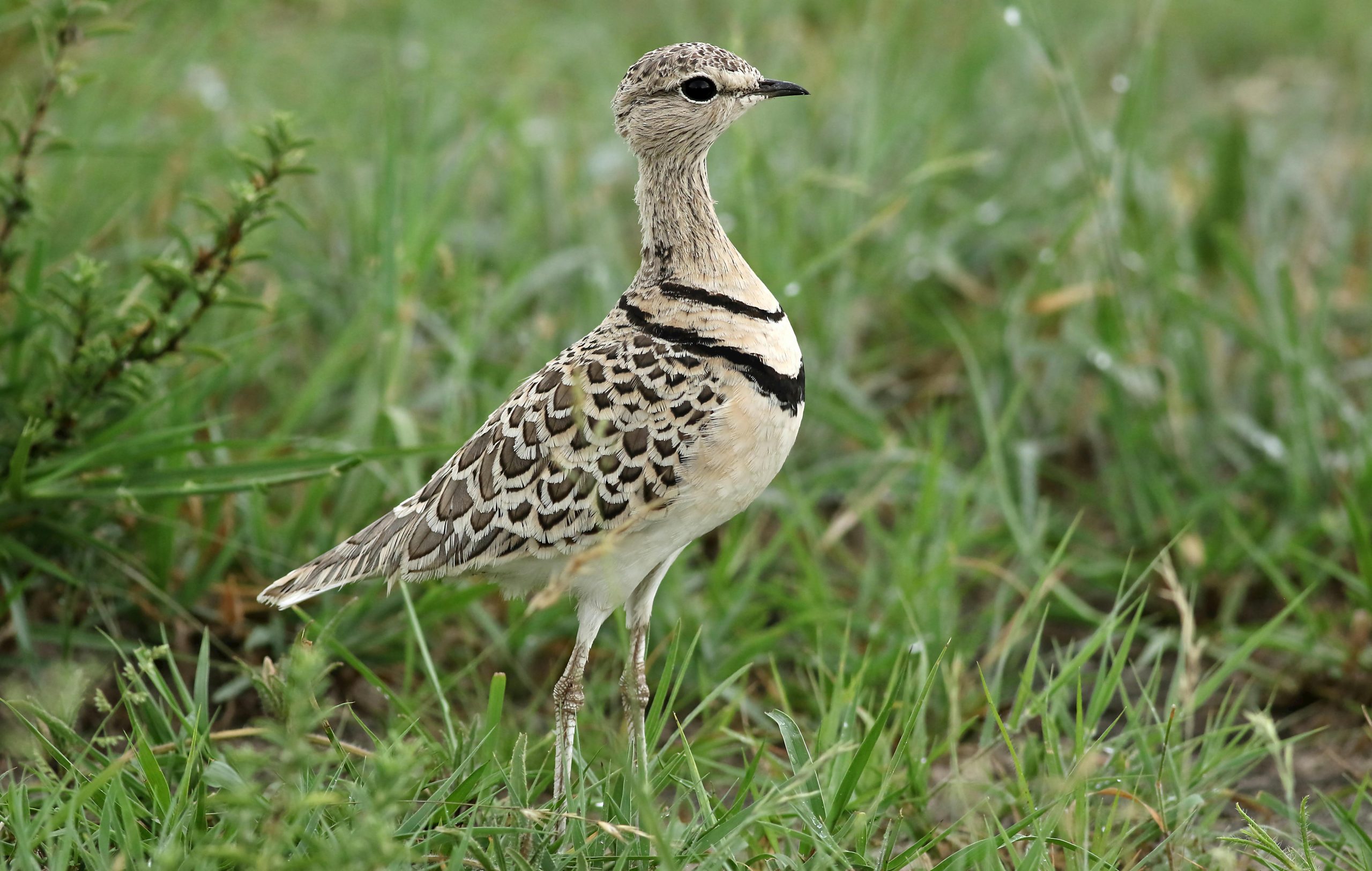
A three-banded courser
Birding in Mgahinga Gorilla National Park
The journey into southwestern Uganda continues to Mgahinga Gorilla National Park, where birdwatching takes place against the spectacular backdrop of the Virunga volcanoes.
Mgahinga’s high-altitude environments include montane forest and bamboo-dominated habitats. These environments provide opportunities to search for birds associated with Uganda’s southwestern mountains and the wider Albertine Rift.
Birding walks can be tailored according to the group’s interests, fitness level and target species. Because of the mountainous terrain, comfortable hiking footwear, rain protection and appropriate clothing are important.
Mgahinga can also be incorporated into itineraries combining birding with gorilla trekking or golden monkey tracking, depending on permit availability and the traveler’s priorities.
Suggested image: mgahinga-birding-safari-uganda.jpg
Alt text: Birding in Mgahinga Gorilla National Park during a Uganda birdwatching tour
Lake Mburo Birding and Wildlife
Lake Mburo National Park provides an excellent final major birding stop before returning toward Kampala or Entebbe.
The park’s combination of acacia woodland, grasslands, wetlands, lakes and rocky areas creates opportunities to search for species different from those encountered in Uganda’s western forests.
Birdwatching can be combined with a game drive, nature walk or other available park activities. Travelers can also look for mammals while continuing to build their bird checklist.
The relatively convenient position of Lake Mburo along the southwestern Uganda route makes it a practical final safari destination before the journey back to Entebbe or Kampala.
After nearly two weeks of exploring Uganda’s wetlands, forests, savannahs and highlands, Lake Mburo provides a fitting conclusion to the birding circuit before the return journey.
Suggested image: lake-mburo-birding-safari.jpg
Alt text: Lake Mburo birding and wildlife on a 14 Days Uganda Birding Safari
Highlights of the 14 Days Uganda Birding Safari
The 14 Days Uganda Birding Safari combines Uganda’s major birding habitats into one extensive journey. Rather than concentrating on a single ecosystem, the route moves through papyrus wetlands, tropical forests, river systems, savannahs, woodlands and the high-altitude forests of southwestern Uganda. This gives birdwatchers opportunities to search for wetland birds, forest specialists, savannah species and several birds associated with the Albertine Rift.
Search for the Shoebill at Mabamba Wetland
The search for the Shoebill at Mabamba Wetland is one of the memorable experiences at the beginning of this Uganda birding safari. Mabamba is an extensive wetland near Lake Victoria characterized by papyrus, open channels and floating vegetation.
Birding is normally conducted from a small canoe accompanied by a local guide. Moving quietly through the wetland channels provides opportunities to scan suitable feeding areas for the Shoebill while observing other wetland birds.
Apart from the Shoebill, birders may encounter African Jacanas, kingfishers, herons, egrets, weavers and numerous other water-associated species. Actual sightings depend on the season, water levels, weather and natural bird movements.
Savannah Birding in Murchison Falls National Park
Murchison Falls introduces birders to the open landscapes of northern Uganda. The park contains a mixture of savannah grassland, woodland, riverine vegetation, wetlands and Nile habitats, creating opportunities to observe a different group of species from those encountered around Lake Victoria.
Early-morning game drives provide time to stop frequently for birds rather than concentrating only on large mammals. Birders can watch for bee-eaters, hornbills, kingfishers, rollers, raptors and numerous grassland and woodland species.
The experience is enhanced by wildlife encounters, allowing the safari to combine serious birdwatching with Uganda’s classic game-viewing experience.
Forest Birding in Budongo Forest
Budongo adds a valuable forest component to the northern section of the itinerary. The forest supports bird communities very different from those of the surrounding savannah.
Guided birding focuses on forest trails, edges and suitable birding areas. The pace is deliberately slow because forest birding often requires listening carefully for calls and watching mixed-species feeding groups moving through different levels of vegetation.
Birders should remember that forest species can be difficult to locate and sightings are never guaranteed. Patience and sufficient time in the habitat are therefore important.
Kibale Forest and Bigodi Wetland Birding
Kibale provides another opportunity for tropical forest birding, while nearby Bigodi Wetland Sanctuary adds swamp, forest-edge and community landscapes.
During forest birding, the guide can help search for species associated with western Uganda’s forests. At Bigodi, birders can explore a mixture of wetlands, secondary vegetation and forest edge.
Birdwatching here may also produce encounters with monkeys, butterflies and other wildlife. Travelers interested in primates can incorporate chimpanzee tracking in Kibale with advance permit arrangements.
Birding in Queen Elizabeth National Park
Queen Elizabeth National Park offers particularly varied birding because of its combination of savannah, bushland, wetlands, crater landscapes, lakes and the Kazinga Channel.
Morning game drives provide opportunities for open-country and raptor species, while the Kazinga Channel offers a completely different birding environment.
A boat trip along the channel can provide close observation of African Fish Eagles, kingfishers, African Jacanas, cormorants, herons, egrets, pelicans and other water-associated birds. Mammals frequently encountered around the channel add to the experience.
Albertine Rift Birding in Bwindi
Bwindi is one of the most important sections of this itinerary for travelers interested in Albertine Rift birding.
The park’s montane and lowland forest environments support numerous forest species, including birds with restricted distributions within the Albertine Rift region.
Depending on the chosen sector and birding trail, birders can spend considerable time searching for target species in the canopy, understory, forest floor and forest edges.
Travelers with particular target birds should provide their checklist before departure so Wild Planet Safaris can consider it when planning the birding route.
Birding in Mgahinga Gorilla National Park
Mgahinga introduces higher-altitude birding against the spectacular landscape of the Virunga volcanoes.
Its montane forests and bamboo zones provide habitat for several highland and Albertine Rift species. Birding here may involve walking mountainous trails, making good hiking shoes and suitable rain protection important.
The destination is particularly useful for birders who want to expand their Albertine Rift experience beyond Bwindi.
Lake Mburo Birding and Wildlife
Lake Mburo provides a rewarding final birding destination before returning to Entebbe or Kampala.
Acacia woodland, grassland, wetlands, lakes and rocky habitats create opportunities to search for additional species that may not have been encountered in the western forests.
Birdwatching can be combined with wildlife viewing and, depending on the final program, a guided nature walk.
Detailed 14 Days Uganda Birding Safari Itinerary
Day 1 – Arrival in Entebbe and Introductory Birding
Upon arrival at Entebbe International Airport, you will be welcomed by a representative of Wild Planet Safaris and transferred to your accommodation.
Depending on your flight arrival time, the first day can include introductory birding around Entebbe. The Lake Victoria shoreline, gardens and other suitable habitats around the town can provide a gentle introduction to Uganda’s birdlife.
This is deliberately a relaxed day, giving you time to recover from your international journey, prepare binoculars and photography equipment and discuss any particular target species with your guide.
In the evening, your guide will provide a safari briefing covering the route, expected driving conditions, birding procedures and preparations for the early departure to Mabamba the following morning.
Accommodation: Budget, mid-range or luxury option
Meals: According to arrival time and selected accommodation
Day 2 – Mabamba Wetland Shoebill Birding & Transfer Toward Murchison Falls
After an early breakfast, depart for Mabamba Wetland, one of Uganda’s well-known locations for searching for the Shoebill.
At the wetland, board a small canoe with a local guide and navigate slowly through papyrus-lined channels. The main objective is to search suitable areas for the Shoebill while also identifying other wetland species.
Keep your binoculars ready for African Jacanas, kingfishers, herons, egrets, weavers and other birds associated with papyrus and open water.
Following the Mabamba excursion, continue the journey toward the Murchison Falls region. There will be opportunities for roadside birding during suitable stops along the way.
Arrive at your accommodation, have dinner and prepare for the next day’s birding.
Accommodation: Budget, mid-range or luxury option
Meals: Breakfast, lunch and dinner
Day 3 – Birding in Murchison Falls National Park
Begin the day early when bird activity is generally high and temperatures are cooler.
The day’s birding explores the savannah, woodland and riverine habitats of Murchison Falls National Park. Your guide will make regular stops during the game drive to identify birds and allow sufficient time for observation and photography.
Possible groups encountered include bee-eaters, kingfishers, hornbills, rollers, raptors and various grassland birds.
Birding can also incorporate areas associated with the Nile, where the change in habitat creates opportunities for waterbirds and riverine species.
Alongside birdwatching, watch for some of the park’s larger wildlife. This makes the day particularly suitable for travelers who want to combine their bird checklist with traditional African safari experiences.
Return to your accommodation after the day’s activities.
Accommodation: Budget, mid-range or luxury option
Meals: Breakfast, lunch and dinner
Day 4 – Budongo Forest Birding
After an early breakfast, travel to the Budongo area for a day dedicated primarily to forest birding.
Accompanied by an experienced guide, walk slowly along suitable forest trails and edges while listening for calls and watching different vegetation levels.
Forest birding requires patience. Some species remain hidden within dense vegetation, while others move rapidly through the canopy in feeding groups. Your guide will help identify birds by both sight and sound.
The morning is normally particularly productive for bird activity, but birding continues into the afternoon depending on weather conditions and the group’s interests.
No particular species should be considered guaranteed because bird movements vary naturally from day to day.
Accommodation: Budget, mid-range or luxury option
Meals: Breakfast, lunch and dinner
Day 5 – Transfer to Kibale Forest with Birding En Route
After breakfast, begin the journey toward Kibale National Park.
Rather than treating this purely as a transfer day, your guide can make appropriate birding stops along the route. Roadside vegetation, farmland, woodland patches and wetlands can produce species different from those encountered inside protected forests.
Continue through western Uganda toward the Kibale region.
Depending on arrival time, take a short afternoon or evening birding walk around suitable forest-edge habitats before checking into your accommodation.
Accommodation: Budget, mid-range or luxury option
Meals: Breakfast, lunch and dinner
Day 6 – Kibale Forest & Bigodi Wetland Birding
Morning: Kibale Forest Birding
Begin early with birding in and around the Kibale forest ecosystem.
The focus is on forest and forest-edge species. Your guide will listen for calls and carefully search the canopy, middle vegetation layers and understory.
Birders with specific target species can discuss these with the guide so the morning’s effort can be concentrated in appropriate habitats where practical.
Travelers who would like to include chimpanzee tracking can arrange this in advance, subject to permit availability and adjustments to the birding schedule.
Afternoon: Bigodi Wetland Sanctuary
After lunch, continue to Bigodi Wetland Sanctuary.
The community-managed area combines swamp, secondary vegetation, forest edge and agricultural landscapes. These habitats can support numerous bird species while also providing opportunities to encounter monkeys, butterflies and other wildlife.
Walk with a local guide while searching wetland vegetation, tree canopies and forest edges.
Return to your accommodation after the excursion.
Accommodation: Budget, mid-range or luxury option
Meals: Breakfast, lunch and dinner
Day 7 – Kibale to Queen Elizabeth National Park
Start the morning with another birding session around Kibale before beginning the journey to Queen Elizabeth National Park.
The drive passes through the landscapes of western Uganda and offers opportunities for additional roadside birding.
Upon reaching Queen Elizabeth National Park, begin exploring its crater, grassland, bushland and wetland environments.
An evening birding game drive provides opportunities to search for open-country birds and raptors while simultaneously watching for mammals.
Accommodation: Budget, mid-range or luxury option
Meals: Breakfast, lunch and dinner
Day 8 – Full-Day Birding in Queen Elizabeth National Park
Today combines two distinctly different birding environments.
Morning Savannah Birding
Depart early for a birding-focused game drive through the park’s open landscapes.
Search grasslands, bushland, woodland and wetland edges for raptors, bee-eaters, kingfishers, lapwings and other open-country species.
The flexible pace allows the vehicle to stop whenever interesting birds are located.
Afternoon Kazinga Channel Boat Safari
After lunch, take a boat safari along the Kazinga Channel.
The channel’s shores, shallow waters and surrounding vegetation attract numerous water-associated species. Possible observations include African Fish Eagle, African Jacana, Pied Kingfisher, Malachite Kingfisher, herons, egrets, cormorants and pelicans. African Skimmers may also be encountered when present.
Hippos and other mammals commonly seen around the channel provide an additional wildlife element.
Accommodation: Budget, mid-range or luxury option
Meals: Breakfast, lunch and dinner
Day 9 – Queen Elizabeth to Bwindi via Ishasha
After breakfast, enjoy morning birding before beginning the journey toward Bwindi Impenetrable National Park.
Travel through the Ishasha area, using the journey to search the surrounding savannah and woodland habitats for additional birds.
Wildlife viewing can be incorporated along the route before continuing toward the forested highlands of Bwindi.
As you approach Bwindi, the landscape changes considerably from open savannah to increasingly forested and mountainous terrain.
If arrival time and weather allow, take a short forest-edge birding walk before dinner.
Accommodation: Budget, mid-range or luxury option
Meals: Breakfast, lunch and dinner
Day 10 – Full-Day Bwindi Forest Birding
Day 10 is one of the most important birding days of the safari and is dedicated to exploring the extraordinary forests of Bwindi Impenetrable National Park.
Begin early with your birding guide and enter an appropriate birding area selected according to the sector, prevailing conditions and target species.
The focus shifts strongly toward Albertine Rift specialties and forest-dependent birds.
Depending on the location and conditions, target species may include birds such as the African Green Broadbill, Rwenzori Batis, Regal Sunbird, Handsome Francolin, Strange Weaver, Red-throated Alethe and Yellow-eyed Black Flycatcher.
Finding these birds requires patience. Some may remain high in the canopy, others occupy dense understory vegetation, and certain species are associated with particular elevations or habitats.
The exact species targeted will therefore depend on the selected Bwindi sector, season, trail conditions and recent local observations.
Travelers with a personal bird checklist should share it with Wild Planet Safaris before the safari so the itinerary can be planned around appropriate birding areas where practical.
Accommodation: Budget, mid-range or luxury option
Meals: Breakfast, packed lunch and dinner
Day 11 – Bwindi Birding or Optional Gorilla Trekking
Travelers have two excellent options today.
Option 1: Full-Day Bwindi Birding
Serious birders can dedicate another full day to Bwindi.
Return to productive forest areas and search for species that were missed during the previous day’s birding. Spending a second day in the forest also increases opportunities to explore different elevations and habitats.
Option 2: Gorilla Trekking and Afternoon Birding
Travelers wanting a broader wildlife experience can spend the morning trekking mountain gorillas.
After an early breakfast, transfer to the relevant park briefing point before joining the assigned trekking group.
The duration of the trek varies according to the location of the assigned gorilla family and conditions in the forest.
After completing the trek and returning to the lodge, afternoon birding may be possible depending on the time and energy levels.
Gorilla permits should be arranged well in advance and included or excluded from the quotation according to the final package booked with Wild Planet Safaris.
Accommodation: Budget, mid-range or luxury option
Meals: Breakfast, packed lunch and dinner
Day 12 – Bwindi to Mgahinga Gorilla National Park
Begin with another morning birding session around Bwindi before departing for the Kisoro and Mgahinga region.
The journey through southwestern Uganda provides beautiful views of cultivated hills, valleys and the volcanic landscapes toward the Virunga region.
Upon arrival near Mgahinga Gorilla National Park, conduct afternoon birding if time and weather permit.
Mgahinga adds an important high-altitude component to the safari. Its montane forest and bamboo environments provide opportunities to search for species associated with the Albertine Rift and Virunga highlands.
Prepare for an early start the following morning.
Accommodation: Budget, mid-range or luxury option
Meals: Breakfast, lunch and dinner
Day 13 – Mgahinga Birding & Transfer Toward Lake Mburo
Start early for birding in the Mgahinga area.
The morning concentrates on montane forest, bamboo and other highland environments. Your guide will help search for species associated with these habitats while taking into account elevation, weather and recent observations.
The spectacular Virunga scenery also makes this a rewarding location for bird photography.
After completing the morning session, begin the journey toward Lake Mburo National Park.
Because this can be a substantial travel day, the exact birding duration and overnight routing can be adjusted by Wild Planet Safaris according to the selected accommodation and travelers’ priorities.
Accommodation: Budget, mid-range or luxury option
Meals: Breakfast, lunch and dinner
Day 14 – Lake Mburo Birding & Return to Entebbe/Kampala
Wake early for the final major birding session of your 14 Days Uganda Birding Safari.
Lake Mburo’s grasslands, acacia woodland, wetlands and lakes provide a final opportunity to add open-country species to your checklist.
Explore productive areas with your guide while searching for savannah and woodland birds and watching for the park’s mammals.
Depending on your schedule, a guided nature walk may also be incorporated.
After breakfast or the morning activity, begin the return journey toward Kampala or Entebbe.
Your guide will transfer you to your hotel or Entebbe International Airport according to your onward arrangements. Travelers flying internationally on Day 14 should choose a sufficiently late departure time; otherwise, an additional night in Entebbe can be arranged.
Meals: Breakfast and lunch, depending on departure schedule
Bird Species to Look for During the 14-Day Safari
One of the strengths of this itinerary is habitat diversity. Instead of promising a fixed bird count, the safari concentrates on exploring different ecosystems and maximizing opportunities to find birds associated with each habitat.
Wetland Birds
Uganda’s wetlands, lakes and river systems form an important part of the safari.
The Shoebill is one of the principal targets at Mabamba Wetland. Other wetland birding opportunities occur around the Nile, Bigodi, Kazinga Channel and Lake Mburo.
Birders may encounter:
- Shoebill
- African Jacana
- Pied Kingfisher
- Malachite Kingfisher
- African Fish Eagle
- Various herons
- Egrets
- Cormorants
- Pelicans
- Other papyrus and water-associated birds
The exact species present vary according to location, season, water conditions and natural bird movements.
Forest Birds
The itinerary provides substantial time in Budongo, Kibale and Bwindi, allowing travelers to experience several of Uganda’s important forest environments.
Forest birding is generally slower and more challenging than savannah birding because many species remain hidden within dense vegetation.
Birders should expect to spend time listening for calls, examining mixed-species feeding flocks and searching different forest levels.
This slower style of birding can be especially rewarding for travelers interested in Uganda’s more specialized forest species.
Albertine Rift Specialties
The southwestern section of the itinerary is particularly important because it enters the Albertine Rift, one of Africa’s major centers of biological diversity.
Bwindi and Mgahinga provide opportunities to search for several restricted-range and highland birds associated with this region.
Potential targets may include species such as Rwenzori Batis, Regal Sunbird, Handsome Francolin, Strange Weaver, Red-throated Alethe and other Albertine Rift specialties, depending on the exact birding location.
The African Green Broadbill may be targeted in appropriate habitat, but sightings should never be guaranteed.
For specialist birders, this part of the safari can be customized around a target list supplied before departure.
Savannah Birds
The open environments of Murchison Falls, Queen Elizabeth and Lake Mburo National Parks provide a striking contrast to Uganda’s dense forests.
Savannah birding can produce hornbills, bee-eaters, rollers, raptors, lapwings, kingfishers and many other woodland and grassland birds.
Open habitats can also make birds easier to observe and photograph than those living inside dense tropical forest.
Game drives allow birdwatchers to move between different habitats while simultaneously encountering Uganda’s larger mammals.
By the end of the 14 Days Uganda Birding Safari, travelers will have explored a broad cross-section of Uganda’s birding environments—from the papyrus wetlands of Mabamba and the Nile landscapes of Murchison Falls to the tropical forests of Kibale and Bwindi, the Albertine Rift highlands of Mgahinga and the savannah ecosystems of Lake Mburo.
For Wild Planet Safaris, this diversity is what makes the itinerary particularly suitable for travelers seeking an in-depth Uganda birdwatching journey rather than a short birding excursion.
Highlights of the 14 Days Uganda Birding Safari
The 14 Days Uganda Birding Safari combines Uganda’s major birding habitats into one extensive journey. Rather than concentrating on a single ecosystem, the route moves through papyrus wetlands, tropical forests, river systems, savannahs, woodlands and the high-altitude forests of southwestern Uganda. This gives birdwatchers opportunities to search for wetland birds, forest specialists, savannah species and several birds associated with the Albertine Rift.
Search for the Shoebill at Mabamba Wetland
The search for the Shoebill at Mabamba Wetland is one of the memorable experiences at the beginning of this Uganda birding safari. Mabamba is an extensive wetland near Lake Victoria characterized by papyrus, open channels and floating vegetation.
Birding is normally conducted from a small canoe accompanied by a local guide. Moving quietly through the wetland channels provides opportunities to scan suitable feeding areas for the Shoebill while observing other wetland birds.
Apart from the Shoebill, birders may encounter African Jacanas, kingfishers, herons, egrets, weavers and numerous other water-associated species. Actual sightings depend on the season, water levels, weather and natural bird movements.
Savannah Birding in Murchison Falls National Park
Murchison Falls introduces birders to the open landscapes of northern Uganda. The park contains a mixture of savannah grassland, woodland, riverine vegetation, wetlands and Nile habitats, creating opportunities to observe a different group of species from those encountered around Lake Victoria.
Early-morning game drives provide time to stop frequently for birds rather than concentrating only on large mammals. Birders can watch for bee-eaters, hornbills, kingfishers, rollers, raptors and numerous grassland and woodland species.
The experience is enhanced by wildlife encounters, allowing the safari to combine serious birdwatching with Uganda’s classic game-viewing experience.
Forest Birding in Budongo Forest
Budongo adds a valuable forest component to the northern section of the itinerary. The forest supports bird communities very different from those of the surrounding savannah.
Guided birding focuses on forest trails, edges and suitable birding areas. The pace is deliberately slow because forest birding often requires listening carefully for calls and watching mixed-species feeding groups moving through different levels of vegetation.
Birders should remember that forest species can be difficult to locate and sightings are never guaranteed. Patience and sufficient time in the habitat are therefore important.
Kibale Forest and Bigodi Wetland Birding
Kibale provides another opportunity for tropical forest birding, while nearby Bigodi Wetland Sanctuary adds swamp, forest-edge and community landscapes.
During forest birding, the guide can help search for species associated with western Uganda’s forests. At Bigodi, birders can explore a mixture of wetlands, secondary vegetation and forest edge.
Birdwatching here may also produce encounters with monkeys, butterflies and other wildlife. Travelers interested in primates can incorporate chimpanzee tracking in Kibale with advance permit arrangements.
Birding in Queen Elizabeth National Park
Queen Elizabeth National Park offers particularly varied birding because of its combination of savannah, bushland, wetlands, crater landscapes, lakes and the Kazinga Channel.
Morning game drives provide opportunities for open-country and raptor species, while the Kazinga Channel offers a completely different birding environment.
A boat trip along the channel can provide close observation of African Fish Eagles, kingfishers, African Jacanas, cormorants, herons, egrets, pelicans and other water-associated birds. Mammals frequently encountered around the channel add to the experience.
Albertine Rift Birding in Bwindi
Bwindi is one of the most important sections of this itinerary for travelers interested in Albertine Rift birding.
The park’s montane and lowland forest environments support numerous forest species, including birds with restricted distributions within the Albertine Rift region.
Depending on the chosen sector and birding trail, birders can spend considerable time searching for target species in the canopy, understory, forest floor and forest edges.
Travelers with particular target birds should provide their checklist before departure so Wild Planet Safaris can consider it when planning the birding route.
Birding in Mgahinga Gorilla National Park
Mgahinga introduces higher-altitude birding against the spectacular landscape of the Virunga volcanoes.
Its montane forests and bamboo zones provide habitat for several highland and Albertine Rift species. Birding here may involve walking mountainous trails, making good hiking shoes and suitable rain protection important.
The destination is particularly useful for birders who want to expand their Albertine Rift experience beyond Bwindi.
Lake Mburo Birding and Wildlife
Lake Mburo provides a rewarding final birding destination before returning to Entebbe or Kampala.
Acacia woodland, grassland, wetlands, lakes and rocky habitats create opportunities to search for additional species that may not have been encountered in the western forests.
Birdwatching can be combined with wildlife viewing and, depending on the final program, a guided nature walk.
Detailed 14 Days Uganda Birding Safari Itinerary
Day 1 – Arrival in Entebbe and Introductory Birding
Upon arrival at Entebbe International Airport, you will be welcomed by a representative of Wild Planet Safaris and transferred to your accommodation.
Depending on your flight arrival time, the first day can include introductory birding around Entebbe. The Lake Victoria shoreline, gardens and other suitable habitats around the town can provide a gentle introduction to Uganda’s birdlife.
This is deliberately a relaxed day, giving you time to recover from your international journey, prepare binoculars and photography equipment and discuss any particular target species with your guide.
In the evening, your guide will provide a safari briefing covering the route, expected driving conditions, birding procedures and preparations for the early departure to Mabamba the following morning.
Accommodation: Budget, mid-range or luxury option
Meals: According to arrival time and selected accommodation
Day 2 – Mabamba Wetland Shoebill Birding & Transfer Toward Murchison Falls
After an early breakfast, depart for Mabamba Wetland, one of Uganda’s well-known locations for searching for the Shoebill.
At the wetland, board a small canoe with a local guide and navigate slowly through papyrus-lined channels. The main objective is to search suitable areas for the Shoebill while also identifying other wetland species.
Keep your binoculars ready for African Jacanas, kingfishers, herons, egrets, weavers and other birds associated with papyrus and open water.
Following the Mabamba excursion, continue the journey toward the Murchison Falls region. There will be opportunities for roadside birding during suitable stops along the way.
Arrive at your accommodation, have dinner and prepare for the next day’s birding.
Day 3 – Birding in Murchison Falls National Park
Begin the day early when bird activity is generally high and temperatures are cooler.
The day’s birding explores the savannah, woodland and riverine habitats of Murchison Falls National Park. Your guide will make regular stops during the game drive to identify birds and allow sufficient time for observation and photography.
Possible groups encountered include bee-eaters, kingfishers, hornbills, rollers, raptors and various grassland birds.
Birding can also incorporate areas associated with the Nile, where the change in habitat creates opportunities for waterbirds and riverine species.
Alongside birdwatching, watch for some of the park’s larger wildlife. This makes the day particularly suitable for travelers who want to combine their bird checklist with traditional African safari experiences.
Return to your accommodation after the day’s activities.
Day 4 – Budongo Forest Birding
After an early breakfast, travel to the Budongo area for a day dedicated primarily to forest birding.
Accompanied by an experienced guide, walk slowly along suitable forest trails and edges while listening for calls and watching different vegetation levels.
Forest birding requires patience. Some species remain hidden within dense vegetation, while others move rapidly through the canopy in feeding groups. Your guide will help identify birds by both sight and sound.
The morning is normally particularly productive for bird activity, but birding continues into the afternoon depending on weather conditions and the group’s interests.
No particular species should be considered guaranteed because bird movements vary naturally from day to day.
Accommodation: Budget, mid-range or luxury option
Meals: Breakfast, lunch and dinner
Day 5 – Transfer to Kibale Forest with Birding En Route
After breakfast, begin the journey toward Kibale National Park.
Rather than treating this purely as a transfer day, your guide can make appropriate birding stops along the route. Roadside vegetation, farmland, woodland patches and wetlands can produce species different from those encountered inside protected forests.
Continue through western Uganda toward the Kibale region.
Depending on arrival time, take a short afternoon or evening birding walk around suitable forest-edge habitats before checking into your accommodation.
Day 6 – Kibale Forest & Bigodi Wetland Birding
Morning: Kibale Forest Birding
Begin early with birding in and around the Kibale forest ecosystem.
The focus is on forest and forest-edge species. Your guide will listen for calls and carefully search the canopy, middle vegetation layers and understory.
Birders with specific target species can discuss these with the guide so the morning’s effort can be concentrated in appropriate habitats where practical.
Travelers who would like to include chimpanzee tracking can arrange this in advance, subject to permit availability and adjustments to the birding schedule.
Afternoon: Bigodi Wetland Sanctuary
After lunch, continue to Bigodi Wetland Sanctuary.
The community-managed area combines swamp, secondary vegetation, forest edge and agricultural landscapes. These habitats can support numerous bird species while also providing opportunities to encounter monkeys, butterflies and other wildlife.
Walk with a local guide while searching wetland vegetation, tree canopies and forest edges.
Return to your accommodation after the excursion.
Accommodation: Budget, mid-range or luxury option
Meals: Breakfast, lunch and dinner
Day 7 – Kibale to Queen Elizabeth National Park
Start the morning with another birding session around Kibale before beginning the journey to Queen Elizabeth National Park.
The drive passes through the landscapes of western Uganda and offers opportunities for additional roadside birding.
Upon reaching Queen Elizabeth National Park, begin exploring its crater, grassland, bushland and wetland environments.
An evening birding game drive provides opportunities to search for open-country birds and raptors while simultaneously watching for mammals.
Accommodation: Budget, mid-range or luxury option
Meals: Breakfast, lunch and dinner
Day 8 – Full-Day Birding in Queen Elizabeth National Park
Today combines two distinctly different birding environments.
Morning Savannah Birding
Depart early for a birding-focused game drive through the park’s open landscapes.
Search grasslands, bushland, woodland and wetland edges for raptors, bee-eaters, kingfishers, lapwings and other open-country species.
The flexible pace allows the vehicle to stop whenever interesting birds are located.
Afternoon Kazinga Channel Boat Safari
After lunch, take a boat safari along the Kazinga Channel.
The channel’s shores, shallow waters and surrounding vegetation attract numerous water-associated species. Possible observations include African Fish Eagle, African Jacana, Pied Kingfisher, Malachite Kingfisher, herons, egrets, cormorants and pelicans. African Skimmers may also be encountered when present.
Hippos and other mammals commonly seen around the channel provide an additional wildlife element.
Accommodation: Budget, mid-range or luxury option
Meals: Breakfast, lunch and dinner
A yellow-billed stork
Day 9 – Queen Elizabeth to Bwindi via Ishasha
After breakfast, enjoy morning birding before beginning the journey toward Bwindi Impenetrable National Park.
Travel through the Ishasha area, using the journey to search the surrounding savannah and woodland habitats for additional birds.
Wildlife viewing can be incorporated along the route before continuing toward the forested highlands of Bwindi.
As you approach Bwindi, the landscape changes considerably from open savannah to increasingly forested and mountainous terrain.
If arrival time and weather allow, take a short forest-edge birding walk before dinner.
Accommodation: Budget, mid-range or luxury option
Meals: Breakfast, lunch and dinner
Day 10 – Full-Day Bwindi Forest Birding
Day 10 is one of the most important birding days of the safari and is dedicated to exploring the extraordinary forests of Bwindi Impenetrable National Park.
Begin early with your birding guide and enter an appropriate birding area selected according to the sector, prevailing conditions and target species.
The focus shifts strongly toward Albertine Rift specialties and forest-dependent birds.
Depending on the location and conditions, target species may include birds such as the African Green Broadbill, Rwenzori Batis, Regal Sunbird, Handsome Francolin, Strange Weaver, Red-throated Alethe and Yellow-eyed Black Flycatcher.
Finding these birds requires patience. Some may remain high in the canopy, others occupy dense understory vegetation, and certain species are associated with particular elevations or habitats.
The exact species targeted will therefore depend on the selected Bwindi sector, season, trail conditions and recent local observations.
Travelers with a personal bird checklist should share it with Wild Planet Safaris before the safari so the itinerary can be planned around appropriate birding areas where practical.
Accommodation: Budget, mid-range or luxury option
Meals: Breakfast, packed lunch and dinner
Day 11 – Bwindi Birding or Optional Gorilla Trekking
Travelers have two excellent options today.
Option 1: Full-Day Bwindi Birding
Serious birders can dedicate another full day to Bwindi.
Return to productive forest areas and search for species that were missed during the previous day’s birding. Spending a second day in the forest also increases opportunities to explore different elevations and habitats.
Option 2: Gorilla Trekking and Afternoon Birding
Travelers wanting a broader wildlife experience can spend the morning trekking mountain gorillas.
After an early breakfast, transfer to the relevant park briefing point before joining the assigned trekking group.
The duration of the trek varies according to the location of the assigned gorilla family and conditions in the forest.
After completing the trek and returning to the lodge, afternoon birding may be possible depending on the time and energy levels.
Gorilla permits should be arranged well in advance and included or excluded from the quotation according to the final package booked with Wild Planet Safaris.
Accommodation: Budget, mid-range or luxury option
Meals: Breakfast, packed lunch and dinner
Day 12 – Bwindi to Mgahinga Gorilla National Park
Begin with another morning birding session around Bwindi before departing for the Kisoro and Mgahinga region.
The journey through southwestern Uganda provides beautiful views of cultivated hills, valleys and the volcanic landscapes toward the Virunga region.
Upon arrival near Mgahinga Gorilla National Park, conduct afternoon birding if time and weather permit.
Mgahinga adds an important high-altitude component to the safari. Its montane forest and bamboo environments provide opportunities to search for species associated with the Albertine Rift and Virunga highlands.
Prepare for an early start the following morning.
Accommodation: Budget, mid-range or luxury option
Meals: Breakfast, lunch and dinner
Day 13 – Mgahinga Birding & Transfer Toward Lake Mburo
Start early for birding in the Mgahinga area.
The morning concentrates on montane forest, bamboo and other highland environments. Your guide will help search for species associated with these habitats while taking into account elevation, weather and recent observations.
The spectacular Virunga scenery also makes this a rewarding location for bird photography.
After completing the morning session, begin the journey toward Lake Mburo National Park.
Because this can be a substantial travel day, the exact birding duration and overnight routing can be adjusted by Wild Planet Safaris according to the selected accommodation and travelers’ priorities.
Accommodation: Budget, mid-range or luxury option
Meals: Breakfast, lunch and dinner
Day 14 – Lake Mburo Birding & Return to Entebbe/Kampala
Wake early for the final major birding session of your 14 Days Uganda Birding Safari.
Lake Mburo’s grasslands, acacia woodland, wetlands and lakes provide a final opportunity to add open-country species to your checklist.
Explore productive areas with your guide while searching for savannah and woodland birds and watching for the park’s mammals.
Depending on your schedule, a guided nature walk may also be incorporated.
After breakfast or the morning activity, begin the return journey toward Kampala or Entebbe.
Your guide will transfer you to your hotel or Entebbe International Airport according to your onward arrangements. Travelers flying internationally on Day 14 should choose a sufficiently late departure time; otherwise, an additional night in Entebbe can be arranged.
Meals: Breakfast and lunch, depending on departure schedule
Bird Species to Look for During the 14-Day Safari
One of the strengths of this itinerary is habitat diversity. Instead of promising a fixed bird count, the safari concentrates on exploring different ecosystems and maximizing opportunities to find birds associated with each habitat.
Wetland Birds
Uganda’s wetlands, lakes and river systems form an important part of the safari.
The Shoebill is one of the principal targets at Mabamba Wetland. Other wetland birding opportunities occur around the Nile, Bigodi, Kazinga Channel and Lake Mburo.
Birders may encounter:
- Shoebill
- African Jacana
- Pied Kingfisher
- Malachite Kingfisher
- African Fish Eagle
- Various herons
- Egrets
- Cormorants
- Pelicans
- Other papyrus and water-associated birds
The exact species present vary according to location, season, water conditions and natural bird movements.
Forest Birds
The itinerary provides substantial time in Budongo, Kibale and Bwindi, allowing travelers to experience several of Uganda’s important forest environments.
Forest birding is generally slower and more challenging than savannah birding because many species remain hidden within dense vegetation.
Birders should expect to spend time listening for calls, examining mixed-species feeding flocks and searching different forest levels.
This slower style of birding can be especially rewarding for travelers interested in Uganda’s more specialized forest species.
Albertine Rift Specialties
The southwestern section of the itinerary is particularly important because it enters the Albertine Rift, one of Africa’s major centers of biological diversity.
Bwindi and Mgahinga provide opportunities to search for several restricted-range and highland birds associated with this region.
Potential targets may include species such as Rwenzori Batis, Regal Sunbird, Handsome Francolin, Strange Weaver, Red-throated Alethe and other Albertine Rift specialties, depending on the exact birding location.
The African Green Broadbill may be targeted in appropriate habitat, but sightings should never be guaranteed.
For specialist birders, this part of the safari can be customized around a target list supplied before departure.
Savannah Birds
The open environments of Murchison Falls, Queen Elizabeth and Lake Mburo National Parks provide a striking contrast to Uganda’s dense forests.
Savannah birding can produce hornbills, bee-eaters, rollers, raptors, lapwings, kingfishers and many other woodland and grassland birds.
Open habitats can also make birds easier to observe and photograph than those living inside dense tropical forest.
Game drives allow birdwatchers to move between different habitats while simultaneously encountering Uganda’s larger mammals.
By the end of the 14 Days Uganda Birding Safari, travelers will have explored a broad cross-section of Uganda’s birding environments—from the papyrus wetlands of Mabamba and the Nile landscapes of Murchison Falls to the tropical forests of Kibale and Bwindi, the Albertine Rift highlands of Mgahinga and the savannah ecosystems of Lake Mburo.
For Wild Planet Safaris, this diversity is what makes the itinerary particularly suitable for travelers seeking an in-depth Uganda birdwatching journey rather than a short birding excursion.
Uganda Birding Habitats Covered on This Safari
One of the biggest advantages of a 14 Days Uganda Birding Safari is the opportunity to explore several very different habitats within one journey. Uganda’s bird diversity is closely connected to its position between East African savannah ecosystems, Central African forests, the Albertine Rift highlands and the extensive wetlands surrounding its lakes and rivers.
A two-week itinerary gives birdwatchers more time to move between these ecosystems than a short birding tour. Instead of concentrating on one national park or habitat, this safari visits wetlands, tropical forests, montane forests, savannahs, woodlands, lakes, river systems and high-altitude bamboo zones.
Wetlands and Papyrus Swamps
Wetlands are an important component of birdwatching in Uganda. On this itinerary, Mabamba Wetland provides one of the first major wetland experiences.
Mabamba’s extensive papyrus channels, shallow waters and floating vegetation provide habitat for numerous water-associated birds. The Shoebill is the principal target for many visitors, but the wetland can also provide opportunities to observe African Jacanas, kingfishers, herons, egrets, weavers and other species.
Exploring Mabamba by canoe allows birders to move quietly through narrow channels and observe wetland habitats from water level. This can also provide useful opportunities for photography.
Other wetlands encountered during the safari further increase the variety of water-associated species that travelers may observe.
Tropical Rainforests
Tropical forest birding forms a major part of the itinerary, particularly in Budongo Forest, Kibale National Park and Bwindi Impenetrable National Park.
Forest birding is very different from watching birds in open savannah. Many species remain partially hidden within thick vegetation, and birders frequently locate them first by their calls.
Guides therefore spend time listening, watching mixed-species feeding flocks and scanning different forest layers—from the forest floor and understory to the upper canopy.
The slower pace of forest birding makes patience important, but it also provides opportunities to search for species that would not normally be encountered in Uganda’s open grasslands.
Albertine Rift Montane Forest
The Albertine Rift is especially important for specialist birdwatchers visiting Uganda. Southwestern destinations such as Bwindi and Mgahinga contain montane environments associated with a number of restricted-range species.
Elevation changes create different vegetation zones, meaning that the birds encountered at lower elevations may differ from those found higher in the mountains.
Depending on the birding location, season and conditions, travelers can search for species associated with the Albertine Rift while exploring forest trails with an experienced guide.
This is one reason Bwindi and Mgahinga are important components of a specialist Uganda birding safari rather than simply destinations for gorilla trekking.
Savannah and Grasslands
The open savannahs of Murchison Falls, Queen Elizabeth and Lake Mburo National Parks create a completely different birding experience.
Grasslands provide opportunities to search for open-country birds, raptors and species that prefer lightly wooded environments.
Birding is frequently combined with game drives, so travelers may encounter elephants, buffaloes, antelopes and other mammals while searching for birds.
Open landscapes can also be particularly rewarding for photography because birds are sometimes easier to locate and observe than in dense tropical forests.
Woodland
Woodland habitats occur throughout several destinations on the safari and create an important transition between open grassland and dense forest.
Woodland birding may produce hornbills, bee-eaters, rollers, woodpeckers, sunbirds and numerous other species, depending on location.
Lake Mburo’s acacia-dominated landscapes are particularly useful for adding woodland species toward the end of the safari.
Roadside woodland can also make transfer days productive. When time and safety allow, the guide can stop at suitable locations for additional birding instead of treating every journey purely as transportation between parks.
Lakes, Rivers and Channels
Uganda’s extensive freshwater systems add another dimension to the safari.
The Nile in Murchison Falls National Park, Kazinga Channel in Queen Elizabeth National Park, Lake Victoria wetlands and the lakes around Lake Mburo provide habitats for numerous waterbirds.
Boat-based birding can produce particularly good observation and photography opportunities because travelers can sometimes approach feeding or resting birds more effectively from the water.
Potential sightings include kingfishers, African Fish Eagles, African Jacanas, cormorants, pelicans, herons, egrets and other water-associated species.
The Kazinga Channel boat safari is especially valuable because birdwatching is combined with opportunities to observe hippos and other wildlife along the shoreline.
Highland and Bamboo Habitats
The higher elevations of southwestern Uganda provide another habitat type that is absent from many shorter safari itineraries.
Around Mgahinga Gorilla National Park, birdwatchers can explore montane forest and bamboo environments associated with the Virunga highlands.
The change in altitude, vegetation and climate creates opportunities to search for highland species and Albertine Rift birds.
Birding at these elevations may require more walking than savannah birding, so appropriate footwear, rain protection and reasonable physical preparation are recommended.
Why Habitat Diversity Matters on a 14-Day Uganda Birding Tour
A short Uganda birding safari can be excellent for specific targets such as the Shoebill or birds within a particular national park. However, it usually cannot cover the same geographical and ecological range as a two-week journey.
A 14-day Uganda birding tour allows travelers to move from Lake Victoria wetlands to northern savannahs, western tropical forests, the Albertine Rift highlands and southwestern woodland ecosystems.
This does not guarantee a particular number of species, but it substantially broadens the range of habitats explored and therefore the types of birds that can potentially be encountered.
Is 14 Days Enough for a Uganda Birding Safari?
For many travelers, 14 days is an excellent amount of time for a Uganda birding safari because it provides enough time to explore several important birding regions without requiring a three- or four-week journey.
Two weeks allows an itinerary to include major destinations such as Mabamba Wetland, Murchison Falls, Budongo, Kibale, Queen Elizabeth, Bwindi, Mgahinga and Lake Mburo.
However, Uganda is geographically diverse, and traveling between some birding areas requires several hours on the road. A well-designed itinerary therefore needs to balance travel time with productive birding time.
Wild Planet Safaris can use transfer days for birding stops where practical, while full days in places such as Bwindi are dedicated to slower, more intensive birding.
For casual and intermediate birdwatchers, 14 days provides a substantial introduction to Uganda’s birdlife and major ecosystems. Experienced birders pursuing a long target-species list may prefer an 18-day, 21-day or longer Uganda birding safari, particularly if they want to incorporate additional specialized birding areas.
The best duration therefore depends on the traveler’s objectives rather than simply the total number of species they hope to record.
Who Is This 14-Day Uganda Birding Safari For?
The itinerary can be adapted to different levels of birding experience and travel interests.
First-Time Birdwatchers
Travelers do not need to be expert ornithologists to enjoy this safari.
For beginners, birding can proceed at a comfortable pace, with the guide spending more time explaining identification features, behavior, habitats and bird calls.
The combination of birdwatching with wildlife viewing, boat trips and scenic landscapes also prevents the journey from becoming overly specialized for someone taking their first dedicated birding safari.
Experienced Birders
Experienced birdwatchers can make the itinerary considerably more intensive.
Travelers can provide a target-species list before arrival, allowing Wild Planet Safaris to consider appropriate habitats and birding locations when finalizing the route.
More time can be allocated to productive forest trails, early-morning birding and difficult target species.
For highly specialized birders, the standard itinerary can also be extended to include additional destinations.
Bird Photographers
Bird photography often requires a slower pace than checklist-focused birding.
Photographers may want additional time to wait for favorable light, positioning and bird behavior rather than immediately moving to the next species.
Boat excursions at Mabamba and Kazinga Channel can provide particularly interesting photographic opportunities, while open savannah environments may offer clearer backgrounds than dense forests.
Travelers carrying large telephoto lenses should notify Wild Planet Safaris in advance so vehicle space and luggage arrangements can be considered.
Couples and Private Travelers
A private birding safari provides more flexibility than traveling with a large general-interest group.
Couples and private travelers can determine how long they want to remain at productive birding locations, when to take photography breaks and whether to prioritize birds, mammals, primates or scenery.
The itinerary can also be adjusted according to preferred accommodation standards and physical ability.
Travelers Combining Birds and Primates
Uganda is particularly suitable for travelers who want to combine birdwatching with primate experiences.
Optional chimpanzee tracking in Kibale National Park can be incorporated into the forest section of the journey.
In southwestern Uganda, travelers can add mountain gorilla trekking in Bwindi or Mgahinga, subject to permit availability.
This allows couples or families with slightly different interests to enjoy the same journey—for example, one traveler may prioritize birding while another is particularly interested in primates and wildlife.
Best Time for a 14 Days Uganda Birding Safari
Uganda can be visited for birdwatching throughout the year, but conditions change according to rainfall, altitude and region.
There is no single month that guarantees the best sightings. The ideal travel period depends on whether the visitor prioritizes resident birds, migratory species, forest conditions, photography, gorilla trekking or general wildlife viewing.
December to February
December through February is often associated with relatively drier conditions in many parts of Uganda, although rainfall can still occur.
Drier conditions can make some roads and forest trails easier to navigate, particularly for travelers combining birding with gorilla trekking and forest walks.
Migratory birds may also add variety during part of this period.
For photographers, periods of clearer weather can be useful, although midday light can become strong and early-morning birding remains preferable.
March to May
March through May generally forms one of Uganda’s wetter periods.
Rain encourages vegetation growth and creates lush landscapes that can be attractive for photography. Bird activity can still be rewarding, but travelers should prepare for muddy forest trails and possible interruptions from heavy showers.
Good waterproof hiking footwear, a rain jacket and protection for binoculars and camera equipment become particularly important.
The advantage of traveling during wetter periods is that the landscapes can be exceptionally green and visually impressive.
June to August
June through August is another popular period for travel in Uganda and generally corresponds with relatively drier conditions in many areas.
Forest trails may be easier to walk compared with the wetter months, making this period attractive to travelers combining birding with gorilla trekking, hiking and wildlife viewing.
Because this overlaps with a popular East African travel period, accommodation and permits for optional primate activities should be arranged early.
September to November
Rainfall generally increases again during parts of September through November, although conditions vary between regions and from year to year.
The return of wetter conditions can bring greener vegetation and changing bird activity.
Migratory species can also become part of the birding experience as the season progresses.
Travelers should again prepare for rain and potentially muddy forest trails while keeping schedules flexible enough to accommodate weather conditions.
So, When Should You Go?
For most travelers, the best approach is to choose dates based on their complete safari priorities rather than searching for one supposedly perfect birding month.
A traveler primarily interested in forest birding and Albertine Rift species may make a different choice from someone interested in photography, migratory birds or combining birdwatching with gorilla trekking.
Wild Planet Safaris can adjust the itinerary according to the travel month and the traveler’s main birding interests.
What to Pack for a 14-Day Uganda Birding Safari
Packing properly makes a major difference on a two-week birding trip because the itinerary passes through hot savannahs, humid forests, wetlands and cooler high-altitude environments.
Binoculars
A reliable pair of binoculars is one of the most important items. Choose binoculars that are comfortable enough to carry throughout long birding days.
Camera and Telephoto Lens
Bird photographers should carry a camera with an appropriate telephoto lens. Remember that larger lenses add considerable weight and require additional storage space.
Uganda or East Africa Bird Field Guide
A printed field guide or reputable bird identification app can help travelers keep track of species encountered during the journey.
Comfortable Hiking Boots
Good footwear is particularly important for Bwindi, Mgahinga, Kibale and Budongo. Trails can become muddy, slippery and uneven after rain.
Lightweight Long Trousers and Long-Sleeved Shirts
Lightweight clothing provides protection from vegetation, insects and direct sunlight while remaining comfortable during long birding sessions.
Rain Jacket
Rain can occur at any time of year, especially around Uganda’s forested and mountainous regions. Pack a lightweight waterproof jacket that can easily fit inside a daypack.
Daypack
A comfortable daypack is useful for carrying water, rain protection, field guides, snacks, batteries and personal equipment.
Hat and Sunscreen
Sun protection is important during open-country birding in national parks and while traveling by boat.
Insect Repellent
Carry a suitable insect repellent, particularly for wetlands, forests and evening activities.
Reusable Water Bottle
Long birding walks require good hydration. A reusable bottle also helps reduce unnecessary single-use plastic.
Notebook or Bird Checklist
A notebook or digital checklist makes it easier to record sightings, locations and memorable observations throughout the safari.
Spare Batteries and Memory Cards
Long birding days can quickly consume camera batteries and storage space. Carry sufficient backups, especially when staying in areas where replacement equipment may not be readily available.
Power Bank
A high-capacity power bank can be useful for charging phones and smaller electronics during long transfer days.
Waterproof Protection for Electronics
Carry waterproof bags, dry bags or rain covers for cameras, binoculars and other sensitive equipment.
14 Days Uganda Birding Safari Price
The price of a 14 Days Uganda Birding Safari depends on the accommodation category, number of travelers, private vehicle requirements, selected activities and whether gorilla or chimpanzee tracking is added.
Rather than advertising one price that may not match every traveler, Wild Planet Safaris can offer budget, mid-range and luxury versions of the same general birding route.
Budget 14-Day Uganda Birding Safari
The budget option is designed for travelers who want to prioritize birding and destinations while keeping accommodation costs lower.
Accommodation generally consists of comfortable budget lodges, guesthouses or safari camps. The safari can still use private transportation and include the principal birding activities specified in the confirmed itinerary.
A budget safari does not mean reducing the amount of birding; the main difference is normally the accommodation standard and related services.
Mid-Range 14-Day Uganda Birding Safari
The mid-range option provides a balance between comfort and price.
Travelers stay in established mid-range lodges and safari camps with private facilities and convenient access to the main birding destinations where possible.
For many international birdwatchers, this category provides a practical balance for a two-week journey because it combines long days in the field with comfortable accommodation at night.
Luxury 14-Day Uganda Birding Safari
The luxury option focuses on higher-end accommodation and increased comfort throughout the journey.
Depending on the destination, travelers can stay at upscale safari lodges and properties offering enhanced rooms, service, dining and locations.
The core birding experience remains the focus, but the accommodation and overall safari comfort are upgraded.
What Determines the Final Safari Price?
The final quotation depends on several factors, including:
- Number of travelers: Sharing a private vehicle and guide generally reduces the per-person cost compared with solo travel.
- Accommodation category: Budget, mid-range and luxury lodges have substantially different nightly rates.
- Private safari vehicle: Vehicle type, fuel requirements and total route distance affect the cost.
- Birding guide: Specialist guiding requirements are included according to the final arrangement.
- National park fees: Entry charges vary according to the destinations visited and current official rates.
- Boat activities: Mabamba canoe birding and scheduled boat excursions such as Kazinga Channel need to be included in the final quotation.
- Gorilla trekking: Travelers selecting the gorilla option need the appropriate permit, subject to availability and current official pricing.
- Chimpanzee tracking: Chimpanzee permits should be added when this optional experience is selected.
- Travel season: Accommodation prices and availability can vary during busy travel periods.
- Airport transfers: Arrival and departure transfers are arranged according to the final itinerary.
- Private versus shared arrangements: This itinerary is designed primarily as a private safari, but the final price depends on the number of people sharing the vehicle and other services.
Request Your 14 Days Uganda Birding Safari Price
There is no need for every traveler to follow exactly the same itinerary. A dedicated birder searching for Albertine Rift species may need a different schedule from a photographer, beginner birdwatcher or couple combining birds with gorillas and chimpanzees.
Request a customized 14 Days Uganda Birding Safari quotation from Wild Planet Safaris based on your travel dates, number of travelers, preferred accommodation category, target birds and optional gorilla or chimpanzee experiences.
When requesting your quotation, provide your preferred travel dates, number of travelers, accommodation level and any target bird species. This allows Wild Planet Safaris to prepare a more relevant itinerary and safari price rather than providing a generic package.