
20 Must-See Birds on a Uganda Birding Safari
Introduction
Birds on a Uganda birding safari range from enormous wetland specialists such as the Shoebill to colorful forest birds, Albertine Rift specialties, kingfishers, bee-eaters, turacos, raptors and savannah species. This remarkable variety is one of the main reasons Uganda deserves a place on the itinerary of both first-time African birdwatchers and experienced international birders.
Uganda’s strength as a birding destination comes largely from its exceptional variety of habitats. During one carefully planned safari, travelers can move between tropical forests, Albertine Rift mountains, papyrus wetlands, freshwater lakes, rivers, acacia woodland, open savannah and high-altitude environments.
Each ecosystem brings a different group of birds.
The forests of southwestern Uganda provide opportunities to search for Albertine Rift-associated species. Kibale and other western forests introduce travelers to a different community of tropical forest birds. Mabamba and other wetlands are important for waterbirds and papyrus-associated species, while Murchison Falls, Queen Elizabeth, Lake Mburo and Kidepo add open-country, woodland, riverine and savannah birding.
Uganda Wildlife Authority describes Uganda as a year-round birding destination and highlights Bwindi and Mgahinga as important accessible locations for Albertine Rift endemics, while Semuliki is particularly important for species associated with the Guinea-Congo forest region.
This guide introduces 20 must-see birds on a Uganda birding safari. They have not been selected simply because they are rare. Instead, the list represents different sides of Uganda’s birding experience.
Some, such as the African Green Broadbill and Green-breasted Pitta, can be important targets for experienced birders. Others, such as the Great Blue Turaco, Grey Crowned Crane and African Fish Eagle, are memorable because of their appearance, behavior or association with African landscapes.
The Shoebill, meanwhile, has become one of Uganda’s signature birding attractions and is an important reason many international birders include wetlands such as Mabamba in their itineraries.
It is important to remember that these are wild birds. No responsible birding operator should guarantee that every species will be seen.
Your chances of encountering particular species can depend on:
- Habitat
- Location
- Elevation
- Weather
- Season
- Bird behavior
- Available birding time
- Quality of local knowledge
- The number of days spent at a destination
Experienced birders traveling with a specific life list should therefore send their priority target species to Wild Planet Safaris before the itinerary is designed. This makes it possible to allocate more time to appropriate habitats instead of simply following a standard Uganda tourism circuit.
Throughout this guide, you will discover why each bird is worth searching for, how to recognize it, the habitat it prefers, where to look for it in Uganda and practical birding considerations.
Why Uganda Is an Exceptional Destination for Birdwatching
Uganda’s birding appeal is not based on one famous bird or one national park. Its greatest advantage is the ability to experience dramatically different bird communities within one country.
A safari can begin with wetland birding around Lake Victoria, continue through western Uganda’s tropical forests, reach the Albertine Rift highlands of Bwindi and Mgahinga, and then move into open savannah or acacia woodland.
This ecological variety allows travelers to build a birding safari around very different interests—from Shoebills and forest specialists to waterbirds, turacos, kingfishers, bee-eaters and open-country species.
Remarkable Bird Diversity
Uganda supports an exceptionally rich avifauna relative to its geographical size.
Rather than relying on one permanent national species total, it is better to recognize that bird checklists can change. New records, taxonomic revisions, species splits and changes in accepted classifications can alter national totals over time.
For travelers, the more important point is the diversity of birds that can be encountered across different habitats.
A comprehensive safari can introduce birders to:
- Forest specialists
- Albertine Rift species
- Papyrus-associated birds
- Waterbirds
- Savannah birds
- Raptors
- Kingfishers
- Bee-eaters
- Hornbills
- Turacos
- Sunbirds
- Weavers
- Migratory species
Uganda Wildlife Authority describes birding as possible throughout the year, with resident birds forming an important part of the country’s birding appeal.
For serious birders, this means Uganda can support anything from a short target-species excursion to a multi-week birding expedition.
Diverse Birding Habitats
One reason Uganda’s bird list is so varied is the country’s mixture of ecosystems.
Tropical Forest
Western Uganda contains important tropical forests supporting birds that may be difficult or impossible to find in open savannah.
Kibale National Park, for example, is an important forest birding destination. Uganda Wildlife Authority currently reports approximately 370 bird species from the park.
Forest birding here is quite different from a conventional game drive. Birders often walk slowly, listen for calls and scan different levels of the forest vegetation.
Montane Forest
At higher elevations, the bird community changes.
Bwindi and Mgahinga provide important montane birding environments where travelers can search for species associated with southwestern Uganda and the Albertine Rift.
These habitats can require longer walks, patience and sometimes repeated searches for difficult species.
Albertine Rift Highlands
The Albertine Rift is particularly important for specialist Uganda birding itineraries.
Uganda Wildlife Authority identifies Bwindi and Mgahinga as key accessible sites for Albertine Rift endemic birds.
The region is therefore especially relevant to international birders who arrive with specific target lists.
Papyrus Wetlands
Uganda’s wetlands add an entirely different bird community.
Papyrus systems can support birds associated closely with wetland vegetation, while larger freshwater swamps provide habitat for the famous Shoebill.
Mabamba Bay is particularly significant. NatureUganda describes it as a Ramsar site and Important Bird Area on Lake Victoria that provides important habitat for the Shoebill and other wetland biodiversity.
Lakes and Rivers
Lake Victoria, Lake Albert, Lake Edward, the Kazinga Channel, the Victoria Nile and other aquatic environments provide opportunities to search for:
- Kingfishers
- Fish eagles
- Herons
- Egrets
- Storks
- Jacanas
- Cormorants
- Pelicans
- Other water-associated species
Boat trips can therefore be as important to a birding itinerary as forest walks.
Savannah
Uganda’s savannah national parks combine traditional wildlife viewing with excellent birdwatching.
Murchison Falls, Queen Elizabeth and Kidepo Valley can allow travelers to search for birds while also watching mammals.
This makes Uganda particularly useful for couples or families where one traveler is primarily interested in birds and another wants a broader African wildlife experience.
Acacia Woodland
Acacia-dominated woodland provides another distinctive birding environment.
Lake Mburo National Park is especially useful for combining woodland, savannah and wetland birding within the same itinerary.
Semi-Arid Northeastern Uganda
Travelers undertaking longer birding expeditions can extend their itinerary to northeastern Uganda and Kidepo Valley.
The relatively dry environment introduces a bird community that differs substantially from the humid forests of Bwindi and Kibale.
For serious birders, including both southwestern forests and northeastern dry-country habitats can significantly broaden the ecological range of a Uganda safari.
Albertine Rift Specialties
For experienced international birders, the Albertine Rift can be one of the strongest reasons to visit Uganda.
This biologically important region extends through parts of East-Central Africa and contains species with relatively restricted geographical ranges.
In Uganda, Bwindi Impenetrable National Park and Mgahinga Gorilla National Park are particularly important.
UWA reports more than 350 bird species in Bwindi and identifies 23 Albertine Rift endemics among its birdlife, including the African Green Broadbill and Shelley’s Crimsonwing.
This makes southwestern Uganda highly relevant to birders whose targets extend beyond Uganda’s more widespread savannah and wetland birds.
A specialist itinerary may combine:
Bwindi → Echuya → Mgahinga → Rwenzori region
depending on target species, available days and current site conditions.
The key planning principle is time.
A traveler who wants to experience Albertine Rift birding properly should not treat Bwindi merely as a one-night stop before or after gorilla trekking. Difficult forest species can require patient searches, and serious birders may benefit from multiple birding sessions.
Birds, Primates and Wildlife in One Safari
Uganda also allows birdwatching to be combined naturally with some of the country’s best-known wildlife experiences.
For example, a longer itinerary could combine:
Mabamba – Shoebill and wetland birding
Murchison Falls – savannah, riverine birds and wildlife
Kibale – forest birds and chimpanzee trekking
Bigodi – wetland and forest-edge birding
Queen Elizabeth – savannah, wetland and Kazinga Channel birding
Bwindi – Albertine Rift birds and mountain gorilla trekking
Mgahinga – high-altitude birding, gorillas or golden monkeys
Lake Mburo – woodland, wetland and savannah birding
This flexibility is valuable for travelers who want a dedicated birding safari without missing Uganda’s primates and larger mammals.
Wild Planet Safaris can therefore design the itinerary around the traveler’s priorities rather than treating birdwatching as an occasional activity added to a conventional wildlife tour.
20 Must-See Birds on a Uganda Birding Safari
The following species illustrate just how varied birdwatching in Uganda can be.
Some require patient forest searches. Others inhabit wetlands, rivers or open landscapes. Some are relatively conspicuous in appropriate habitat, while others may challenge even experienced birders.
Each bird should therefore be viewed as a target to search for rather than a guaranteed sighting.
1. Shoebill
Scientific name: Balaeniceps rex
Few birds represent Uganda birding as powerfully as the Shoebill.
Standing almost motionless among papyrus and wetland vegetation, the Shoebill has an extraordinary appearance that can seem almost prehistoric. Its enormous bill immediately distinguishes it from the storks, herons and other large waterbirds that may share its habitat.
For many first-time visitors, finding a Shoebill is one of the most anticipated moments of an entire Uganda birding safari.
Why See the Shoebill?
The Shoebill’s appeal comes from a combination of its:
- Extraordinary appearance
- Large size
- Huge shoe-shaped bill
- Slow, deliberate hunting behavior
- Association with extensive African wetlands
- Conservation significance
NatureUganda describes the Shoebill as a species of conservation concern and identifies Mabamba as important habitat for it.
The bird often hunts by standing remarkably still before striking at prey.
Watching this behavior through binoculars—or patiently waiting for the bird to move into a suitable photography position—can be far more memorable than simply ticking it off a list.
How to Identify a Shoebill
The enormous bill is unmistakable.
Other useful identification characteristics include:
- Very large body
- Long legs
- Broad wings
- Grey plumage
- Large head
- Powerful hooked tip to the bill
- Slow and deliberate movements
In flight, its huge wings make the bird particularly impressive.
Shoebill Habitat
Shoebills are associated with large freshwater wetland systems containing floating vegetation, reeds, grasses and papyrus.
NatureUganda specifically notes the species’ preference for extensive freshwater swamps and describes Mabamba Bay as providing favorable Shoebill habitat.
Such wetlands provide feeding opportunities while allowing the bird to remain relatively concealed.
Where to Look for Shoebills in Uganda
Mabamba Bay Wetland
For many visitors, Mabamba is the most practical location to include in a Uganda birding itinerary.
The wetland lies within reach of Entebbe and can therefore be incorporated at the beginning or end of a longer safari.
Birding usually involves exploring wetland channels in a small boat or canoe with a local guide.
NatureUganda identifies Mabamba as both a Ramsar site and Important Bird Area and continues to work with local communities on ecotourism and Shoebill conservation.
Murchison Falls–Albert Delta
The Albert Delta Wetland System provides another important Shoebill habitat.
Uganda Wildlife Authority describes the delta at the confluence with Lake Albert as a shallow wetland particularly important for waterbirds including Shoebills, pelicans, darters and herons.
This means a Murchison itinerary can combine Shoebill searching with savannah birding, a Nile boat experience and general wildlife viewing.
Birding Tip
An early start is often practical for a Mabamba excursion, particularly when combining the trip with other activities.
Bring:
- Binoculars
- Camera with telephoto lens
- Hat
- Sunscreen
- Drinking water
- Lightweight rain protection
- Waterproof protection for camera equipment
Most importantly, remain patient.
A Shoebill sighting should never be guaranteed. Weather, water conditions and natural bird movements can all affect an excursion.
2. Green-breasted Pitta
Scientific name: Pitta reichenowi
For experienced birders, the Green-breasted Pitta can be one of the most exciting forest targets on a Uganda birding safari.
Unlike a Shoebill standing in an open wetland, a pitta can be remarkably difficult to locate.
Dense forest vegetation, low light and secretive behavior can turn the search into an exercise in patience.
Uganda Wildlife Authority includes the Green-breasted Pitta in its wildlife directory, reflecting its place among the country’s notable bird species.
Why See the Green-breasted Pitta?
The Green-breasted Pitta combines striking plumage with the challenge of locating a secretive forest bird.
For serious birders, that challenge is part of the appeal.
Rather than being a bird casually spotted from a safari vehicle, it is a species that may require:
- Early starts
- Careful listening
- Slow forest walking
- Local knowledge
- Patience
- Appropriate timing
Finding one can therefore feel particularly rewarding.
How to Identify a Green-breasted Pitta
Look for its compact pitta shape and combination of rich green, blue and other contrasting plumage features.
However, identification in the field is rarely as simple as looking at a photograph.
Forest conditions can mean only part of the bird is visible. Calls and behavior can therefore become important clues.
Habitat
The Green-breasted Pitta is associated with tropical forest.
This means searching for it requires a completely different birding style from looking for wetland or savannah species.
Birders may spend significant periods listening and scanning relatively small sections of forest.
Where to Look in Uganda
Kibale National Park is strongly associated with Green-breasted Pitta searches in Uganda’s birding circuit.
Kibale itself is an exceptionally rich forest ecosystem. Uganda Wildlife Authority currently reports approximately 370 bird species from the park.
The wider Kibale area also gives travelers opportunities to combine birding with:
- Chimpanzee trekking
- Other primates
- Bigodi Wetland
- Forest photography
- General nature walks
This makes Kibale particularly useful on itineraries combining specialist birding with primate experiences.
Birding Tip
Do not schedule a Green-breasted Pitta search as a quick activity between long road transfers.
Serious target-species birding benefits from dedicated time.
An experienced birder should consider allocating multiple birding sessions in Kibale rather than relying on one short forest walk.
Weather and seasonal behavior can influence detectability, and sightings should never be promised.
For photographers, the challenge can be even greater. Seeing a pitta briefly through binoculars is very different from obtaining a clear photograph in a dark forest understory.
3. African Green Broadbill
Scientific name: Pseudocalyptomena graueri
The African Green Broadbill is one of the birds that can turn an ordinary Uganda birding itinerary into a serious Albertine Rift expedition.
It is a highly localized species associated with montane forest in the Albertine Rift and is particularly important to birders visiting Bwindi Impenetrable National Park.
Uganda Wildlife Authority specifically lists the African Green Broadbill among Bwindi’s Albertine Rift endemic birds.
Why See the African Green Broadbill?
For experienced international birders, this species is important because of its restricted geographical range.
Unlike widespread African birds that can be encountered across numerous countries, the African Green Broadbill requires birders to visit a relatively limited part of the continent.
That makes it an important target for:
- Life-list birders
- Albertine Rift specialists
- Repeat African birders
- Conservation-focused travelers
- Bird photographers seeking difficult forest subjects
It is not necessarily the easiest bird to find, which makes appropriate itinerary planning particularly important.
How to Identify an African Green Broadbill
The bird is small and predominantly green, allowing it to blend remarkably well with forest foliage.
Its coloration is beautiful but also contributes to the difficulty of finding it.
Birders searching the canopy and mid-level vegetation need to pay attention to:
- Shape
- Movement
- Calls
- Feeding behavior
- Subtle color differences against leaves
This is where an experienced birding guide familiar with the habitat becomes particularly useful.
African Green Broadbill Habitat
The species is associated with montane forest.
This immediately explains why a conventional savannah wildlife itinerary will not be sufficient for someone targeting the bird.
Searching for it can involve:
- Mountainous terrain
- Forest trails
- Changing weather
- Dense vegetation
- Long periods of careful observation
Good walking footwear, rain protection and suitable binoculars are therefore important.
Where to Look in Uganda
Bwindi Impenetrable National Park
Bwindi is the key destination.
UWA reports more than 350 bird species and 23 Albertine Rift endemics from the park, specifically mentioning the African Green Broadbill among them.
The Ruhija sector and the Mubwindi Swamp area are particularly associated with specialist birding itineraries targeting the broadbill and other Albertine Rift birds.
Birders should recognize that this is not casual roadside birding.
Depending on the precise route and current trail conditions, accessing productive habitat may involve a substantial forest walk.
Why Serious Birders Should Spend More Time in Bwindi
A common itinerary mistake is allocating only one full day to Bwindi because the traveler is also going gorilla trekking.
That may be sufficient for the gorilla activity, but it is restrictive for specialist birding.
Bwindi deserves additional time because birders may also be searching for a broader suite of Albertine Rift and montane forest species.
Weather can also affect birding.
Heavy rain during one morning should not destroy the entire opportunity to search for a high-priority target.
Experienced birders should therefore consider several nights in the region, depending on the importance of the African Green Broadbill and other Bwindi targets.
Combine African Green Broadbill Birding with Gorilla Trekking
One advantage of Bwindi is the possibility of combining two very different wildlife experiences within the same broader destination:
Albertine Rift birding + mountain gorilla trekking.
However, these should normally be treated as separate activities.
Gorilla trekking can occupy much of a day, and its duration cannot be predicted precisely. Serious birders should therefore reserve separate time for forest birding.
Birding Tip
If the African Green Broadbill is one of your highest-priority birds, tell Wild Planet Safaris before the safari itinerary is finalized.
This allows sufficient time to be allocated to the relevant part of Bwindi rather than simply adding a short birding walk to a gorilla-focused itinerary.
Also prepare for:
- Early starts
- Long walks
- Muddy trails
- Rain
- Uneven terrain
- Slow birding
- Extended periods of scanning vegetation
The reward is the opportunity to search for one of the most geographically distinctive birds on a specialist Uganda birding itinerary.
Sightings remain dependent on natural conditions and cannot be guaranteed.
Planning to Search for These Birds in Uganda?
The Shoebill, Green-breasted Pitta and African Green Broadbill illustrate why a Uganda birding safari should be designed around habitats rather than simply a list of famous national parks.
A traveler targeting all three may need to incorporate three very different environments:
Mabamba → Kibale → Bwindi
That provides:
Mabamba: freshwater wetland and Shoebill habitat
Kibale: tropical forest and Green-breasted Pitta searches
Bwindi: montane Albertine Rift forest and African Green Broadbill searches
Wild Planet Safaris can use your target list to determine how much time should be allocated to each destination.
SEND US YOUR UGANDA BIRDING TARGET LIST
4. Great Blue Turaco
Scientific name: Corythaeola cristata
The Great Blue Turaco is one of the most spectacular birds to encounter on a Uganda birding safari. Its combination of large size, striking blue-green plumage, prominent crest and flashes of contrasting color in flight makes it especially memorable for travelers experiencing African forest birding for the first time.
Unlike some of Uganda’s difficult specialist targets, the Great Blue Turaco can be relatively conspicuous in suitable habitat. Its size, vocalizations and tendency to move through the forest canopy can help birders locate it.
Why See the Great Blue Turaco?
The Great Blue Turaco is impressive partly because of its sheer size. It is the largest member of the turaco family and looks dramatically different from many smaller forest birds.
Its appeal includes:
- Large body
- Prominent crest
- Blue-green and grey-blue coloration
- Long tail
- Strong, conspicuous bill
- Loud vocalizations
- Striking appearance when moving through forest trees
For first-time African birders, this can be an excellent introduction to Uganda’s colorful forest avifauna.
It is also a good bird for travelers who are not specialist birders. Even someone without extensive identification experience can appreciate the size, color and character of a Great Blue Turaco moving through the canopy.
How to Identify a Great Blue Turaco
Look first at its size.
This is not a small, easily overlooked forest bird. It has a substantial body, long tail and prominent crest.
Its overall plumage combines shades of blue, green and grey. The bill has contrasting coloration, while the bird’s large crest contributes to its unmistakable profile.
When it moves through the trees or flies between sections of forest, its broad wings and long tail make it particularly impressive.
Great Blue Turaco Habitat
The species is primarily associated with forests, forest edges and wooded environments.
This means birders do not necessarily need to penetrate the deepest sections of forest to encounter one. Productive forest edges and areas with mature fruiting trees can also be worth watching.
Fruit forms an important part of its diet, so patient observation around productive trees can sometimes provide excellent viewing opportunities.
Where to Look for Great Blue Turacos in Uganda
Several of Uganda’s forested destinations can provide opportunities.
Kibale National Park
Kibale is an important destination for travelers interested in forest birds as well as primates.
A birding itinerary here can combine searches for colorful and conspicuous forest birds such as the Great Blue Turaco with more difficult specialist targets.
Bigodi Wetland Sanctuary
Bigodi is another useful location.
Its mixture of wetland, forest edge and surrounding vegetation provides a different birding experience from deeper forest birding in Kibale.
A Kibale + Bigodi combination can therefore be particularly productive for first-time birders because it introduces several habitats without requiring long-distance transfers.
Other suitable forested areas around Uganda can also produce Great Blue Turaco sightings.
Birding Tip
Listen as much as you look.
Large forest birds are often detected by sound or movement before they are clearly visible.
Once a turaco is located, avoid rushing toward it. Instead, watch the direction in which it is moving and allow your guide to choose a suitable viewing position.
For photographers, forest edges may sometimes provide better opportunities than dense interior forest because there is more available light and fewer branches blocking the subject.
5. Rwenzori Turaco
Scientific name: Gallirex johnstoni
The Rwenzori Turaco introduces birders to a completely different side of Uganda’s birdlife: the high-altitude forests and mountains of the Albertine Rift.
It is particularly relevant to specialist birders exploring southwestern Uganda and the Rwenzori region.
Uganda Wildlife Authority identifies the Rwenzori Turaco among the characteristic birds of Rwenzori Mountains National Park, whose bird community includes numerous restricted-range Albertine Rift species.
Why See the Rwenzori Turaco?
The species is attractive not only because of its colorful appearance but because of the environment in which birders search for it.
A Rwenzori Turaco search can take visitors into:
- Montane forest
- Bamboo zones
- Mountain slopes
- Albertine Rift landscapes
- Cool, high-altitude environments
This provides a dramatic contrast to searching for Shoebills in papyrus wetlands or savannah birds in Murchison Falls.
How to Identify a Rwenzori Turaco
The Rwenzori Turaco is a colorful, long-tailed forest bird.
Depending on viewing conditions, birders can notice:
- Green body coloration
- Blue and purplish tones
- Prominent crest
- Long tail
- Red coloration exposed in the wings during flight
Its vocalizations can also help birders locate individuals concealed by mountain vegetation.
Montane Habitat and Altitude
Altitude is particularly important when planning a search for this species.
The Rwenzori Mountains contain clearly differentiated vegetation zones. UWA describes montane forest in the lower elevations, followed by bamboo at approximately 2,500–3,000 metres and higher vegetation zones above this.
Different bird communities occur at different elevations.
That means specialist mountain birding cannot always be treated like an ordinary roadside stop. Birders may need to walk into suitable elevation zones to reach the habitats occupied by their targets.
Where to Look in Uganda
Rwenzori Mountains
The Rwenzori Mountains are one of the most important locations.
UWA’s management information identifies the Rwenzori Turaco among the characteristic birds of the park and notes the significance of the mountains for Albertine Rift restricted-range species.
Mgahinga Gorilla National Park
Mgahinga should also feature prominently on an Albertine Rift itinerary. UWA reports more than 180 bird species and 14 Albertine Rift endemics from the park.
Mgahinga can be particularly attractive because travelers can combine highland birding with gorilla trekking, golden monkey tracking and volcanic scenery.
Birding Tip
Prepare for mountain weather.
Carry:
- Waterproof jacket
- Good hiking footwear
- Warm lightweight layer
- Binoculars
- Water
- Camera rain protection
Serious birders should also tell Wild Planet Safaris which high-altitude targets are priorities before the route is finalized. The correct destination is only part of the equation; the right habitat and elevation also matter.
6. Grey Crowned Crane
Scientific name: Balearica regulorum

Few birds have a stronger connection with Uganda’s national identity than the Grey Crowned Crane.
It is Uganda’s national bird and is immediately recognizable by the spectacular crown of golden feathers on its head. NatureUganda also identifies it as Uganda’s national bird in its crane-conservation work.
For birders, however, the Grey Crowned Crane is more than a national symbol. It also provides an important introduction to the conservation challenges facing Uganda’s wetlands and grasslands.
Why See the Grey Crowned Crane?
The crane combines elegance, size and striking coloration.
Its most recognizable features include:
- Golden crown
- Grey body
- White wings
- Black and chestnut wing markings
- Long legs
- Long neck
- Red throat pouch
- Distinctive facial pattern
Pairs or small groups moving through open grasslands can be particularly beautiful to observe and photograph.
Habitat
Grey Crowned Cranes use environments that can include:
- Wetlands
- Marsh edges
- Grasslands
- Seasonally flooded areas
- Agricultural landscapes close to suitable wetlands
Wetlands are particularly important for breeding and roosting.
Conservation Importance
This is where the Grey Crowned Crane becomes especially valuable to the article.
Wetland loss is not only an environmental issue in the abstract—it directly affects birds.
NatureUganda’s conservation work around wetland systems has documented important breeding populations of Grey Crowned Cranes and emphasizes protecting wetland habitats while working with local communities.
This gives travelers a useful reminder that bird tourism and habitat conservation are closely connected.
Responsible Grey Crowned Crane Birding
Birders and photographers should be particularly cautious around breeding birds.
Never:
- Approach nests closely
- Disturb adults attending chicks
- Move vegetation around nests
- Chase cranes for flight photographs
- Encourage birds to leave feeding areas
- Reveal sensitive nesting locations unnecessarily
Long lenses and binoculars allow excellent observation without disturbing the birds.
Birding Tip
Do not concentrate exclusively on national parks.
Some memorable Uganda birding encounters can occur in wetlands, community landscapes and agricultural areas between major protected areas.
A good birding guide remains alert even during transfers.
7. Papyrus Gonolek
Scientific name: Laniarius mufumbiri
The Papyrus Gonolek demonstrates why Uganda birding itineraries should include wetlands rather than focusing entirely on forests and national parks.
Its bold coloration makes it spectacular when seen clearly, but actually locating it can be challenging because the bird frequently remains concealed among dense papyrus stems.
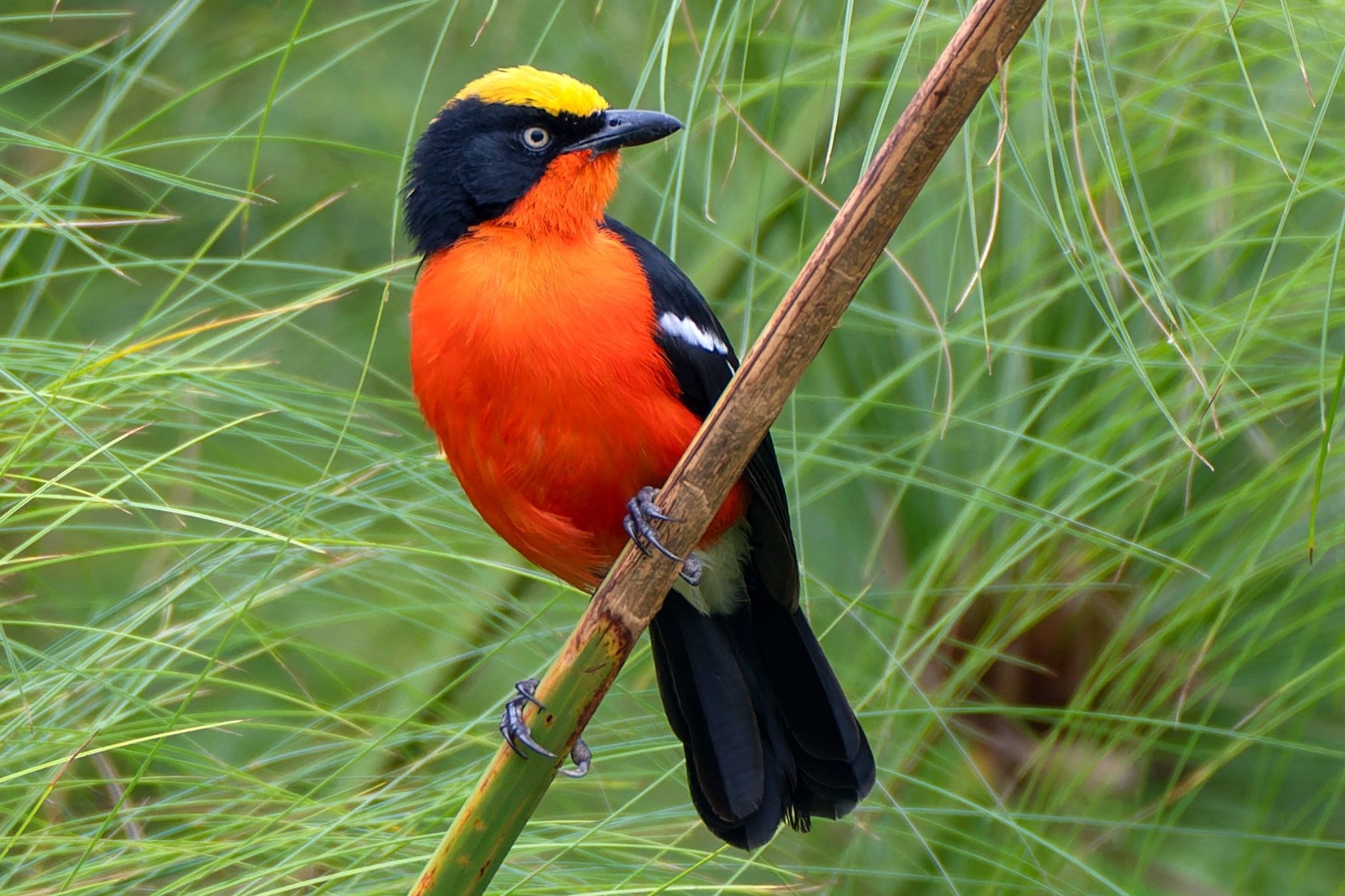
Why See the Papyrus Gonolek?
This species is particularly interesting because of its strong association with papyrus wetland habitat.
Its plumage combines:
- Deep black upperparts
- Brilliant red underparts
- Contrasting wing markings
Despite these striking colors, the bird can disappear remarkably effectively into dense vegetation.
Birders often know a Papyrus Gonolek is nearby because they hear it before they see it.
Identification by Voice
This is a useful species for teaching first-time birders an important lesson:
Birdwatching is not only about eyesight.
In dense vegetation, vocalizations can be essential for detecting and identifying species.
A specialist guide who recognizes calls can locate a bird that would otherwise remain completely unnoticed.
Papyrus Habitat
The Papyrus Gonolek is closely associated with healthy papyrus systems.
These wetlands are ecologically valuable for many other species as well.
NatureUganda’s wetland monitoring and conservation work documents Papyrus Gonolek in important Ugandan wetland systems alongside other wetland-dependent wildlife.
NatureUganda has also reported the species from Lubigi Wetland in the central region, illustrating that important bird habitats can occur surprisingly close to major urban areas.
Why Wetlands Belong on a Uganda Birding Itinerary
An itinerary focusing exclusively on famous forest national parks would miss an important part of Uganda’s avifauna.
Wetlands can add:
- Papyrus specialists
- Shoebills
- Kingfishers
- Jacanas
- Herons
- Egrets
- Storks
- Crakes
- Migratory waterbirds
Combining forest and wetland birding therefore produces a much more complete Uganda experience.
Birding Tip
When searching papyrus, be patient and use your ears.
A bird may call repeatedly without immediately becoming visible.
Avoid forcing it into view through excessive playback. Allow your guide to determine a responsible approach.
Suggested image: papyrus-gonolek-uganda.jpg
Alt text: Papyrus Gonolek in papyrus wetland during birdwatching in Uganda
Image title: Papyrus Gonolek Uganda
Caption: The colorful Papyrus Gonolek is strongly associated with papyrus wetlands and is often detected by its calls before it is seen.
8. African Finfoot
Scientific name: Podica senegalensis
The African Finfoot is one of those birds that can transform a quiet boat excursion into one of the highlights of a birding safari.
It is secretive, strongly associated with waterways and often remains close to overhanging vegetation.
Uganda Wildlife Authority’s wildlife directory includes the African Finfoot, while Lake Mburo conservation planning specifically highlights the species among the area’s notable birds.
Why See the African Finfoot?
The Finfoot differs noticeably from Uganda’s more conspicuous waterbirds.
Instead of standing openly like a heron or soaring overhead like a fish eagle, it tends to keep close to:
- Shaded banks
- Overhanging vegetation
- Quiet waterways
- Wooded lake margins
This secretive behavior makes a good sighting particularly satisfying.
How to Identify an African Finfoot
Look for:
- Long neck
- Streamlined swimming profile
- Pointed bill
- Strongly patterned plumage
- Distinctive lobed feet when visible
Males and females differ in some plumage details.
Its behavior is also useful. A finfoot may swim quietly along the edge of vegetation and then disappear rapidly into cover.
Habitat
African Finfoots favor wooded waterways and vegetated lake or river margins.
Shade and overhanging vegetation are important components of the environment in which birders often search.
Where to Look in Uganda
Lake Mburo is a useful destination to consider.
The park provides a combination of lake, wetland, woodland and savannah habitat, making it valuable even when the Finfoot is not encountered.
Because the species is secretive, it should always be presented as a target rather than a guaranteed sighting.
Why Boat Birding Helps
A boat can provide access to stretches of shoreline that are difficult to observe properly from land.
Birders can slowly scan:
- Overhanging branches
- Shaded banks
- Reed edges
- Quiet coves
Boat birding can also produce kingfishers, fish eagles, herons and other water-associated species.
Birding Tip
Scan the edges rather than constantly looking across open water.
A Finfoot may remain close to vegetation and disappear quickly when disturbed.
Keep binoculars ready even during apparently quiet sections of the boat trip.

9. Standard-winged Nightjar
Scientific name: Caprimulgus longipennis
The Standard-winged Nightjar introduces another dimension to Uganda birding: what happens after daylight begins to disappear.
A safari restricted entirely to daytime birding can miss a fascinating group of nocturnal and crepuscular species.
Uganda Wildlife Authority includes the Standard-winged Nightjar in its wildlife directory.
Why See the Standard-winged Nightjar?
Adult males in breeding plumage can develop extraordinary elongated wing feathers.
These unusual feathers give the bird one of the most distinctive silhouettes among African nightjars.
Watching a displaying male at dusk can therefore be very different from almost any daytime bird encounter.
Identification
Outside breeding plumage, nightjars can be challenging because their cryptic colors help them blend into:
- Bare ground
- Dry leaves
- Tracks
- Grass
- Open woodland
The breeding male’s specialized wing feathers, however, can be spectacular in flight.
Nocturnal Behavior
Nightjars generally become active around dusk and at night.
This means finding them may require:
- Late-afternoon birding
- Dusk observation
- Night activities where legally permitted
- Knowledge of productive locations
Open-Country Habitat
Suitable habitat can include open savannah and woodland environments.
Murchison Falls and suitable northern/open-country areas can be incorporated into itineraries that include nightjar targets.
Site conditions and seasonal behavior matter, so exact targeting should be discussed when planning the safari.
Why Evening Birding Matters
Adding an evening session can expand the bird list beyond species active during daylight.
Depending on destination and regulations, travelers may search for:
- Nightjars
- Owls
- Other crepuscular birds
Night activities must always comply with national park rules and guide instructions.
Birding Tip
Do not disturb a resting nightjar simply to make it fly.
Cryptic plumage is an important defense, and repeatedly flushing birds for photographs is poor birding practice.
Observe responsibly and allow the guide to manage positioning.
10. African Fish Eagle
Scientific name: Icthyophaga vocifer
(Often listed in older references as Haliaeetus vocifer*.)*
The African Fish Eagle provides one of the classic sights and sounds of an African waterside landscape.
Its powerful call can carry across lakes and rivers, and its striking white head and chest make adults relatively easy to recognize when perched prominently above the water.
Uganda Wildlife Authority includes the African Fish Eagle in its national wildlife directory.
Why See the African Fish Eagle?
The species combines:
- Powerful raptor appearance
- Dramatic vocalizations
- Waterside habitat
- Spectacular fishing behavior
- Excellent photography potential
For first-time African birders, hearing its call while traveling along the Nile or Kazinga Channel can be as memorable as seeing the bird itself.
How to Identify an African Fish Eagle
Adult birds are recognizable by their:
- White head
- White chest
- Chestnut body
- Dark wings
- Strong yellow-and-black bill
- Powerful talons
Juveniles look different and can require more careful identification.
Fishing Behavior
Fish form an important component of the species’ diet.
A bird may sit high above the water scanning the surface before launching from its perch.
Watching an eagle descend toward the water and attempt to seize prey is one of the most exciting behaviors a bird photographer can encounter.
Where to Look in Uganda
Good aquatic environments can include:
Kazinga Channel
A boat safari provides opportunities to observe numerous waterbirds alongside other wildlife.
Victoria Nile
Murchison Falls itineraries can combine river birding with savannah species and wildlife.
Lake Mburo
The lake adds aquatic birding to the park’s woodland and savannah environments.
Other suitable lakes, rivers and wetlands around Uganda may also produce sightings.
Why Boat Safaris Are Excellent for Birders
Boat trips can provide opportunities to observe:
- African Fish Eagles
- Kingfishers
- Herons
- Egrets
- Storks
- Cormorants
- Pelicans
- Jacanas
They also offer a completely different photographic perspective from vehicle-based birding.
Birding Tip
Watch exposed branches overlooking water.
Fish eagles often use prominent perches that provide a clear view of feeding areas.
Photographers should have their cameras ready before the bird launches; fishing action can happen extremely quickly.
Suggested image: african-fish-eagle-uganda.jpg
Alt text: African Fish Eagle during a boat birding safari in Uganda
Image title: African Fish Eagle Uganda
Caption: African Fish Eagles are characteristic birds of Uganda’s lakes and rivers and can often be searched for during boat-based birding.
More Spectacular Birds to Look For in Uganda
Uganda’s must-see birds are not limited to rare forest specialists.
Some of the most enjoyable sightings involve birds whose unusual adaptations, colors and behaviors can be appreciated even by travelers who have never previously taken a dedicated birding safari.
The African Jacana is an excellent example.
11. African Jacana
Scientific name: Actophilornis africanus
The African Jacana is one of Uganda’s most fascinating wetland birds because it appears almost capable of walking directly across the surface of the water.
In reality, it is walking across floating aquatic vegetation using its extraordinarily long toes to distribute its weight.
Uganda Wildlife Authority includes the African Jacana in its national wildlife directory.
Why See the African Jacana?
Its feet are the feature that immediately attracts attention.
The extremely elongated toes allow the bird to move across:
- Water lilies
- Floating leaves
- Other aquatic vegetation
This has led jacanas to be popularly described as birds that appear to “walk on water.”
For first-time birders, observing this adaptation in the wild can be more interesting than simply seeing the species in a field guide.
How to Identify an African Jacana
Adult African Jacanas show a combination of:
- Chestnut body
- Dark head and neck
- White facial and throat areas
- Blue frontal shield
- Long legs
- Extremely long toes
Their body shape and walking behavior make them relatively distinctive in appropriate habitat.
Juveniles look considerably different and may require more careful identification.
Freshwater Wetland Habitat
African Jacanas are associated with freshwater environments containing sufficient floating vegetation.
Potential habitat can include:
- Shallow lake margins
- Marshes
- Wetlands
- Quiet channels
- Vegetated ponds
Rather than scanning only open water, birders should pay close attention to areas covered by floating vegetation.
Photography Opportunities
Jacanas can be excellent photography subjects because they frequently forage in relatively open wetland environments.
Their long toes, colorful plumage and interaction with floating vegetation provide interesting compositions.
Photographers may also have opportunities to capture:
- Feeding behavior
- Walking across vegetation
- Flight
- Territorial interactions
- Adults with young
A boat can sometimes provide a useful low perspective, but photographers should avoid asking guides to approach birds too closely.
Why Wetlands Matter
By this stage of the list, an important pattern becomes clear.
The Shoebill, Papyrus Gonolek, African Finfoot, African Fish Eagle and African Jacana all demonstrate why wetlands, lakes and rivers deserve substantial time on a Uganda birding itinerary.
A safari focusing only on forests would miss an enormous part of the country’s ecological diversity.
Combining destinations such as Mabamba, Kazinga Channel, Murchison Falls and Lake Mburo with forest areas such as Kibale and Bwindi creates a much more varied birding experience.
Birding Tip
Look closely at floating vegetation rather than scanning only for large birds.
A wetland may initially appear quiet, but careful observation can reveal jacanas, crakes, kingfishers and other smaller species moving among the plants.
For photography, patience is usually more effective than continually moving the boat closer.
Suggested image: african-jacana-uganda.jpg
Alt text: African Jacana walking on floating vegetation during a Uganda birding safari
Image title: African Jacana Uganda Birding Safari
Caption: The African Jacana’s exceptionally long toes allow it to walk across floating vegetation in Uganda’s freshwater wetlands.
12. Malachite Kingfisher
Scientific name: Corythornis cristatus
The Malachite Kingfisher may be small, but its extraordinary combination of electric blue, turquoise and warm orange makes it one of the most photogenic birds on a Uganda birding safari.
It is particularly rewarding for travelers exploring Uganda’s wetlands, lakes, channels and slow-moving waterways. Unlike some specialist forest birds that may require hours of searching, Malachite Kingfishers can sometimes be observed perched relatively openly beside water, although sightings should never be treated as guaranteed.
Why See the Malachite Kingfisher?
The first surprise for many travelers is its size. Photographs can make the bird appear much larger than it really is.
Its appeal comes from a combination of:
- Brilliant blue upperparts
- Rich orange underparts
- Long pointed bill
- Small, compact body
- Distinctive crown
- Waterside behavior
- Excellent photographic potential
In good light, the blues on the upperparts can appear almost luminous.
For photographers, this combination of intense color and waterside perching behavior makes the Malachite Kingfisher an excellent target.
How to Identify a Malachite Kingfisher
Look for a tiny kingfisher sitting on a reed, papyrus stem or low branch above water.
Important characteristics include:
- Very small size
- Bright blue upperparts
- Orange-rufous underparts
- Blue-and-black barred crown
- White throat patches
- Long pointed bill
The bird may sit quietly while watching the water before suddenly diving after aquatic prey.
Habitat
Malachite Kingfishers are associated with freshwater environments such as:
- Wetlands
- Marshes
- Lake margins
- Rivers
- Channels
- Reed beds
- Papyrus edges
- Vegetated pools
Areas with low perches close to shallow water can be particularly useful feeding habitat.
Where to Look in Uganda
Mabamba Wetland
Mabamba is best known internationally for the Shoebill, but birders should not allow the search for one famous species to distract them from the many smaller wetland birds.
During a wetland excursion, carefully scan reeds and low vegetation for kingfishers.
Other Freshwater Habitats
Suitable wetlands and waterways elsewhere in Uganda can also provide opportunities.
A longer itinerary combining Mabamba, Murchison Falls, Queen Elizabeth and Lake Mburo exposes birders to a wide variety of aquatic habitats.
Photography Tip
A Malachite Kingfisher can make a spectacular photograph when perched against a clean water or vegetation background.
Avoid constantly approaching the bird.
If it has selected a regular feeding perch, remaining still and waiting can produce much better photographic opportunities than repeatedly following it.
Suggested image: malachite-kingfisher-uganda.jpg
Alt text: Malachite Kingfisher during wetland birding in Uganda
Image title: Malachite Kingfisher Uganda
Caption: The brilliantly colored Malachite Kingfisher is a rewarding photographic subject around Uganda’s freshwater wetlands and waterways.
13. Pied Kingfisher
Scientific name: Ceryle rudis
The Pied Kingfisher demonstrates an important principle of birdwatching: a species does not need to be extremely rare to provide an extraordinary wildlife encounter.
This striking black-and-white kingfisher is closely associated with water and is particularly fascinating because of its spectacular hunting technique.
Why See the Pied Kingfisher?
Instead of relying exclusively on a fixed perch from which to hunt, Pied Kingfishers can hover above water while searching for fish.
A bird may remain suspended in the air with rapidly beating wings before folding its wings and plunging toward the water.
This provides birders with an opportunity to observe an entire sequence of natural hunting behavior.
How to Identify a Pied Kingfisher
Its plumage is dramatically different from the Malachite Kingfisher.
Look for:
- Bold black-and-white coloration
- Shaggy-looking crest
- Long dark bill
- White underparts
- Black breast markings
- Medium-sized kingfisher shape
Sexes can be distinguished by differences in the breast bands.
Hovering and Fishing Behavior
Watching a Pied Kingfisher hunt can be one of the highlights of boat-based birding.
A typical sequence may involve:
Perching → scanning → flying over water → hovering → diving → returning to a perch
Even if the species has already been recorded on the traveler’s checklist, watching this behavior is worth taking time for.
Where to Look in Uganda
Pied Kingfishers can be encountered around suitable:
- Lakes
- Rivers
- Channels
- Wetlands
- Reservoirs
- Fish-rich waterways
Two particularly useful birding environments are:
Kazinga Channel
Boat trips through the Kazinga Channel can combine waterbird observation with sightings of mammals along the shoreline.
Victoria Nile
Boat-based birding in the Murchison Falls region provides opportunities to watch kingfishers alongside many other aquatic and river-associated birds.
Photography Tip
Photographing a hovering Pied Kingfisher is an excellent challenge for wildlife photographers.
Use a fast shutter speed when possible and begin following the bird before it starts its dive.
A slower itinerary gives photographers time to observe repeated hunting attempts rather than simply taking one identification photograph and moving on.
Suggested image: pied-kingfisher-uganda.jpg
Alt text: Pied Kingfisher hovering during a Uganda birding safari
Image title: Pied Kingfisher Uganda
Caption: Pied Kingfishers can often be observed hovering above Uganda’s lakes and rivers before diving for fish.
14. Black Bee-eater
Scientific name: Merops gularis
For serious forest birders, the Black Bee-eater can be one of the most attractive species to search for in Uganda.
Its striking combination of dark plumage and vivid contrasting colors gives it a very different appearance from the brighter open-country bee-eaters many travelers associate with African safaris.
Why See the Black Bee-eater?
The species is particularly attractive because it combines:
- Striking coloration
- Elegant bee-eater shape
- Forest habitat
- Specialist birding appeal
- Excellent photography potential when perched openly
For travelers accustomed to seeing bee-eaters in savannahs and open woodland, finding one inside a humid forest environment provides a completely different experience.
How to Identify a Black Bee-eater
Its predominantly dark coloration immediately separates it from many other African bee-eaters.
Features to watch for include:
- Black body
- Bright blue facial and throat coloration
- Red throat patch
- Long, slightly curved bill
- Classic bee-eater body shape
Light conditions can dramatically affect how the colors appear.
Forest Habitat
Unlike species strongly associated with open savannah and exposed riverbanks, Black Bee-eaters favor forest environments.
This makes western Uganda particularly important.
Potential birding environments include tropical forest, forest edges and clearings within suitable forest systems.
Why Birders Value the Species
The Black Bee-eater is a good example of why serious Uganda birding safaris need dedicated forest time.
A standard wildlife itinerary focused primarily on game drives would provide few opportunities to search properly for forest specialists.
Birders interested in the species should therefore include suitable western forest destinations and allow time for slow observation.
Photography Potential
If a Black Bee-eater selects an exposed perch, it can become an exceptional photographic subject.
However, forest photography presents challenges:
- Low light
- Dark backgrounds
- Branches
- Rapid movement
- High contrast between sunlight and shade
Photographers should be prepared to adjust camera settings quickly.
Birding Tip
Do not rush forest birding.
Spend time around productive forest edges, openings and known feeding areas where appropriate.
Listening to an experienced guide can also be important because vocalizations may reveal a bird before it becomes visible.
Image title: Black Bee-eater Uganda
Caption: The colorful Black Bee-eater is a sought-after forest bird for travelers exploring suitable habitats in western Uganda.
15. Red-throated Bee-eater
Scientific name: Merops bulocki
The Red-throated Bee-eater provides an excellent contrast to the forest-associated Black Bee-eater.
Instead of searching deep vegetation, birders may encounter these colorful birds around open riverine environments where suitable nesting banks are available.
Why See the Red-throated Bee-eater?
This is an especially rewarding bird for photographers because several individuals may occur around suitable colonies.
Its appeal includes:
- Colorful plumage
- Distinctive red throat
- Graceful flight
- Social behavior
- Aerial insect hunting
- Colonial nesting behavior
Watching a group repeatedly leave their perches to capture insects can provide excellent behavioral observations.
Colonial Behavior
Red-throated Bee-eaters can nest colonially in suitable earthen banks.
This social behavior means birders may have opportunities to observe interactions among several individuals rather than seeing only one bird.
However, nesting colonies must be treated carefully.
Never approach nest entrances too closely or interfere with birds returning to burrows.
Murchison Falls Birding
The Murchison Falls region is particularly useful for incorporating this species into a broader safari.
The destination offers a combination of:
- Riverine birds
- Savannah birds
- Raptors
- Waterbirds
- Mammals
- Nile boat experiences
This makes it especially valuable for travelers who want serious birding without giving up classic African wildlife viewing.
Photography Tip
Bee-eaters often return to favored perches.
Instead of chasing them from perch to perch, position yourself responsibly and wait.
This can provide opportunities to photograph:
- Perched birds
- Flight
- Social interaction
- Feeding behavior
16. Ross’s Turaco
Scientific name: Musophaga rossae
The Ross’s Turaco is another spectacular member of Uganda’s turaco family and provides an excellent opportunity to compare different species encountered across the country’s habitats.
Its deep violet-blue coloration and brilliant red crest make it dramatically different from the enormous Great Blue Turaco.
Why See Ross’s Turaco?
This is a bird that can impress experienced birders and casual wildlife travelers alike.
Look for:
- Deep violet-blue body
- Bright red crest
- Yellow bill
- Long tail
- Red wing feathers revealed in flight
The intense combination of violet, red and yellow makes an adult particularly memorable in good light.
Habitat
Ross’s Turacos can occur in suitable:
- Woodland
- Forest edges
- Riverine vegetation
- Mature wooded landscapes
Fruit-bearing trees can be particularly productive places to watch.
Ross’s Turaco vs Great Blue Turaco
The Great Blue Turaco is considerably larger and has a predominantly blue-green appearance with a large crest.
The Ross’s Turaco is smaller and dominated by intense violet-blue coloration with a conspicuous red crest.
Ross’s Turaco vs Rwenzori Turaco
The Rwenzori Turaco is associated more strongly with high-altitude Albertine Rift environments.
Ross’s Turaco occurs in different wooded habitats and has a distinctive violet-and-red appearance.
Seeing several turaco species during one safari helps demonstrate how Uganda’s changing habitats produce different bird communities.
Birding Tip
Watch fruiting trees carefully.
Large fruit-eating birds may remain hidden inside foliage before suddenly moving into an exposed position or flying across an opening.
Their calls can also help reveal their presence.
17. African Grey Parrot
Scientific name: Psittacus erithacus
The African Grey Parrot is internationally famous for its intelligence and vocal abilities, but encountering wild African Greys flying over a tropical forest provides an entirely different perspective from seeing the species in captivity.
For birders, the opportunity to experience parrots in their natural ecological setting can be particularly memorable.
Why See African Grey Parrots in the Wild?
A wild encounter may involve hearing the birds before seeing them.
Their strong calls can travel through forest environments, and groups may move rapidly overhead between feeding and roosting locations.
Birders may experience:
- Pairs
- Small groups
- Larger flocks where conditions permit
- Feeding activity
- Fast overhead flight
- Powerful vocalizations
Identification
Adults are predominantly grey with:
- Pale facial area
- Dark curved bill
- Grey body
- Brilliant red tail
The red tail can become especially obvious when a bird flies overhead.
Forest Habitat
African Grey Parrots are strongly associated with forested environments and landscapes containing suitable large trees.
This means western Uganda’s forests and adjoining wooded areas can be relevant when building an itinerary around forest species.
Conservation Importance
The African Grey Parrot is classified as Endangered on the IUCN Red List. Habitat loss and capture for the wild bird trade have been major conservation pressures.
For travelers, seeing the species in the wild reinforces an important principle of responsible bird tourism: wild birds should be valued in their natural habitats rather than as commodities.
Responsible Birding
Never encourage activities that disturb roosts or nesting sites.
Photographers should avoid excessive approaches to congregations and should follow the instructions of guides and protected-area staff.
Birding Tip
Listen for calls overhead when walking through or around suitable forest.
A flock can pass quickly, so keeping binoculars accessible rather than packed away can make the difference between a brief sound-only encounter and a clear sighting.
As with all species in this article, Wild Planet Safaris should present the African Grey Parrot as a possible target rather than a guaranteed sighting.
Suggested image: african-grey-parrot-uganda.jpg
Alt text: African Grey Parrot seen during forest birding in Uganda
Image title: African Grey Parrot Uganda
Caption: Encountering African Grey Parrots in their natural forest habitat can be a memorable part of a Uganda birding safari.
18. Abyssinian Ground Hornbill
Scientific name: Bucorvus abyssinicus
The Abyssinian Ground Hornbill takes the Uganda birding experience out of dense forest and back into the broad open landscapes of northern Uganda.
It is an enormous terrestrial bird whose appearance, behavior and size make it difficult to confuse with most other species.
Why See the Abyssinian Ground Hornbill?
This bird can be fascinating even to travelers with little previous birding experience.
Its striking features include:
- Very large body
- Long legs
- Huge curved bill
- Mostly black plumage
- Bare facial and throat skin
- White primary feathers visible particularly in flight
It spends considerable time walking across the ground rather than moving continuously between trees.
Ground-Foraging Behavior
Abyssinian Ground Hornbills search for a variety of food on the ground.
Watching one slowly walking through savannah vegetation can provide an excellent opportunity to observe natural feeding behavior.
Their large size means they can sometimes be watched effectively from a safari vehicle without needing to approach closely.
Open Savannah Habitat
The species is associated with open environments such as:
- Savannah
- Grassland
- Open woodland
- Dry bush country
This provides a dramatic ecological contrast with birds such as the African Green Broadbill, Green-breasted Pitta and Black Bee-eater.
Where to Look in Uganda
Murchison Falls National Park
Murchison is particularly useful because it combines extensive savannah birding with river habitats.
Birders can search for ground hornbills while also watching:
- Giraffes
- Elephants
- Buffalo
- Antelopes
- Raptors
- Bee-eaters
- Other savannah birds
Suitable northern and northeastern open-country environments may provide additional opportunities.
Birding Tip
Do not dismiss large birds simply because they are easier to see than secretive forest specialists.
Observing behavior is an important part of birdwatching.
Take time to watch ground hornbills forage, interact and move through their habitat rather than immediately driving on after identifying them.
Suggested image: abyssinian-ground-hornbill-uganda.jpg
Alt text: Abyssinian Ground Hornbill on safari in Uganda
Image title: Abyssinian Ground Hornbill Uganda
Caption: The huge Abyssinian Ground Hornbill is a distinctive terrestrial bird of Uganda’s northern savannah landscapes.
19. Saddle-billed Stork
Scientific name: Ephippiorhynchus senegalensis
The Saddle-billed Stork is one of the most impressive large waterbirds that birders can hope to encounter during a Uganda safari.
Its combination of enormous size, striking black-and-white plumage and spectacular multicolored bill makes an adult unmistakable at close range.
Why See the Saddle-billed Stork?
Its bill is the defining feature.
The long bill combines:
- Red
- Black
- A distinctive yellow saddle-like structure
Together with the bird’s long legs and black-and-white body, this gives it one of the most dramatic appearances among African storks.
How to Identify a Saddle-billed Stork
Look for:
- Very large size
- Long red-and-black bill
- Yellow saddle
- Black neck and head
- White body
- Long dark legs with colored joints
Its height makes it conspicuous when feeding in shallow wetlands.
Wetland and Waterway Habitat
Saddle-billed Storks are associated with aquatic environments such as:
- Marshes
- Floodplains
- River margins
- Shallow lakes
- Seasonal wetlands
They may walk slowly through shallow water while searching for prey.
Where to Look in Uganda
Suitable wetland environments within Uganda’s national parks can provide opportunities.
A broad birding itinerary incorporating Murchison Falls, Queen Elizabeth and other productive aquatic habitats gives travelers exposure to the type of environments used by large storks and other waterbirds.
Photography Potential
Few birds create a stronger full-body portrait.
Photographers should look for:
- Reflections in calm water
- Feeding behavior
- Flight
- Clean backgrounds
- Interaction with other waterbirds
Because the bird is large, it can often be photographed effectively without approaching closely.
Birding Tip
Scan shallow water carefully during game drives and boat excursions.
Safari travelers sometimes concentrate so heavily on mammals that large birds standing at the edge of wetlands are overlooked.
Suggested image: saddle-billed-stork-uganda.jpg
Alt text: Saddle-billed Stork during a Uganda birding safari
Image title: Saddle-billed Stork Uganda
Caption: The Saddle-billed Stork is one of Uganda’s most impressive large waterbirds, recognizable by its spectacular multicolored bill.
20. Great White Pelican
Scientific name: Pelecanus onocrotalus
The Great White Pelican completes this list by returning us to the wetlands and lakes that contribute so much to Uganda’s bird diversity.
Its enormous wingspan, large bill and social behavior make it an impressive bird to watch both on the water and in flight.
Why See the Great White Pelican?
A Great White Pelican can be impressive individually, but groups can be even more spectacular.
Birders may observe pelicans:
- Resting together
- Swimming
- Fishing
- Flying in formation
- Soaring on rising air currents
Their size becomes especially apparent when they fly close to smaller waterbirds.
Identification
Important characteristics include:
- Very large white body
- Huge bill
- Expandable throat pouch
- Long broad wings
- Black flight feathers visible in flight
- Short legs relative to body size
During flight, pelicans can appear surprisingly graceful for such large birds.
Social Feeding Behavior
Pelicans can sometimes cooperate while feeding.
Groups may move through water in ways that concentrate fish before attempting to capture them.
Watching feeding behavior provides a much richer experience than simply adding the species to a checklist.
Lakes and Wetlands
Great White Pelicans are associated with large aquatic systems.
Suitable environments can include:
- Lakes
- Broad rivers
- Wetlands
- Shallow feeding areas
- Large open-water systems
Their presence can vary, so they should not be guaranteed for a particular safari.
Waterbird Photography
Large size makes pelicans attractive photography subjects.
Potential images include:
- Birds taking off
- Landing sequences
- Group flight
- Feeding
- Reflections
- Portraits
- Birds against broad wetland landscapes
Photographers should also watch the sky. Pelicans may use thermals and soar high above the landscape.
Why Finish the List with a Pelican?
Not every must-see bird needs to be a difficult endemic or restricted-range specialist.
A well-designed Uganda birding safari should balance specialist targets with the pleasure of watching spectacular birds behaving naturally.
The Great White Pelican provides exactly that.
A first-time African birder may be just as impressed by a group of huge pelicans flying overhead as an experienced birder is by finally finding a difficult forest target.
Suggested image: great-white-pelican-uganda.jpg
Alt text: Great White Pelican during wetland birding in Uganda
Image title: Great White Pelican Uganda
Caption: Great White Pelicans add impressive size, flight and social behavior to Uganda’s diverse wetland birding experience.
From Shoebills to Albertine Rift Specialists: Uganda’s Birding Diversity
These 20 species illustrate why a Uganda birding safari cannot be defined by a single habitat or destination.
A traveler searching for the full variety represented in this guide would need to explore several ecosystems.
Wetlands and waterways provide opportunities to search for birds such as:
- Shoebill
- Papyrus Gonolek
- African Finfoot
- African Jacana
- Malachite Kingfisher
- Pied Kingfisher
- African Fish Eagle
- Saddle-billed Stork
- Great White Pelican
Tropical and montane forests introduce a very different group:
- Green-breasted Pitta
- African Green Broadbill
- Great Blue Turaco
- Rwenzori Turaco
- Black Bee-eater
- African Grey Parrot
And Uganda’s savannahs and open woodland add species such as:
- Standard-winged Nightjar
- Red-throated Bee-eater
- Abyssinian Ground Hornbill
This is why serious birding itineraries should be designed around habitat diversity and target species, rather than simply visiting as many national parks as possible.
Want to Search for These Birds with Wild Planet Safaris?
If several species on this list are priorities for you, send your target list to Wild Planet Safaris before your itinerary is finalized.
A specialist interested primarily in the African Green Broadbill, Green-breasted Pitta and Rwenzori Turaco needs a very different itinerary from a photographer interested mainly in Shoebills, kingfishers, bee-eaters and large waterbirds.
Wild Planet Safaris can design the route around your:
- Priority bird species
- Available travel days
- Preferred birding pace
- Photography interests
- Accommodation preference
- Gorilla or chimpanzee trekking plans
- General wildlife interests
- Entebbe or Kigali starting point
CTA: REQUEST A CUSTOMIZED UGANDA BIRDING ITINERARY
Quick Guide to the 20 Must-See Birds
Uganda’s must-see birds occupy very different ecological zones. A birder interested in the Shoebill needs a very different habitat from someone searching for the African Green Broadbill, while travelers interested in dry-country birds may need to travel much farther north or northeast.
The table below provides a quick planning reference. The locations are suggested search areas rather than guaranteed sighting sites. Wild birds move naturally, and local conditions, season, weather, habitat and individual bird behavior can all affect sightings.
| Bird | Main Habitat | Suggested Uganda Birding Area |
|---|---|---|
| Shoebill | Papyrus and freshwater wetlands | Mabamba / Albert Delta |
| Green-breasted Pitta | Tropical forest | Kibale region |
| African Green Broadbill | Montane forest | Bwindi |
| Great Blue Turaco | Forest / forest edge | Kibale / Bigodi |
| Rwenzori Turaco | Montane forest | Mgahinga / Rwenzori region |
| Grey Crowned Crane | Wetlands / grasslands | Suitable wetlands and grasslands |
| Papyrus Gonolek | Papyrus wetland | Suitable papyrus systems |
| African Finfoot | Wooded waterways | Lake Mburo region |
| Standard-winged Nightjar | Open country | Murchison region |
| African Fish Eagle | Lakes / rivers | Kazinga / Nile / Lake Mburo |
| African Jacana | Freshwater wetland | Wetlands and vegetated channels |
| Malachite Kingfisher | Wetlands / waterways | Mabamba and freshwater sites |
| Pied Kingfisher | Lakes / rivers | Kazinga / Nile |
| Black Bee-eater | Forest | Western Uganda forests |
| Red-throated Bee-eater | Riverbanks / open country | Murchison region |
| Ross’s Turaco | Woodland / forest edge | Suitable western habitats |
| African Grey Parrot | Forest | Western Uganda forests |
| Abyssinian Ground Hornbill | Savannah / open woodland | Northern Uganda |
| Saddle-billed Stork | Wetlands / waterways | Savannah park wetlands |
| Great White Pelican | Lakes / wetlands | Suitable aquatic sites |
The table should be used as a starting point for itinerary planning rather than a guarantee of where a bird will occur on a particular day. For travelers with a serious life list, Wild Planet Safaris can use the target species to prioritize appropriate habitats and allocate enough time to difficult locations.
Best Places to See Uganda’s Must-See Birds
One of the biggest mistakes when planning a Uganda birding safari is choosing destinations simply because they are famous.
A better approach is to ask:
Which habitats do my target birds require?
A Shoebill-focused itinerary should prioritize wetlands. An Albertine Rift itinerary needs montane forests. A traveler interested in Guinea-Congo forest species needs a different route again, while dry-country birding may require extending the safari to northeastern Uganda.
The following destinations help illustrate how Uganda’s different habitats fit together.
Mabamba Wetland – Shoebill and Wetland Birds
Mabamba Bay Wetland is one of the most useful destinations for beginning or ending a Uganda birding safari, particularly for travelers arriving through Entebbe.
Its headline attraction is the Shoebill.
NatureUganda describes Mabamba Bay as a Ramsar site and Important Bird Area on Lake Victoria. The organization also identifies its extensive freshwater swamp, reeds and papyrus as important Shoebill habitat.
However, visiting Mabamba should not become a one-bird exercise.
The wetland environment can introduce travelers to a much broader collection of water-associated birds.
Depending on conditions, birders can spend time looking for:
- Kingfishers
- Jacanas
- Herons
- Egrets
- Weavers
- Papyrus-associated species
- Waterbirds
- Raptors
- Migratory species when present
How Birding at Mabamba Works
Birding normally involves entering wetland channels with a local guide in a small boat or canoe.
The experience is very different from birding inside a national park.
Instead of driving long distances, birders move slowly through channels while scanning:
- Papyrus
- Floating vegetation
- Reed edges
- Open water
- Muddy margins
- Perches above the wetland
The slow pace can be particularly useful for photographers.
How Much Time Should You Allow?
A half-day excursion can work well for travelers primarily interested in a Shoebill search.
A longer visit is more appropriate for travelers who want to pay greater attention to the overall wetland bird community rather than leaving immediately after finding their headline target.
Conservation Matters at Mabamba
Mabamba also demonstrates the connection between bird tourism and local conservation.
NatureUganda has been working with local communities and the Mabamba Wetland Ecotourism Association on sustainable tourism and Shoebill conservation.
This makes responsible guiding and community participation particularly important.
Bwindi – Albertine Rift Specialties
For serious birders, Bwindi Impenetrable National Park should be much more than a place to trek mountain gorillas.
Its montane forest forms part of the biologically important Albertine Rift and supports a collection of birds that makes southwestern Uganda especially attractive to specialist birders.
Uganda Wildlife Authority identifies Bwindi, together with Mgahinga, among Uganda’s most accessible sites for Albertine Rift endemic birds.
What Makes Bwindi Different?
Bwindi birding is fundamentally different from wetland or savannah birding.
Expect:
- Dense vegetation
- Forest trails
- Elevation changes
- Low-light conditions
- Birds hidden in the canopy
- Species detected initially by call
- Slow walking
- Periods of patient observation
This environment rewards travelers who enjoy the process of searching rather than simply accumulating a rapid checklist.
African Green Broadbill
For the 20-bird list in this guide, the African Green Broadbill is one of the principal reasons to include Bwindi.
Specialist itineraries frequently concentrate on the Ruhija side and appropriate montane habitats, depending on the target list and current local conditions.
Because difficult forest birds cannot be guaranteed, serious birders should avoid giving Bwindi only one rushed morning.
Birding and Gorilla Trekking
Bwindi also offers one of Uganda’s strongest combinations:
Albertine Rift birding + mountain gorilla trekking.
However, these activities should generally be allocated separate days.
A gorilla trek can occupy a substantial part of the day, while serious forest birding benefits from early starts and sufficient time on productive trails.
A traveler whose primary goal is birds may therefore want several nights in Bwindi.
Kibale – Forest Birds
Kibale National Park adds a different tropical forest ecosystem to the itinerary.
For the purposes of this 20-bird guide, Kibale is particularly relevant to travelers interested in searching for the Green-breasted Pitta as well as enjoying broader forest birding.
Why Include Kibale?
Forest birding can involve listening as much as looking.
Birders may search:
- Forest floor
- Understory
- Mid-level vegetation
- Canopy
- Forest openings
- Edges
Different species occupy different layers.
This makes a specialist birding guide particularly useful because calls and subtle movements may reveal birds that inexperienced visitors would easily miss.
Green-breasted Pitta Searches
The Green-breasted Pitta is a sought-after target, but it should never be advertised as guaranteed.
A traveler specifically targeting it should allow appropriate birding time rather than attempting a brief search immediately before a long transfer.
Combine Kibale with Primates
Kibale also allows travelers to combine forest birding with chimpanzee trekking.
For a bird-focused itinerary, however, the chimpanzee activity should not replace dedicated birding time.
A useful structure could be:
Day 1: Arrive Kibale + afternoon birding
Day 2: Dedicated early forest birding
Day 3: Chimpanzee trekking + additional birding
Day 4: Bigodi birding + onward transfer
This gives the forest more time to reveal its diversity.
Bigodi – Turacos and Wetland/Forest-Edge Birds
Bigodi Wetland Sanctuary works naturally with Kibale because the two provide complementary birding environments.
Rather than simply repeating another deep-forest session, Bigodi introduces birders to a mixture of:
- Wetland
- Forest edge
- Secondary vegetation
- Community landscape
This can produce a different collection of birds.
Great Blue Turaco
For travelers following the 20-bird list, the Great Blue Turaco is one of the charismatic birds worth watching for in the wider Kibale–Bigodi landscape.
Its large size and dramatic coloration make it particularly enjoyable for first-time African birders.
Why Combine Kibale and Bigodi?
The combination gives travelers two different styles of birding without requiring another long road transfer.
It can also add:
- Primates
- Butterflies
- Community interaction
- Photography
- General nature observation
This makes Kibale + Bigodi particularly useful for mixed-interest travelers.
Mgahinga – High-Altitude and Albertine Rift Birds
Mgahinga Gorilla National Park introduces birders to southwestern Uganda’s volcanic and high-altitude environments.
Uganda Wildlife Authority highlights Mgahinga, alongside Bwindi, as a key destination for Albertine Rift endemic birding.
Why Altitude Matters
Bird distribution is strongly influenced by habitat and elevation.
As elevation changes, vegetation can shift from lower forest to montane environments and bamboo-dominated zones.
That means a traveler cannot simply arrive anywhere near the mountains and expect every highland target.
Specific trails and elevations may be necessary.
Birding and Primates
Mgahinga also allows travelers to combine birding with:
- Mountain gorilla trekking
- Golden monkey tracking
- Mountain scenery
This makes it useful for travelers who want a broader natural-history safari rather than birds alone.
Recommended Planning
Allow at least a dedicated birding day if Albertine Rift species are important.
Serious birders may need additional time depending on their target list.
Queen Elizabeth – Waterbirds and Savannah Species
Queen Elizabeth National Park is particularly valuable because it allows birders to move between multiple habitats without leaving the broader conservation area.
Birding can involve:
- Open savannah
- Wetlands
- Bushland
- Crater areas
- Lakes
- Kazinga Channel
- Woodland
- Ishasha landscapes
This makes Queen Elizabeth an excellent transition between Uganda’s forests and open-country birding.
Kazinga Channel Birding
A boat safari along the Kazinga Channel is especially useful for observing aquatic and shoreline birds.
Potential groups include:
- Kingfishers
- Fish eagles
- Herons
- Egrets
- Storks
- Cormorants
- Pelicans
- Other waterbirds
For photographers, the boat can provide a useful perspective close to water level.
Birding While Watching Wildlife
Another advantage is that travelers do not need to choose between birds and mammals.
Game drives can provide opportunities for both.
A birder can watch raptors and open-country species while other travelers concentrate on mammals.
Murchison Falls – Savannah, Riverine and Northern Species
Murchison Falls National Park is one of the most useful destinations for expanding a birding itinerary beyond southwestern Uganda.
Uganda Wildlife Authority describes Murchison as excellent for a wide range of common birds and specials, including Shoebill.
The greater Murchison wetland system is also important for waterbirds. NatureUganda notes that the Murchison Falls–Albert Delta system supports Shoebills, pelicans, darters and several heron species, especially around the delta toward Lake Albert.
Why Murchison Is Important for This List
The wider Murchison landscape can contribute several very different targets, including birds associated with:
- Savannah
- Riverbanks
- Open woodland
- Wetlands
- Nile environments
For this article’s 20-bird selection, it is particularly relevant to birds such as:
- Red-throated Bee-eater
- Standard-winged Nightjar in appropriate habitat
- African Fish Eagle
- Shoebill around suitable wetland areas
- Large storks and other waterbirds
Birding by Vehicle and Boat
A strong Murchison itinerary should not rely exclusively on game drives.
Combining:
Savannah game drive + Nile boat birding
provides far greater habitat diversity.
Combine with Budongo
Serious birders can extend the experience to Budongo Forest, adding forest species to Murchison’s open-country and riverine birding.
Lake Mburo – Woodland and Wetland Birds
Lake Mburo National Park is valuable because it packs several habitats into a relatively compact area.
UWA describes the park as containing savannah, riparian woodland and papyrus swamp and reports more than 315 bird species.
For birders, this means a single stop can introduce:
- Acacia-associated birds
- Woodland species
- Wetland birds
- Raptors
- Waterbirds
- Open-country species
African Finfoot
For this article, one of the particularly interesting targets is the African Finfoot.
Because finfoots favor vegetated waterways and can be secretive, boat-based birding can be useful.
Sightings should never be promised.
Why Lake Mburo Works Well Logistically
Lake Mburo can fit naturally into many southwestern Uganda circuits.
For example:
Bwindi → Lake Mburo → Entebbe
This allows travelers to move from montane forest into savannah, woodland and wetland environments before finishing the safari.
Semuliki – Central African Forest Species
Semuliki National Park is particularly valuable to experienced birders.
Uganda Wildlife Authority describes Semuliki as an essential destination for serious birders because of its combination of Albertine Rift endemics, restricted-range birds and other specialist species. UWA highlights the Sempaya–Ntandi road and Kirumia Trail as important birding routes.
UWA also describes Semuliki as Uganda’s key destination for many Guinea-Congo regional species.
Why Semuliki Is Different
Semuliki’s bird community reflects its ecological relationship with the forests of the Congo Basin.
This introduces species and birding conditions quite different from Uganda’s:
- Savannah parks
- Papyrus wetlands
- Albertine Rift highlands
It is therefore particularly valuable for birders who have already visited East African savannah destinations and want to expand their regional checklist.
Who Should Include Semuliki?
Semuliki is especially suitable for:
- Experienced birders
- Forest-bird specialists
- Travelers with detailed target lists
- Repeat visitors to Uganda
- Longer birding expeditions
A casual first-time visitor with only a few days may obtain greater variety by combining more accessible habitats elsewhere.
Kidepo – Dry-Country and Northeastern Species
Kidepo Valley National Park takes birders into a completely different ecological environment.
Its northeastern location and relatively dry landscapes provide an important contrast with western Uganda’s humid forests.
UWA reports more than 476 bird species for Kidepo and notes that several species recorded there are not found in Uganda’s other national parks.
Why Include Kidepo?
Kidepo adds:
- Dry-country birds
- Savannah species
- Raptors
- Open-country birds
- Northeastern specialties
It is particularly valuable for travelers undertaking a comprehensive Uganda birding expedition.
The Distance Factor
Kidepo is geographically distant from destinations such as Bwindi and Mgahinga.
That means including it requires additional time.
For a short 7-day safari, attempting to combine Kidepo with southwestern Uganda may create an itinerary dominated by transfers.
For a 14–21+ day specialist safari, however, Kidepo can substantially expand habitat and species diversity.
Can You See All 20 Birds on One Uganda Birding Safari?
Potentially, a long itinerary can cover habitats suitable for many of the birds in this guide.
But no responsible birding itinerary should guarantee all 20 species.
Birds are wild animals.
Even when you visit exactly the right habitat with an experienced guide, a target species may not appear.
Several factors affect sightings.
Habitat
A Shoebill requires very different habitat from an African Green Broadbill.
Simply visiting Uganda is not enough. The itinerary must reach the correct ecosystems.
Elevation
Some Albertine Rift birds are associated with particular altitudinal zones.
This is why highland birding may require walking into appropriate habitats rather than merely staying near a national park.
Geography
Uganda’s birding regions are spread across the country.
Mabamba, Bwindi, Semuliki, Murchison and Kidepo cannot realistically be treated as neighboring attractions.
Season and Weather
Rain, temperature and seasonal behavior can influence detectability.
Uganda Wildlife Authority describes Uganda as a year-round birding destination, but notes that wet conditions can affect roads, forest trails and available birding time.
Bird Behavior
Some birds are naturally conspicuous.
Others are:
- Secretive
- Quiet
- Nocturnal
- Canopy-dwelling
- Difficult to photograph
- Highly localized
Seeing a Pied Kingfisher is therefore a very different challenge from searching for a difficult montane forest specialist.
The Value of a Target List
Travelers should send Wild Planet Safaris their target list before the itinerary is designed.
The list can then be divided into:
Priority targets – species worth allocating significant time to.
Secondary targets – birds you would particularly like to see when passing through suitable habitat.
General interests – for example, kingfishers, raptors, Albertine Rift birds, wetland species or photography.
This approach creates a much stronger itinerary than simply attempting to visit every famous destination.
How Many Days Do You Need to Search for These Birds?
There is no universal ideal duration.
The correct number of days depends on:
- Target species
- Number of destinations
- Photography priorities
- Physical ability
- Budget
- Gorilla/chimpanzee activities
- Starting airport
- Whether Kidepo or other distant regions are included
The following ranges provide a practical starting point.
3–5 Days: Selected Target Birds
A short safari should be focused rather than ambitious.
Trying to search for all 20 species in five days would create an unrealistic itinerary.
Instead, choose one geographical region or a small number of targets.
For example:
Option 1: Wetland Focus
Entebbe → Mabamba → selected nearby birding areas
Good for travelers interested in:
- Shoebill
- Kingfishers
- Jacanas
- Wetland birds
Option 2: Kibale Focus
Spend several days around Kibale and Bigodi for:
- Forest birds
- Great Blue Turaco
- Green-breasted Pitta searches where appropriate
- Primates
- Forest photography
Option 3: Bwindi Focus
Concentrate on:
- Albertine Rift birds
- African Green Broadbill searches
- Montane forest
- Optional gorilla trekking
Best for: travelers with limited time and a short target list.
7–10 Days: Several Habitats
A week or slightly longer allows the itinerary to become much more varied.
One possible route could combine:
Mabamba → Kibale/Bigodi → Queen Elizabeth → Bwindi
This introduces:
- Wetlands
- Tropical forest
- Forest edge
- Savannah
- Lakes and channels
- Montane forest
Another route could emphasize Murchison + Budongo + Kibale, depending on the target list.
The key is still to avoid overloading the itinerary.
Birders generally gain more from spending adequate time in productive habitats than from continually packing their binoculars for another long transfer.
Best for: first-time birders who want meaningful habitat diversity without attempting a complete Uganda circuit.
14 Days: Comprehensive Uganda Birding Safari
Two weeks provides much greater flexibility.
A possible route might include:
Mabamba → Murchison/Budongo → Kibale/Bigodi → Queen Elizabeth → Bwindi → Mgahinga → Lake Mburo
Such an itinerary can expose travelers to:
- Papyrus wetlands
- Nile environments
- Savannah
- Tropical forest
- Forest edge
- Albertine Rift montane forest
- Highland environments
- Acacia woodland
- Lakes and waterways
Fourteen days can also make it easier to incorporate additional experiences such as:
- Gorilla trekking
- Chimpanzee trekking
- Boat safaris
- Wildlife game drives
- Bird photography
However, even 14 days does not guarantee all 20 species.
The objective should be strong habitat coverage and sufficient birding time rather than simply chasing a number.
Best for: first-time serious birders, bird-and-wildlife travelers and photographers seeking a broader Uganda experience.
21 Days or Longer: Specialist Birding Expedition
For experienced birders with substantial target lists, 21 days or longer provides the greatest flexibility.
A longer expedition can reach geographically distant regions without turning every second day into a major road transfer.
A comprehensive route might connect:
Mabamba → Murchison → Budongo → Kibale → Semuliki → Queen Elizabeth → Bwindi → Mgahinga → Lake Mburo
Depending on priorities and logistics, a longer expedition can also incorporate Kidepo Valley.
The extra time allows for:
- Repeat searches for difficult targets
- Full birding days
- Slower forest birding
- More photography time
- Evening birding where permitted
- Weather disruptions
- Multiple altitude zones
- More extensive habitat coverage
This becomes especially important for specialist forest birds.
If heavy rain affects one morning in Bwindi, a traveler staying several days still has opportunities to return to productive habitat. Someone allocated only a few hours may lose their only chance.
Why Experienced Birders Often Need More Time
A serious birder is not necessarily trying to see only the 20 birds listed in this article.
They may arrive with a target list containing dozens or hundreds of potential species.
Their safari may therefore require:
- Early starts
- Full-day birding
- Multiple visits to productive habitats
- Specific elevation zones
- Night birding where permitted
- Long forest walks
- Flexible departure times
For these travelers, the itinerary should be built around birds first and conventional sightseeing second.
Best for: experienced birders, life-list travelers, bird photographers and travelers pursuing difficult specialist targets.
Which Duration Should You Choose?
A simple way to think about your Uganda birding safari is:
| Safari Length | Best For | Birding Approach |
|---|---|---|
| 3–5 days | Short visits | A few priority targets |
| 7–10 days | First-time birders | Several complementary habitats |
| 14 days | Comprehensive birding | Wetlands + forests + savannah + highlands |
| 21+ days | Specialist birders | Extensive target-species expedition |
There is no advantage in choosing 21 days if your only priorities are the Shoebill and a few wetland species.
Likewise, a 5-day itinerary is unlikely to satisfy an experienced birder whose targets are scattered between Mabamba, Semuliki, Bwindi, Mgahinga, Murchison and Kidepo.
The safari length should follow the target list, not the other way around.
Not sure how long to spend birdwatching in Uganda? Read our complete guide: How Many Days Do You Need for a Uganda Birding Safari?
Let Wild Planet Safaris Build the Route Around Your Target Birds
The most effective Uganda birding itinerary begins with a simple question:
Which birds do you most want to see?
Send Wild Planet Safaris your target list together with:
- Number of available days
- Travel dates
- Number of travelers
- Birding experience
- Photography interests
- Preferred accommodation level
- Gorilla trekking interests
- Chimpanzee trekking interests
- Wildlife interests
- Preferred arrival point
Wild Planet Safaris can then structure the itinerary around the habitats most relevant to your priorities rather than trying to fit every traveler into the same route.
CTA: SEND US YOUR TARGET BIRD LIST
Best Time to See Birds in Uganda
Uganda can be visited for birdwatching throughout the year, but the experience changes with rainfall, breeding activity, migration, road conditions and the habitats included in the itinerary.
There is therefore no single month that is automatically the “best” for every birder.
A traveler primarily interested in forest species in Bwindi and Kibale may have different priorities from a photographer concentrating on Shoebills, kingfishers and waterbirds, while another birder may want to time the safari to increase opportunities for encountering migratory species.
Uganda Wildlife Authority describes birdwatching as a year-round activity and notes that resident birds can be observed throughout the year, while seasonal conditions influence accessibility and the overall experience. Uganda Wildlife Authority – Birding
Year-Round Resident Birding
One of Uganda’s major advantages is its extensive resident birdlife.
Many of the species travelers hope to search for are resident rather than birds that occur only during a very short annual window.
This means a Uganda birding safari does not have to be planned around one narrow “birding season.”
Destinations such as:
- Bwindi
- Kibale
- Mabamba
- Queen Elizabeth
- Murchison Falls
- Lake Mburo
- Mgahinga
- Semuliki
can all contribute meaningful birding at different times of year.
However, year-round availability does not mean year-round conditions are identical. Rainfall, vegetation, breeding behavior and accessibility can change considerably.
Birding During Drier Periods
Uganda’s relatively drier periods can be attractive for travelers concerned about road conditions, muddy forest trails and extended rainfall.
They can be particularly convenient when the itinerary involves:
- Long forest walks
- Mountain birding
- Gorilla trekking
- Extensive road travel
- Bird photography equipment
- Multiple national parks
Drier weather does not guarantee better bird sightings, however.
Some bird activity and breeding behavior can be influenced by rainfall, while vegetation and food availability also change seasonally.
The correct question is therefore not simply “When is Uganda driest?” but “When is most appropriate for the species and habitats I want to experience?”
Birding During Rainier Periods
Rain should not automatically discourage a serious birder.
Rainier periods can bring lush vegetation, increased insect activity and interesting bird behavior.
They can also create beautiful photographic conditions when storms clear and soft light returns.
The disadvantages are mainly practical.
Heavy rainfall can result in:
- Muddy forest trails
- Slower road travel
- Reduced visibility during showers
- Wet camera equipment
- Changes to planned birding sessions
A well-designed itinerary should allow some flexibility rather than scheduling every difficult target into a single narrow time slot.
Forest Birding
Forest birding is particularly sensitive to local weather conditions.
Rain can temporarily reduce activity, while dense vegetation and low light already make forest photography challenging.
In places such as Bwindi, Kibale, Semuliki and Mgahinga, serious birders should consider allocating enough time to allow for changing conditions.
If an important target is missed during one wet morning, an additional birding session may provide another opportunity.
This is one reason specialist birders often benefit from slower itineraries with multiple nights in key forest destinations.
Migratory Birds
Uganda’s birding experience also changes when Palearctic and intra-African migrants are present.
Migratory species can supplement Uganda’s resident bird community, particularly around:
- Wetlands
- Lakes
- Open grasslands
- River systems
- Savannah habitats
Birders specifically interested in migration should discuss their target groups and travel dates before the itinerary is finalized.
Migration timing is another reason not to rely on one simplistic “best month” recommendation.
Breeding Activity
Breeding seasons can create interesting opportunities to observe:
- Courtship
- Territorial behavior
- Display
- Vocal activity
- Adults in breeding plumage
However, breeding birds also require additional care from photographers and birders.
A breeding bird should never be forced away from a nest simply to obtain a clearer photograph.
Weather and Road Conditions
Weather matters beyond bird behavior.
Some specialist birding locations require:
- Forest walks
- Mountain trails
- Unpaved roads
- Wetland access
- Long overland transfers
Heavy rainfall can therefore affect how quickly a safari moves between destinations.
Travelers should bring waterproof protection for themselves, binoculars and photographic equipment regardless of the month.
Want a Month-by-Month Comparison?
For a detailed breakdown covering individual months, seasonal conditions, destinations and planning considerations, read:
Uganda Birding Month by Month – When to Plan Your Birdwatching Safari
Uganda Birding Safari for Photographers
Uganda can be exceptionally rewarding for bird photography because the country combines colorful forest species, enormous wetland birds, raptors, kingfishers, bee-eaters, turacos and dramatic landscapes.
However, a photography-focused birding safari should generally move more slowly than a checklist-focused itinerary.
The objective is not simply to identify a bird.
A photographer may need time to wait for:
- Better light
- Cleaner backgrounds
- Natural behavior
- Flight
- Feeding
- A more exposed perch
- Improved positioning
Some particularly attractive photographic subjects from this guide include:
Shoebill – size, prehistoric appearance and wetland setting.
Grey Crowned Crane – elegant shape and extraordinary golden crown.
Great Blue Turaco – dramatic coloration and large size.
Malachite Kingfisher – brilliant color and intimate waterside compositions.
Pied Kingfisher – hovering and diving behavior.
Black and Red-throated Bee-eaters – color, perching and flight photography.
African Fish Eagle – portraits, flight and fishing behavior.
Saddle-billed Stork – size and spectacular bill.
Abyssinian Ground Hornbill – excellent open-country behavioral photography.
Telephoto Lenses
A telephoto lens is one of the most useful pieces of equipment on a bird photography safari.
Bird photographers commonly benefit from focal lengths in the general 300–600 mm range, although the ideal setup depends on camera system, subject distance, weight and personal shooting style.
A lighter zoom can sometimes be more practical than an extremely large prime lens when:
- Hiking in Bwindi
- Walking mountain trails
- Entering boats
- Changing shooting positions quickly
Bring sufficient:
- Memory cards
- Batteries
- Chargers
- Lens-cleaning equipment
- Rain protection
A beanbag can also be useful when photographing from a safari vehicle.
Forest Bird Photography
Forest photography can be technically challenging.
Conditions often involve:
- Low light
- Dense foliage
- High contrast
- Branches obstructing subjects
- Birds moving rapidly between vegetation layers
This is particularly relevant in Bwindi, Kibale, Budongo and Semuliki.
A bird may be perfectly visible through binoculars yet extremely difficult to photograph cleanly.
Photographers should therefore avoid measuring a successful forest birding session solely by the number of perfect images obtained.
Patience is essential.
Boat Photography
Boat birding can provide some of Uganda’s strongest photographic opportunities.
Destinations such as the Kazinga Channel, Nile and Lake Mburo can bring photographers relatively close to water-associated birds while maintaining an appropriate distance.
Potential subjects include:
- African Fish Eagle
- Pied Kingfisher
- Malachite Kingfisher
- African Jacana
- Herons
- Egrets
- Storks
- Pelicans
- Cormorants
Protect cameras from water and avoid leaning dangerously out of small boats in pursuit of a photograph.
Vehicle-Based Bird Photography
Savannah destinations can be excellent for photography from a safari vehicle.
Murchison Falls, Queen Elizabeth, Lake Mburo and Kidepo can provide opportunities for:
- Raptors
- Ground hornbills
- Bee-eaters
- Storks
- Savannah species
Vehicles can sometimes act as useful photography hides because birds may tolerate a stationary vehicle better than an approaching person.
Always follow park rules regarding leaving vehicles.
Why Bird Photographers Need Slower Itineraries
A checklist birder may identify a target and move on.
A photographer may want another 20 minutes—or another morning.
For that reason, a photography-oriented safari should include:
- Fewer rushed transfers
- Multiple nights in productive locations
- Early morning sessions
- Late-afternoon sessions
- Time for changing light
- Repeat visits where appropriate
When contacting Wild Planet Safaris, photographers should state clearly that photography is a major priority so that the itinerary can be paced accordingly.
Combining Birding with Gorillas, Chimpanzees and Wildlife
One of Uganda’s greatest advantages for international birders is that a dedicated birding trip does not have to exclude the country’s famous primates and large mammals.
A well-planned itinerary can combine specialist birding with mountain gorillas, chimpanzees, game drives and boat safaris.
Birds + Gorilla Trekking
Bwindi
Bwindi is particularly well suited to travelers interested in both Albertine Rift birds and mountain gorillas.
A strong itinerary could allocate:
Day 1: Arrival and introductory birding
Day 2: Full-day specialist birding
Day 3: Gorilla trekking
Day 4: Additional birding
Day 5: Continue to the next destination
This is generally better for serious birders than arriving one evening, trekking gorillas the following morning and leaving immediately afterward.
The forest deserves dedicated birding time.
Mgahinga
Mgahinga offers another excellent combination of:
- Albertine Rift birding
- Mountain gorillas
- Golden monkeys
- Montane forest
- Bamboo habitat
- Volcanic scenery
Birders with high-altitude targets should discuss the required trails and physical demands before finalizing the safari.
Birds + Chimpanzee Trekking
Kibale National Park is the obvious destination for combining forest birding with chimpanzee trekking.
Rather than allowing chimpanzee tracking to replace birding, allocate separate sessions.
A possible stay could combine:
Kibale forest birding → chimpanzee trekking → Bigodi birding
Bigodi then adds forest-edge, wetland and community landscapes to the itinerary.
This combination works particularly well for couples or families with different interests.
One traveler may be an experienced birder while another is primarily interested in primates, yet both can enjoy the same destination.
Birds + Wildlife
Uganda’s savannah parks allow birding to continue while travelers search for traditional African wildlife.
Queen Elizabeth National Park
Combine:
- Savannah birding
- Game drives
- Kazinga Channel boat safari
- Waterbirds
- Raptors
- Mammals
Murchison Falls National Park
Combine:
- Savannah birds
- Nile birding
- Riverine species
- Game drives
- Mammals
- Budongo forest where included
Lake Mburo National Park
Combine:
- Acacia woodland birding
- Wetland species
- Boat birding
- Savannah wildlife
- Walking activities where available and permitted
Kidepo Valley National Park
Combine:
- Northeastern dry-country birds
- Raptors
- Savannah species
- Large mammals
- Dramatic landscapes
This flexibility means a Uganda birding safari does not have to feel like a continuous specialist checklist exercise.
It can be a broader natural-history journey.
How to Plan a Target-Species Uganda Birding Safari
If you already have a bird list, send it to Wild Planet Safaris before the itinerary is designed.
A useful way to organize it is the three-list method.
Priority Birds
These are the species that genuinely influence where you travel.
For example:
Priority Targets
- African Green Broadbill
- Green-breasted Pitta
- Shoebill
- Rwenzori Turaco
If the African Green Broadbill is a major target, the itinerary needs appropriate Bwindi habitat and sufficient birding time.
If the Shoebill is a priority, a suitable wetland should be included.
Priority birds therefore influence:
- Destinations
- Number of nights
- Birding guides
- Walking requirements
- Activities
- Safari duration
Keep this list relatively short.
Secondary Targets
These are birds you would particularly enjoy seeing but would not completely redesign the safari around.
Examples might include:
- Great Blue Turaco
- African Fish Eagle
- Malachite Kingfisher
- Grey Crowned Crane
- Pied Kingfisher
- Saddle-billed Stork
Your guide can remain alert for these species whenever the itinerary passes through appropriate habitat.
General Birding Interests
The third category does not need to contain individual species.
Instead, tell Wild Planet Safaris which types of birding excite you.
For example:
- Albertine Rift specialties
- Forest birds
- Wetland birds
- Raptors
- Kingfishers
- Bee-eaters
- Migrants
- Bird photography
- Shoebill-focused birding
- Night birds
- Dry-country species
This information can dramatically improve itinerary design.
A photographer interested primarily in colorful and large birds may require a different pace from an experienced life-list birder pursuing secretive forest species.
Send Your Target List Before Booking
When requesting a customized itinerary, send:
- Priority birds
- Secondary targets
- General birding interests
- Travel dates
- Number of available days
- Photography requirements
- Gorilla/chimpanzee interests
- Preferred accommodation category
Wild Planet Safaris can then design the route around the habitats relevant to your targets, rather than simply placing birdwatching into a standard Uganda safari itinerary.
CTA: SEND US YOUR UGANDA BIRD TARGET LIST
Responsible Birdwatching When Searching for Target Species
Finding a rare bird should never come at the expense of the bird itself.
This becomes particularly important when birders and photographers are searching for localized, breeding or difficult-to-find species.
Responsible birdwatching protects the birds while helping preserve the quality of the experience for future visitors.
Never Disturb Nests
A nest should never be manipulated to improve visibility.
Do not:
- Move vegetation surrounding a nest
- Touch eggs or chicks
- Force an adult away
- Stand unnecessarily close
- Block the bird’s normal approach
- Reveal sensitive nest locations publicly without good reason
A photograph is never more important than successful breeding.
Keep a Respectful Distance
Different species tolerate human presence differently.
Use binoculars, spotting scopes and telephoto lenses rather than continually moving closer.
If a bird repeatedly moves away, changes its behavior or gives alarm calls because of your presence, you may already be too close.
Follow the guide’s advice.
Avoid Excessive Playback
Playback—the use of recorded calls to attract a bird—can sometimes alter bird behavior.
Repeated playback may cause territorial birds to spend time responding to a perceived intruder rather than feeding, resting or caring for young.
Responsible birding therefore means using playback sparingly or avoiding it when inappropriate, particularly around breeding birds, sensitive species and heavily visited locations.
Your guide should consider the species, site and circumstances.
Don’t Chase Birds for Photographs
A bird repeatedly flying away from photographers is not providing an invitation to follow it.
Chasing a bird can:
- Waste its energy
- Interrupt feeding
- Cause stress
- Push it away from preferred habitat
- Disturb other wildlife
Instead, choose a suitable position and wait.
Patience often produces better photographs anyway.
Follow Your Guide’s Instructions
Local birding guides understand far more than simply bird identification.
Experienced guides may know:
- Sensitive breeding sites
- Restricted areas
- Appropriate viewing distances
- Trail conditions
- Animal behavior
- Park regulations
- Which areas should not be entered
If a guide asks the group not to approach a bird more closely, respect that instruction.
Respect Park and Reserve Rules
Protected areas have regulations for a reason.
Travelers should respect rules concerning:
- Trails
- Vehicle access
- Night activities
- Off-road driving
- Boats
- Walking
- Photography
- Wildlife approaches
- Drone use
- Protected habitats
Uganda Wildlife Authority manages the country’s national parks and provides official information on protected areas and visitor activities. Uganda Wildlife Authority
Responsible bird tourism should contribute to conservation rather than creating additional pressure on the species travelers have come to enjoy.
A Better Definition of a Successful Birding Safari
A successful Uganda birding safari is not simply one on which the longest possible checklist is produced.
It is one where travelers can enjoy wild birds behaving naturally in healthy habitats.
Whether you are searching for a Shoebill in Mabamba, an African Green Broadbill in Bwindi or photographing bee-eaters along a riverbank, the bird’s welfare should always come before the sighting or photograph.
Wild Planet Safaris can design private Uganda birding itineraries around your target species, available travel time, photography interests and additional gorilla, chimpanzee or wildlife experiences.
CTA: PLAN MY UGANDA BIRDING SAFARI
Why Book a Uganda Birding Safari with Wild Planet Safaris?
A successful Uganda birding safari is not simply about visiting as many national parks as possible. It is about matching the itinerary to the birds, habitats and experiences that matter most to the traveler.
A first-time birder hoping to photograph a Shoebill, Great Blue Turaco and African Fish Eagle may need a very different itinerary from an experienced birder whose priorities include the African Green Broadbill, Green-breasted Pitta and other Albertine Rift or forest species.
Wild Planet Safaris can design Uganda birding itineraries around your available travel time, target birds and additional interests rather than treating birdwatching as a small addition to a conventional wildlife safari.
Customized Birding Itineraries
Every birder has different priorities.
Some travelers want an intensive birding expedition with early starts and full days in the field. Others prefer a more relaxed journey combining birdwatching with gorillas, chimpanzees, wildlife, landscapes and photography.
Wild Planet Safaris can customize an itinerary according to factors such as:
- Number of available travel days
- Priority bird species
- Preferred destinations
- Birding experience
- Photography interests
- Preferred safari pace
- Accommodation category
- Gorilla trekking plans
- Chimpanzee trekking plans
- Wildlife interests
- Starting and finishing points
This is particularly important for specialist birders because Uganda’s birding habitats are geographically diverse.
A traveler interested primarily in Albertine Rift species may need to spend more time around Bwindi and Mgahinga, while someone interested in wetlands may prioritize Mabamba and other productive freshwater habitats.
Travelers interested in combining forest, wetland and savannah birding may require a much broader circuit.
The itinerary should therefore follow your interests—not force your interests into a standard route.
Private Uganda Birding Safaris
A private Uganda birding safari can provide valuable flexibility for travelers who want to control the pace of their trip.
Birdwatching rarely follows a perfect timetable.
One morning a productive forest trail may deserve several additional hours. On another day, a photographer may want to remain beside a wetland waiting for better light or natural behavior.
Private arrangements can make it easier to adjust the pace around the traveler’s priorities.
Depending on the itinerary, this can provide more flexibility for:
- Early departures
- Longer birding sessions
- Photography stops
- Target-species searches
- Habitat-specific birding
- Rest periods
- Wildlife viewing
- Additional birding stops during transfers
Private safaris are particularly useful for experienced birders and photographers who do not want to rush away from a productive location because a larger group is following a fixed schedule.
They can also work well for couples, families and small groups traveling together.
Target-Species Planning
If you already have a target list, send it before the itinerary is designed.
This is one of the most useful things you can do when planning a specialist Uganda birding safari.
Wild Planet Safaris can review your priorities and structure the journey around habitats associated with those targets.
For example, a list containing:
Shoebill → Green-breasted Pitta → African Green Broadbill → Rwenzori Turaco
immediately suggests the need for several very different habitats.
The itinerary may need to incorporate:
Wetlands → tropical forest → Albertine Rift montane forest → high-altitude environments
Target-species planning can also help determine how many nights should be allocated to particular destinations.
A difficult forest bird should not be treated in the same way as a relatively conspicuous open-country species.
Use the Three-List Method
When contacting Wild Planet Safaris, divide your birds into:
Priority Birds – species you specifically want to search for and around which the route may need to be designed.
Secondary Targets – species you would particularly like to see when visiting suitable habitat.
General Interests – categories such as Albertine Rift birds, forest species, kingfishers, raptors, bee-eaters, wetland birds or photography.
This provides much more useful planning information than simply saying, “I want to go birdwatching in Uganda.”
Bird Photography Itineraries
Bird photographers often need a different pace from checklist-focused birders.
Identifying a Malachite Kingfisher may take only seconds. Photographing it against a clean background in good light could require much longer.
A photography-oriented itinerary can therefore allow more time for:
- Early-morning light
- Late-afternoon photography
- Waiting at productive perches
- Boat-based photography
- Vehicle-based photography
- Forest photography
- Behavioral images
- Flight photography
- Repeat visits where practical
Uganda provides a wide variety of potential photographic subjects, including:
- Shoebills
- Grey Crowned Cranes
- Turacos
- Kingfishers
- Bee-eaters
- African Fish Eagles
- Ground hornbills
- Storks
- Pelicans
- Forest birds
Tell Wild Planet Safaris that photography is a priority when requesting your safari so the route can be paced accordingly.
Birding and Gorilla Trekking Combinations
Uganda offers an unusual opportunity to combine specialist birding with mountain gorilla trekking.
Two particularly important destinations are Bwindi Impenetrable National Park and Mgahinga Gorilla National Park.
Uganda Wildlife Authority identifies both Bwindi and Mgahinga as important accessible sites for Albertine Rift endemic birds. Uganda Wildlife Authority – Birding in Uganda
Bwindi
A longer Bwindi stay can combine:
- Albertine Rift birding
- Montane forest birding
- African Green Broadbill searches
- Other forest targets
- Mountain gorilla trekking
Serious birders should ideally allocate separate time for birding rather than assuming the gorilla trekking day will also provide sufficient specialist birdwatching.
Mgahinga
Mgahinga can combine:
- Highland birding
- Albertine Rift species
- Bamboo and montane habitats
- Gorilla trekking
- Golden monkey tracking
This makes southwestern Uganda particularly attractive to travelers interested in both birds and primates.
Birding and Chimpanzee Combinations
Kibale provides an excellent setting for travelers who want to combine forest birding and chimpanzee trekking.
A stay in the area can incorporate:
- Kibale forest birding
- Green-breasted Pitta searches where appropriate
- Chimpanzee trekking
- Other primates
- Bigodi Wetland Sanctuary
- Forest-edge birding
Rather than trying to squeeze everything into one day, bird-focused travelers should consider allocating separate time for chimpanzee trekking and dedicated birding.
This allows both experiences to receive the attention they deserve.
Birding and Wildlife Combinations
A birding safari does not mean giving up Uganda’s traditional wildlife experiences.
Several national parks allow travelers to combine productive birding with game viewing.
Queen Elizabeth National Park
Combine birdwatching with:
- Game drives
- Kazinga Channel boat safari
- Savannah wildlife
- Waterbirds
- Raptors
- Wetland species
Murchison Falls National Park
Combine:
- Savannah birding
- Nile boat birding
- Riverine species
- Raptors
- Game drives
- Large mammals
Lake Mburo National Park
Combine:
- Woodland birds
- Wetland species
- Boat birding
- Savannah wildlife
- Walking activities where available
Kidepo Valley National Park
For longer itineraries, Kidepo can add:
- Dry-country birds
- Northeastern species
- Raptors
- Savannah wildlife
- Dramatic landscapes
These combinations can be especially useful when travelers within the same group have different interests.
Entebbe and Kigali Starting Options
Uganda birding itineraries can be structured around different arrival points depending on the route.
Starting from Entebbe
Entebbe is particularly convenient for broader Uganda circuits.
An itinerary can begin with birding around Lake Victoria and potentially include Mabamba Wetland before continuing toward western or northern Uganda.
A longer route might follow:
Entebbe → Mabamba → Murchison/Budongo → Kibale/Bigodi → Queen Elizabeth → Bwindi → Mgahinga → Lake Mburo → Entebbe
The exact sequence should depend on travel time and target species.
Starting from Kigali
Travelers concentrating on southwestern Uganda may also consider starting in Kigali, Rwanda, subject to current immigration and cross-border travel requirements.
A southwestern route might connect:
Kigali → Mgahinga → Bwindi → Echuya/Lake Bunyonyi region → Queen Elizabeth
This can be particularly relevant to travelers whose priority targets are concentrated in southwestern Uganda.
Cross-border requirements should always be checked close to the travel date because visa, entry and transport rules can change.
Send Us Your Target Bird List
Already have a list of birds you hope to find in Uganda?
Send it to Wild Planet Safaris together with your:
- Travel dates
- Number of days
- Number of travelers
- Priority species
- Secondary target species
- Photography interests
- Gorilla or chimpanzee plans
- Preferred accommodation category
- Preferred starting point
We can use those priorities to design a private itinerary around the habitats and destinations relevant to your birding interests.
SEND US YOUR TARGET BIRD LIST
Frequently Asked Questions About Birds on a Uganda Birding Safari
What are the must-see birds in Uganda?
There is no single definitive list because the most desirable birds depend on a traveler’s experience and interests.
Popular and sought-after species can include the Shoebill, Green-breasted Pitta, African Green Broadbill, Rwenzori Turaco, Great Blue Turaco, Grey Crowned Crane, Papyrus Gonolek, African Finfoot, Black Bee-eater, African Fish Eagle and Abyssinian Ground Hornbill.
Experienced birders may place greater emphasis on restricted-range and forest species, while first-time African birders may particularly enjoy Uganda’s colorful turacos, kingfishers, bee-eaters and large waterbirds.
What is the most famous bird in Uganda?
The Shoebill is one of Uganda’s most internationally recognized birding attractions.
Its enormous shoe-shaped bill, large body and prehistoric appearance make it particularly memorable.
Uganda’s Grey Crowned Crane is also highly significant because it is the country’s national bird.
Where can I see a Shoebill in Uganda?
Mabamba Bay Wetland near Lake Victoria is one of the country’s best-known locations for Shoebill excursions.
NatureUganda identifies Mabamba as an important Shoebill habitat and has worked with local communities on conservation and ecotourism there. NatureUganda – Shoebill Conservation at Mabamba Bay
The Albert Delta in the greater Murchison Falls system is another important Shoebill habitat.
Sightings at any location remain dependent on wild bird movements and should never be guaranteed.
Where can I see the Green-breasted Pitta in Uganda?
Kibale and suitable western Ugandan forest habitat are strongly associated with searches for the Green-breasted Pitta.
This is a secretive forest bird, so finding one can require patience, good local knowledge and appropriate timing.
Travelers specifically targeting the species should allow dedicated forest birding time rather than relying on a short incidental walk.
Where can I see the African Green Broadbill?
Bwindi Impenetrable National Park is the principal Uganda destination associated with African Green Broadbill searches.
The Ruhija side and appropriate montane habitats feature prominently in specialist birding itineraries.
Uganda Wildlife Authority identifies the African Green Broadbill among Bwindi’s Albertine Rift endemic birds. Uganda Wildlife Authority – Bwindi Impenetrable National Park
Because it is a specialist target, birders should allow adequate time and should not expect a guaranteed sighting.
What birds can I see in Bwindi?
Bwindi supports an exceptionally rich montane forest bird community.
Depending on sector, elevation, conditions and luck, birders can search for Albertine Rift specialties, turacos, sunbirds, forest robins, flycatchers, warblers and other montane forest birds.
The African Green Broadbill is one of its best-known specialist targets.
Birders should ideally plan Bwindi around a target list rather than relying on a generic species checklist.
What birds can I see in Kibale?
Kibale provides opportunities to search for tropical forest species, including the Green-breasted Pitta as an important specialist target.
The wider Kibale region can also provide opportunities for turacos, hornbills and numerous other forest birds.
Combining Kibale with nearby Bigodi expands the range of habitats to include forest edge and wetland environments.
What birds can I see at Mabamba Wetland?
Mabamba is particularly famous for the Shoebill, but visitors should also pay attention to the broader wetland bird community.
Depending on conditions, birders may encounter:
- Kingfishers
- Jacanas
- Herons
- Egrets
- Weavers
- Raptors
- Papyrus-associated birds
- Other waterbirds
A dedicated birder may therefore want to continue birdwatching even after a successful Shoebill encounter.
What are the best Albertine Rift birds to see in Uganda?
This depends on the traveler’s target list, but specialist birders may be interested in species associated with the Albertine Rift forests and mountains of southwestern Uganda.
Destinations such as Bwindi and Mgahinga are particularly important.
Rather than selecting destinations based solely on park names, serious birders should consider the exact species, elevation and habitat required.
What is Uganda’s national bird?
Uganda’s national bird is the Grey Crowned Crane (Balearica regulorum).
It is recognizable by its spectacular golden crown, long legs, grey body and contrasting facial coloration.
The species also highlights the importance of protecting Uganda’s wetlands and grasslands.
What are the best birds to photograph in Uganda?
Uganda provides a wide range of attractive bird photography subjects.
Popular examples include:
- Shoebill
- Grey Crowned Crane
- Great Blue Turaco
- Malachite Kingfisher
- Pied Kingfisher
- Bee-eaters
- African Fish Eagle
- Saddle-billed Stork
- Abyssinian Ground Hornbill
The ideal species depends on whether the photographer prefers portraits, flight, behavior, forest photography or environmental images.
A photography-focused itinerary should usually move more slowly than a checklist-focused birding safari.
How many days do I need for a Uganda birding safari?
A short 3–5 day trip can focus on a few habitats or target species.
Around 7–10 days allows several complementary birding destinations to be combined.
Approximately 14 days can support a much broader circuit involving wetlands, forests and savannahs.
Serious birders may prefer 21 days or longer, especially when pursuing specialist species across geographically distant destinations.
The ideal duration should be based on the target list rather than an arbitrary number of days.
Can I combine birdwatching with gorilla trekking?
Yes.
Bwindi and Mgahinga are particularly useful because they combine important birding habitats with mountain gorilla trekking.
Serious birders should ideally allocate separate time for birdwatching and gorilla trekking rather than expecting to complete both properly in one day.
Can I combine birding with chimpanzee trekking?
Yes.
Kibale National Park allows travelers to combine tropical forest birding with chimpanzee trekking.
Nearby Bigodi can add wetland and forest-edge birding.
A multi-night stay is preferable when both birds and chimpanzees are important priorities.
Can Wild Planet Safaris plan a trip around my target bird list?
Yes. Travelers can provide Wild Planet Safaris with their priority birds, secondary targets, preferred habitats, available travel days and photography interests.
The itinerary can then be structured around appropriate birding destinations while also incorporating activities such as gorilla trekking, chimpanzee trekking and wildlife viewing where requested.
Because birds are wild, itinerary planning can improve the opportunity to search suitable habitats but cannot guarantee individual species.
Start Planning Your Uganda Birding Safari
The 20 must-see birds in this guide represent only a small part of Uganda’s wider birding experience.
The real attraction of birdwatching in Uganda lies in the variety.
One journey can take you from a Shoebill search among Lake Victoria’s papyrus wetlands to tropical forest birding in Kibale, Albertine Rift birding in Bwindi and Mgahinga, boat-based birdwatching along the Kazinga Channel and Nile, and open-country birding across Uganda’s savannahs.
The strongest itinerary is therefore not necessarily the one that visits the greatest number of national parks.
It is the one designed around your birds and your interests.
A first-time African birder may want a balanced safari combining spectacular birds, primates and mammals.
A photographer may prefer fewer destinations and considerably more time at each location.
An experienced birder may arrive with a detailed target list requiring specific forests, wetlands, elevations and longer birding sessions.
Wild Planet Safaris can structure the journey around:
- Your available travel days
- Priority target birds
- Preferred habitats
- Photography interests
- Birding experience
- Gorilla trekking
- Chimpanzee trekking
- Wildlife viewing
- Accommodation preference
- Entebbe or Kigali starting options
Above all, remember that birding is about searching for wild birds in natural habitats. No individual species should be guaranteed, and a rewarding safari can produce memorable encounters far beyond the original target list.
Have a Uganda birding target list? Send it to Wild Planet Safaris and let us design a private birding itinerary around the species, habitats and destinations you most want to experience.
SEND US YOUR TARGET BIRD LIST