
Uganda Birding Safari for Couples – Private Birdwatching Tours
Introduction
A Uganda birding safari for couples offers two travelers the opportunity to explore some of East Africa’s most varied birding habitats together while enjoying the flexibility of a privately arranged safari. Uganda combines tropical forests, papyrus wetlands, open savannahs, lakes, river systems and montane habitats, allowing couples to experience very different birding environments within one itinerary.
A private birding safari can be particularly suitable for couples because the journey can be designed around shared interests rather than a fixed group schedule. You may want to begin before sunrise to search for forest birds, spend extra time photographing a particular species, enjoy a relaxed afternoon at your lodge, or combine birdwatching with Uganda’s other wildlife experiences.
Depending on the length and focus of the trip, a couples birding safari can include destinations such as Mabamba Wetland, Bwindi Impenetrable National Park, Mgahinga Gorilla National Park, Kibale National Park, Queen Elizabeth National Park, Murchison Falls National Park, Lake Mburo National Park, Budongo Forest and Semuliki National Park.
The experience does not have to be exclusively about birds. Couples can combine birdwatching with gorilla trekking, chimpanzee tracking, golden monkey tracking, game drives, boat safaris, nature walks and general wildlife viewing.
For dedicated birders, the itinerary can instead concentrate on target species and Uganda’s different birding habitats. For beginners, the pace can be more relaxed, combining easily observed birds with Uganda’s scenery, wildlife and primates.
Whether both travelers are experienced birdwatchers or one is a keen birder while the other prefers a broader wildlife experience, Wild Planet Safaris can structure the journey around the interests you share.
PLAN YOUR PRIVATE UGANDA BIRDING SAFARI
Why Choose a Uganda Birding Safari for Couples?
Traveling privately as two people can provide a level of flexibility that is particularly useful for birdwatching.
Birding is unpredictable. A species you are hoping to see may appear immediately, or you may need to wait quietly and search carefully. A productive mixed-species flock may suddenly become active beside a forest trail, while a photographic opportunity may require remaining in one location longer than originally planned.
A private itinerary allows more room to adapt the day’s activities around these situations.
Private Safari Vehicle
On road-based itineraries, a private safari vehicle can give couples greater control over the pace of the journey.
Instead of following the priorities of a larger group, you can spend more time observing a bird, stop at suitable locations along the route where permitted, or dedicate additional time to photography.
This can be especially useful during savannah birding in destinations such as Queen Elizabeth, Murchison Falls and Lake Mburo, where interesting birds may be encountered between the main scheduled activities.
A private vehicle can also make camera equipment, field guides and other birding gear easier to organize and access.
Flexible Daily Schedule
Birdwatching often works best when the itinerary has some flexibility.
Many species are particularly active during the cooler early hours, making early departures valuable. Couples interested in serious birding may choose to begin before breakfast or arrange an early packed breakfast where available.
Other travelers may prefer a less intensive schedule with dedicated birding in the morning followed by a relaxed afternoon.
A private itinerary can balance these priorities more easily.
More Time at Productive Birding Sites
One of the advantages of private birding is the ability to spend additional time at productive locations.
If a forest trail is particularly active, there may be little reason to rush away simply because a fixed group schedule requires departure.
Similarly, if you are searching for a particular target species, additional observation time can sometimes be valuable.
Wild bird sightings can never be guaranteed, but allocating appropriate time to suitable habitats can improve the quality of the birding experience.
Shared Birdwatching Experiences
A birding safari provides couples with experiences they can share throughout the journey.
That might be the first sighting of a Shoebill, watching a colorful turaco move through the forest canopy, identifying an unfamiliar raptor together or reviewing the day’s checklist over dinner.
Couples do not need to have identical levels of birding experience.
One traveler may be an experienced birder while the other is discovering birdwatching for the first time. The itinerary can incorporate broader wildlife and nature experiences so that the journey remains interesting to both travelers.
Photography Flexibility
Bird photography often requires patience.
Finding a bird and obtaining a satisfactory photograph are two very different things. Photographers may need additional time to wait for better light, a clearer perch or a more suitable angle.
Private arrangements can provide greater flexibility to allocate time to photography rather than immediately continuing once a species has been identified.
Couples where both travelers photograph wildlife can also discuss a slower itinerary during the planning stage.
Accommodation Choices
A private Uganda birding safari can be planned around different accommodation categories depending on availability, itinerary and budget.
Options may range from practical budget accommodation to comfortable mid-range lodges and higher-end safari properties.
For birdwatchers, location can sometimes be as important as luxury.
Accommodation near a productive birding site can reduce transfer times and make early starts easier. Some properties may also provide interesting birding around their grounds.
Time to Relax
Not every day needs to involve birding from sunrise until sunset.
Longer itineraries can include periods for relaxing at the lodge, enjoying the surrounding scenery or simply recovering between demanding forest walks.
This is particularly useful for couples who want serious birding without turning every day into an intensive expedition.
Combine Birding with Other Wildlife Experiences
A Uganda birding safari for two can incorporate much more than birdwatching.
Depending on the route, couples may combine birding with:
- Mountain gorilla trekking
- Chimpanzee tracking
- Golden monkey tracking
- Game drives
- Boat safaris
- Guided nature walks
- Primate viewing
- Wetland excursions
- General wildlife photography
This flexibility is especially valuable when the two travelers have different primary interests.
What Is a Private Uganda Birding Safari for Couples Like?
No two couples need to experience Uganda in exactly the same way.
A private safari can range from a relaxed week combining birds and wildlife to a 14- or 21-day specialist birding expedition covering multiple habitats.
However, there are several experiences commonly associated with a Uganda birding journey.
Early-Morning Birding
Many birding days begin early.
The hours around sunrise can offer excellent bird activity, and starting early can also provide cooler conditions for walking.
Depending on the destination, you may leave your lodge with binoculars, camera and daypack before beginning a guided forest walk, wetland excursion or game drive.
For dedicated birders, an early start can be one of the most productive parts of the day.
Forest Walks
Uganda’s forests are an important part of a specialist birding itinerary.
Forest birding is very different from watching birds in open habitats. Some species remain within dense vegetation or high in the canopy, and birders may hear a species before seeing it.
Patience becomes important.
A guide may stop to listen for calls, examine mixed-species flocks or scan a particular section of canopy.
Couples interested in forest birding should be prepared for slower, more deliberate observation rather than expecting every bird to be immediately visible.
Wetland Excursions
Wetlands introduce another birding environment.
At places such as Mabamba, birdwatchers can explore papyrus and open-water habitats while searching for wetland-associated species.
These excursions can provide a contrast to forest walking and are particularly useful for couples who want varied birding experiences within one itinerary.
Boat-Based Birding
Some Uganda itineraries incorporate birdwatching from the water.
Boat activities can provide opportunities to observe waterbirds, kingfishers, raptors and other species associated with aquatic habitats.
The Kazinga Channel in Queen Elizabeth National Park and sections of the Victoria Nile associated with Murchison Falls itineraries are examples where boat activities can complement land-based birding.
Couples interested in photography should keep cameras accessible while protecting equipment appropriately from water.
Savannah Game Drives
Game drives allow couples to combine birdwatching with traditional African wildlife viewing.
Rather than concentrating only on mammals, a bird-focused game drive can pay attention to raptors, bustards, lapwings, hornbills, bee-eaters, rollers and other species found in open habitats.
This combination works particularly well when one traveler has a stronger interest in birds while the other is more interested in larger wildlife.
Roadside Birding Stops
Some memorable sightings can occur while traveling between major destinations.
Where stopping is safe and permitted, a birding-focused itinerary may include opportunities to investigate interesting habitats along the route.
These stops are one reason private travel can work particularly well for dedicated birders.
Photography Sessions
Bird photography requires time.
Couples interested in photography may spend longer at certain locations rather than trying to maximize the number of destinations visited.
This slower approach can allow more time to observe behavior, consider backgrounds and wait for suitable photographic opportunities.
Evening Checklist Reviews
For dedicated birders, reviewing the day’s sightings can become part of the safari routine.
After returning to the lodge, couples can compare photographs, check difficult identifications and update their species list.
A notebook, digital checklist or birding application can help maintain a record of:
- Species observed
- Location
- Date
- Habitat
- Interesting behavior
- Photographed species
- Target species encountered
Lodge Stays
Accommodation is not simply somewhere to sleep.
After long days in the field, a comfortable lodge provides time to rest, recharge camera batteries, back up photographs and prepare equipment for the following morning.
Depending on location and habitat, lodge grounds themselves may also offer casual birdwatching opportunities.
Transfers Between Birding Destinations
Uganda’s key birding areas are spread across different regions, so road transfers form part of many itineraries.
Rather than treating every transfer as lost time, a well-planned birding route can incorporate changing landscapes and, where appropriate, birding opportunities along the journey.
Couples should nevertheless allow realistic travel times rather than trying to include too many distant destinations in a short itinerary.
Best Places for Couples to Go Birdwatching in Uganda
Uganda’s diversity is one of its major attractions for birdwatchers.
Instead of visiting only one ecosystem, couples can move between papyrus wetlands, tropical forests, montane habitats, savannahs, lakes, woodland and riverine environments.
The best destinations for an individual couple depend on available time, target species, birding experience and whether they want to combine birdwatching with primates or big-game viewing.
Mabamba Wetland – Shoebill Birding
Mabamba Wetland is one of the best-known birding locations near Entebbe and is strongly associated with searches for the remarkable Shoebill.
The Shoebill’s enormous bill, prehistoric appearance and preference for wetland habitats make it one of the birds many international visitors particularly hope to encounter in Uganda.
A Mabamba excursion generally involves exploring wetland channels with local guidance while scanning papyrus, floating vegetation and open areas for birds.
The experience is not exclusively about the Shoebill. Depending on conditions, birders can also look for a variety of wetland-associated species.
Why Mabamba Works Well for Couples
Its location makes Mabamba relatively easy to incorporate near the beginning or end of an Uganda itinerary, particularly for travelers using Entebbe as their international arrival and departure point.
This means couples do not necessarily need to dedicate several additional travel days simply to include a major wetland birding experience.
It can work as:
- A first birding excursion after arrival
- Part of an Entebbe birding extension
- A final birding experience before departure
- One component of a longer specialist itinerary
Photographers should bring a telephoto lens and appropriate protection for camera equipment because wetland birding may involve travel on the water.
Wildlife sightings remain unpredictable, so a Shoebill encounter should be treated as a target rather than a guarantee.
Bwindi Impenetrable National Park
For forest-focused birders, Bwindi Impenetrable National Park can be one of the most important destinations on a Uganda itinerary.
The park’s montane and lowland forest environments support a rich variety of birds, including species associated with the Albertine Rift.
Birding here is immersive.
Couples may spend hours walking forest trails, listening carefully for calls and watching the canopy, understory and forest edges.

A regal sunbird
Forest birding can be more challenging than birding in open savannah because birds are frequently partially hidden by vegetation. This makes patience and experienced guidance particularly valuable.
Albertine Rift Birding
One of the major reasons specialist birders include Bwindi is the opportunity to search for birds associated with the Albertine Rift.
Birders with specific targets should provide their desired species list during itinerary planning so that appropriate sectors, trails and time allocations can be considered.
No particular species should be guaranteed because bird distribution, weather and daily activity influence sightings.
Combine Birding with Gorilla Trekking
Bwindi also provides one of Uganda’s most distinctive combination opportunities: birding and mountain gorilla trekking.
Couples can allocate separate days to the two activities rather than trying to rush through the destination.
This makes Bwindi particularly attractive to travelers who want a serious birding experience but also consider seeing mountain gorillas an important part of their Uganda journey.
Mgahinga Gorilla National Park
Mgahinga Gorilla National Park offers another important montane environment in southwestern Uganda.
The park forms part of the Virunga landscape and can complement a birding itinerary that already includes Bwindi.
Its higher-elevation habitats make it particularly interesting to birders searching for montane and Albertine Rift-associated species.
Birding conditions can be cool and wet, so couples should prepare with:
- Reliable hiking footwear
- Long trousers
- Rain protection
- Warm layer
- Binoculars
- Lightweight daypack
- Drinking water
Birding and Primate Experiences
Mgahinga can also allow couples to combine birding with other major wildlife activities depending on availability and the itinerary.
These can include mountain gorilla trekking and golden monkey tracking.
This makes the destination particularly useful for couples who want an itinerary combining specialist birding with memorable primate experiences.
Kibale National Park
Kibale National Park is well known for primates, but its forest habitats also make it valuable within a broader Uganda birding itinerary.
Birding around Kibale requires many of the same skills needed in other tropical forests: listening carefully, watching mixed flocks and patiently scanning dense vegetation.
For some specialist birders, forest targets can justify dedicating substantial time to the area rather than treating Kibale solely as a primate stop.
Birding and Chimpanzee Tracking
One of Kibale’s biggest advantages for couples is the possibility of combining forest birding with chimpanzee tracking, subject to the appropriate arrangements and permits.
A couple can therefore devote one part of the stay to birding and another to primates.
This provides useful variety, particularly when the two travelers have different wildlife priorities.
Bigodi Wetland Sanctuary
Bigodi Wetland Sanctuary, near Kibale, can complement forest birding with a community-based wetland and forest-edge experience.
The habitat differs from the deeper forest, giving couples opportunities to observe birds associated with wetlands, forest edges and surrounding vegetation.
A guided walk can also provide opportunities to encounter other wildlife depending on the day.
Bigodi can work particularly well as an additional excursion when couples are already staying in the Kibale area.
It creates a natural transition between intensive forest birding and the broader landscapes encountered elsewhere on the safari.
Queen Elizabeth National Park
Queen Elizabeth National Park can add remarkable habitat variety to a Uganda birding safari for couples.
Its wider landscape includes savannah, wetlands, woodland, lakes and channels, allowing birders to search for very different species from those encountered in Uganda’s forests.
Savannah Birding
Game drives can combine birdwatching with mammal viewing.
Birders can watch for raptors and open-country species while still enjoying the park’s broader wildlife.
A private safari vehicle can be particularly useful because couples can allocate more attention to birds instead of focusing exclusively on large mammals.
Kazinga Channel Birding
A boat trip on the Kazinga Channel adds a different perspective.
Birders can look for water-associated species along the shoreline while also observing other wildlife.
For photographers, the boat environment can create excellent opportunities, although cameras should be protected from water and handled securely.
Queen Elizabeth is therefore a strong choice for couples seeking birding, photography and general wildlife viewing within the same destination.
Murchison Falls National Park
Murchison Falls National Park can combine savannah birding, riverine habitats, wildlife viewing and boat-based experiences.
The park’s open landscapes provide a substantial contrast to the dense forests of western Uganda.
Couples can combine birdwatching with game drives while looking for species associated with woodland, grassland and aquatic environments.
Birding from the Water
Boat activities along the Victoria Nile can provide opportunities to observe birds associated with the river and its banks.
Keep binoculars and cameras accessible, but protect electronic equipment appropriately.
Birding and Big-Game Viewing
Murchison is particularly suitable for couples who want birdwatching to remain central without excluding Uganda’s larger wildlife.
This can make it an excellent component of a mixed-interest itinerary.
Budongo Forest
Budongo Forest is an important destination for couples interested in forest-focused birding.
It can fit particularly well into itineraries that also include Murchison Falls because the two destinations provide very different habitats within the broader route.
Budongo gives birders another opportunity to concentrate on forest species after or before exploring open savannah.
Couples interested in serious forest birding should allow enough time rather than treating the forest as a brief roadside stop.
Forest birding can require patience, and additional time gives birders more opportunities to work through different calls, feeding flocks and habitats.
Lake Mburo National Park
Lake Mburo National Park combines woodland, savannah, wetland and lakeside habitats within a relatively compact destination.
It can fit conveniently into southwestern Uganda circuits and is often useful toward the beginning or end of a route connecting Entebbe with western and southwestern birding areas.
Birding can be combined with broader wildlife viewing, and different activities may provide opportunities to experience the park from different perspectives.
For couples returning from Bwindi or Mgahinga, Lake Mburo can also provide a contrasting final birding environment before continuing toward Entebbe.
Semuliki National Park
Semuliki National Park is particularly relevant to couples with a stronger specialist interest in birding.
Its ecological character differs from many of Uganda’s better-known montane forests, giving dedicated birders another distinctive habitat to explore.
A Semuliki extension makes most sense when the itinerary has enough time to justify the additional travel and when the couple’s birding priorities align with the area’s specialties.
For a short first-time Uganda safari, attempting to include Semuliki alongside every other major destination can make the itinerary unnecessarily rushed.
For a longer specialist journey, however, it can add significant habitat diversity.
Kidepo Valley National Park
Kidepo Valley National Park offers a very different landscape from the humid forests and wetlands of western and central Uganda.
Its remote northeastern setting introduces dry-country and savannah habitats that can broaden a specialist birding itinerary considerably.
Birders can search for species associated with more arid and open environments while also enjoying extensive scenery and wildlife viewing.
Why Include Kidepo on a Longer Couples Safari?
The principal consideration is distance.
Kidepo is geographically separated from many of the forest birding destinations commonly included on southwestern circuits.
For this reason, it generally fits more naturally into a longer Uganda birding safari than a short trip where couples are already trying to include Mabamba, Kibale, Queen Elizabeth, Bwindi and Mgahinga.
For travelers with sufficient time, however, combining Kidepo’s dry-country environments with Uganda’s wetlands and western forests can produce an exceptionally varied birding journey.
How to Choose the Right Birding Destinations as a Couple
You do not need to include every birding destination in Uganda to have a rewarding safari.
In fact, trying to visit too many places can reduce the amount of actual birding time because more of the trip is spent transferring between destinations.
A better approach is to choose locations according to your shared priorities.
For Shoebill and wetland birding, consider Mabamba.
For Albertine Rift and montane forest birding, prioritize Bwindi and Mgahinga.
For forest birds and chimpanzee combinations, consider Kibale and nearby Bigodi.
For savannah birds, boat birding and traditional wildlife, Queen Elizabeth and Murchison Falls can be strong additions.
For forest-focused specialist birding, Budongo and Semuliki can add further habitat diversity.
For woodland, wetland and savannah birding on a southwestern circuit, Lake Mburo can fit naturally into the route.
For dry-country birding on a longer expedition, consider Kidepo.
The most effective Uganda birding safari for couples is therefore not necessarily the itinerary with the greatest number of destinations. It is the itinerary that gives both travelers enough time in the habitats that match their interests.
Planning a private birding safari for two? Send Wild Planet Safaris your travel dates, available number of days and target bird list so your itinerary can be structured around the birds, habitats and additional wildlife experiences you want to prioritize.
CTA: SEND US YOUR TARGET BIRD LIST
Best Birds to Look for on a Couples Birding Safari
One of the attractions of a Uganda birding safari for couples is the opportunity to explore several different habitats within the same journey. Forests, papyrus wetlands, savannahs, lakes, rivers and montane environments support very different bird communities, so the potential species list changes as couples travel from one destination to another.
Rather than building an itinerary around a simple list of famous birds, it is more useful to consider habitat, geographic range and the amount of time available. A couple concentrating on Bwindi and Mgahinga, for example, will have different potential targets from travelers spending more time around Mabamba, Queen Elizabeth or Murchison Falls.
Birds are wild and sightings cannot be guaranteed. Weather, season, habitat conditions, bird activity and the exact route can all influence what is encountered.
Some birds couples may hope to look for include the following.
Shoebill

The extraordinary Shoebill is one of Uganda’s most recognizable birding targets.
Its enormous shoe-shaped bill, tall body and almost prehistoric appearance make it particularly memorable.
Wetland environments are the places to search for this species. Mabamba Wetland, near Entebbe, is one of the best-known locations incorporated into Uganda birding itineraries for this purpose.
Because Mabamba can fit conveniently near the beginning or end of many Uganda itineraries, couples can potentially include a Shoebill search without substantially altering a longer western Uganda route.
A Shoebill sighting should never be treated as guaranteed, however. The experience is about exploring suitable wetland habitat while looking for this and numerous other birds.
Great Blue Turaco
The Great Blue Turaco is one of the striking birds couples may encounter in suitable forested environments.
Its large size, colorful plumage and distinctive shape make it easier for beginner birders to appreciate than many small forest species.
Turacos can also provide rewarding photographic opportunities when they remain visible long enough in the canopy.
Green-breasted Pitta
For serious birders, the Green-breasted Pitta can be a highly sought-after forest target.
It is associated with forest habitat and can require patience and appropriate timing to locate.
Couples particularly interested in difficult forest specialties should discuss their target list before the safari so that enough time can be allocated to relevant destinations rather than trying to rush through them.
African Green Broadbill
The African Green Broadbill is another important target for specialist birders interested in southwestern Uganda’s forests and Albertine Rift region.
Searching for highly localized forest species illustrates why target-species birding requires a different itinerary from a general wildlife safari.
It may involve longer periods on foot, careful listening and more time dedicated to specific habitats.
Rwenzori Turaco
The colorful Rwenzori Turaco is associated with montane habitats of the Albertine Rift region.
Couples including destinations such as Mgahinga in a specialist itinerary may be interested in searching for this regional specialty along with other high-elevation birds.
Montane birding can involve cooler temperatures, steep terrain and changing weather, so suitable footwear and rain protection are important.
Papyrus Gonolek
The striking Papyrus Gonolek is closely associated with papyrus habitats.
This makes wetland areas particularly important for travelers hoping to search for papyrus-associated birds.
Unlike large open-water birds, species living within papyrus can sometimes be heard more readily than seen, adding an interesting identification challenge.
African Finfoot
The African Finfoot is associated with suitable wooded waterways and riverine environments.
It can be difficult to locate, making an encounter particularly rewarding for dedicated birders.
Its habitat requirements demonstrate the value of including rivers and waterways alongside forests and savannahs when designing a more comprehensive Uganda birding itinerary.
Grey Crowned Crane
Uganda’s national bird, the Grey Crowned Crane, is among the country’s most distinctive birds.
Its golden crown, tall profile and striking plumage make it appealing to experienced birders, beginners and photographers alike.
Couples can watch for cranes in appropriate wetland and grassland environments along their route.
African Fish Eagle
The call of the African Fish Eagle is strongly associated with East Africa’s lakes and waterways.
Couples visiting aquatic habitats may have opportunities to search for these impressive raptors perched near water or flying overhead.
Malachite Kingfisher
The small and brilliantly colored Malachite Kingfisher is one of several kingfishers birders may look for around suitable wetlands and waterways.
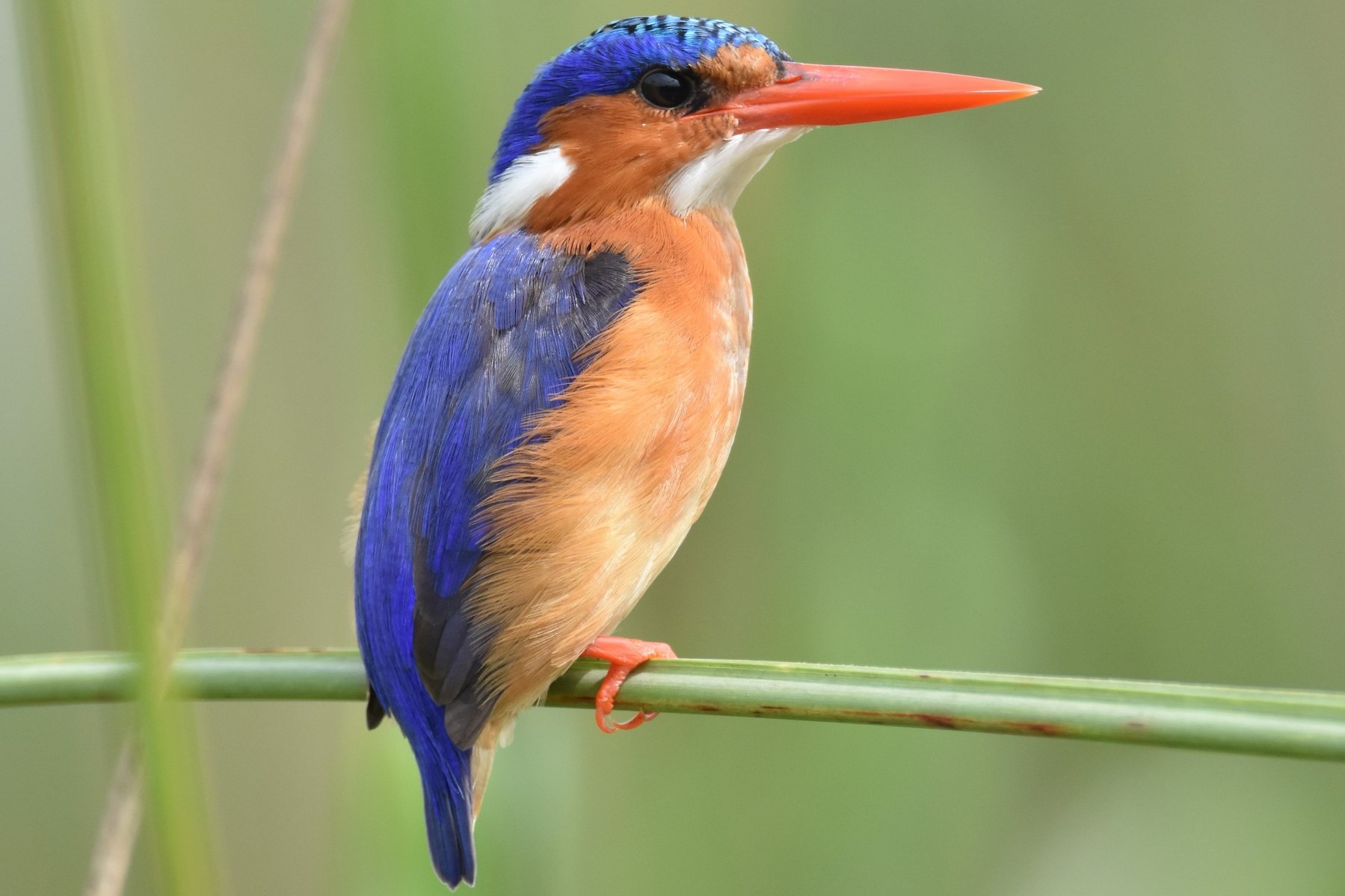
Its vivid coloration makes it an excellent target for beginner birdwatchers and photographers.
African Jacana
The African Jacana is closely associated with freshwater wetlands containing floating vegetation.
Its exceptionally long toes allow it to move across aquatic vegetation, making its behavior almost as interesting as its appearance.
Bee-eaters
Uganda supports several bee-eater species occupying different habitats.
Their vivid plumage, aerial feeding behavior and tendency to perch in exposed positions can make bee-eaters particularly rewarding for photographers.
Sunbirds
Sunbirds add flashes of color to many Uganda birding environments.
Different species can be associated with forests, gardens, woodland and montane habitats.
Watching flowering vegetation around lodges can sometimes produce enjoyable birding without even leaving the accommodation grounds.
Hornbills
Several hornbill species can be encountered in appropriate habitats.
Their large bills, distinctive calls and strong silhouettes make them memorable additions to a couples birding safari.
Weavers
Weavers can be excellent birds for beginners because many are colorful, active and associated with fascinating nest-building behavior.
Learning to distinguish different weaver species can also provide a useful introduction to more detailed bird identification.
Raptors
Uganda’s open landscapes provide opportunities to look for different birds of prey.
Savannah destinations such as Murchison Falls, Queen Elizabeth, Lake Mburo and Kidepo Valley can be particularly interesting for couples who enjoy raptor identification.
Raptors can require careful attention to size, shape, flight style and plumage, making them rewarding targets for more experienced birders.
Build Your Target List Around Habitat
Instead of expecting every famous Uganda bird on one safari, couples should choose destinations according to the birds and habitats that interest them most.
A target list can be grouped into:
- Forest species
- Albertine Rift specialties
- Montane birds
- Wetland birds
- Papyrus specialists
- Savannah species
- Raptors
- Waterbirds
- Photographic targets
Wild Planet Safaris can use this information when discussing a suitable route, while keeping expectations realistic because wildlife sightings remain unpredictable.
Uganda Birding Safari for Beginner Couples
You do not need to be an experienced ornithologist to enjoy birdwatching in Uganda.
A Uganda birding safari for couples can be designed for two travelers who simply enjoy wildlife, photography and spending time outdoors.
For beginners, the goal does not need to be identifying hundreds of species. It can instead be learning how to observe birds, recognizing distinctive species and gradually becoming more confident.
Learning to Use Binoculars
Using binoculars effectively takes a little practice.
Beginners sometimes locate a bird with the naked eye and then lose it while raising their binoculars.
A useful technique is to keep looking directly at the bird while bringing the binoculars toward your eyes rather than looking down at the binoculars first.
With practice, locating birds becomes much faster.
An experienced guide can also help couples learn how to:
- Focus binoculars quickly
- Follow moving birds
- Scan the canopy
- Search wetland vegetation
- Observe without disturbing wildlife
- Recognize useful field marks
Start with Distinctive Birds
Trying to identify every small bird immediately can become frustrating.
Beginning with larger, colorful or distinctive species can make birding more enjoyable.
Possible examples include turacos, kingfishers, bee-eaters, hornbills, cranes, fish eagles and Shoebills.
As confidence develops, couples can begin distinguishing more challenging groups.
Learn to Identify Birds by More Than Color
A guide can help beginners understand that identification involves much more than plumage.
Useful characteristics include:
- Size
- Shape
- Bill structure
- Tail shape
- Flight pattern
- Behavior
- Habitat
- Voice
- Feeding method
- Perching style
Learning these characteristics can quickly improve identification skills.
Choose a Slower Pace
Beginner couples do not need an intensive schedule beginning before sunrise every day.
A relaxed itinerary might combine morning birding with afternoon wildlife viewing, a boat trip or time at the lodge.
This allows travelers to develop their interest without making the safari exhausting.
Combine Birds with Wildlife
One of Uganda’s strengths for beginners is the ability to combine birding with other wildlife.
A couple might spend one morning identifying wetland birds before taking a game drive later in the day, or combine forest birding with chimpanzee or gorilla experiences.
This creates a varied safari even when one partner is more enthusiastic about birds than the other.
Use a Birding Guide
A knowledgeable guide can transform the experience for beginners.
Instead of spending long periods trying to identify unfamiliar birds independently, travelers can learn which characteristics to observe and how different species use their habitats.
Keep a Shared Checklist
A shared bird checklist can turn the safari into an enjoyable joint activity.
Record:
- Species
- Date
- Destination
- Habitat
- Memorable behavior
- Photographed species
- Favorite sighting of the day
The objective does not have to be achieving the largest possible number. The checklist becomes a record of the experience the couple shared.
Uganda Birding Safari for Experienced Birding Couples
For experienced birders, Uganda can support a much more intensive itinerary.
Instead of simply visiting major national parks, serious birders may plan the route according to specific habitats, regional specialties and target species.
Target-Species Planning
Experienced birding couples should consider sending their target list during the early planning stages.
This can help determine:
- Which destinations deserve the most time
- Which habitats need to be included
- Whether specialist forest birding is important
- Whether wetland sites should be prioritized
- Whether a longer itinerary is justified
Target species remain targets rather than guaranteed sightings.
Forest Specialties
Forest birding can form a major part of a specialist itinerary.
Potential destinations include:
- Bwindi
- Kibale
- Budongo
- Semuliki
- Mgahinga
Forest birding can be demanding because visibility is often restricted. Experienced birders may therefore want longer sessions and repeated opportunities in productive habitats.
Albertine Rift Birds
The Albertine Rift is particularly important for specialist itineraries in southwestern Uganda.
Couples interested in regional specialties may prioritize Bwindi and Mgahinga, allowing more time for montane and forest birding.
Wetland Specialists
Wetlands add another group of potential targets.
Mabamba and other suitable wetland environments can provide opportunities to search for Shoebill and species associated with papyrus, open water and marsh habitats.
Longer Birding Days
Experienced birders often prefer to maximize the most productive hours.
Days may begin before sunrise and include several birding sessions separated by meals, transfers or periods of reduced activity.
This type of itinerary should be planned realistically so that adequate rest is still included.
Detailed Checklists
Serious birders may maintain detailed records including:
- Species
- Subspecies where relevant
- Location
- Date
- Habitat
- Number observed
- Vocalizations
- Photographs
- Target status
Digital checklists can be complemented by handwritten field notes.
Multiple Habitats
A longer itinerary can combine:
Wetlands → forests → savannahs → montane habitats → lakes → riverine systems → woodland
This habitat diversity is one of the main reasons longer Uganda birding itineraries can be attractive to experienced couples.
14–21+ Day Specialist Birding Itineraries
Serious birders should consider allocating enough time to avoid rushing between distant destinations.
A 14-day safari can cover several major birding areas, while 21 days or longer allows a broader exploration of habitats and additional specialist destinations.
Couples with extensive target lists can internally continue to Wild Planet Safaris’ 21 Days Uganda Specialist Birding Safari for a longer itinerary option.
SEND US YOUR TARGET BIRD LIST
Uganda Bird Photography Safari for Couples
For some couples, seeing the bird is only half the experience—they also want to photograph it.
A photography-focused Uganda birding safari generally benefits from a slower pace than a checklist-focused trip.
Advantages of a Private Vehicle
A private vehicle can provide greater flexibility for photographers during road-based birding.
Where stopping is safe and permitted, couples may have more time to wait for a bird to move into a suitable position rather than continuing immediately.
Camera equipment can also remain organized and accessible.
Allow Extra Observation Time
A birder may confirm a species in seconds.
A photographer may need significantly longer to achieve the desired image.
Factors include:
- Light
- Distance
- Background
- Vegetation
- Bird position
- Movement
- Weather
A photography-oriented itinerary should therefore avoid trying to visit too many destinations.
Camera Equipment
Useful equipment may include:
- Camera body
- Telephoto lens
- Spare batteries
- Extra memory cards
- Rain cover
- Lens cloth
- Camera strap
- Beanbag
- Backup storage
Couples should bring equipment they already understand rather than learning an entirely new camera system during the safari.
Telephoto Lenses
A telephoto lens is particularly useful because birds are often small or distant.
However, the longest or heaviest lens is not automatically the most practical choice.
Forest birding can involve substantial walking, so photographers should balance reach with portability.
Beanbags
A beanbag can provide stable support for a telephoto lens during vehicle-based photography without requiring the space of a full tripod.
Forest Bird Photography
Forest photography can be challenging because light levels are lower and vegetation can obstruct subjects.
Photographers should be comfortable adjusting shutter speed, ISO and autofocus settings quickly.
Rain protection is also particularly important.
Wetland Photography
Wetlands can offer opportunities to photograph Shoebills, kingfishers, waterbirds and other species.
Protect cameras and lenses carefully during canoe or boat-based excursions.
Savannah Bird Photography
Open-country environments can provide cleaner backgrounds and better light, although birds may be farther away.
Bee-eaters, raptors, hornbills and other open-country species can provide rewarding photographic subjects.
Build a Slower Photography Itinerary
Photography rewards patience.
Couples whose main goal is obtaining high-quality images may benefit from spending more time at fewer destinations rather than attempting to maximize their species list.
Birding and Gorilla Trekking Safari for Couples
Combining birdwatching and mountain gorilla trekking can create one of the most diverse private safari experiences available in Uganda.
The combination works particularly well because some of Uganda’s major gorilla destinations—especially Bwindi and Mgahinga—are also important birding areas.
Couples therefore do not necessarily need to choose between a serious birding itinerary and a gorilla experience.
Birding and Gorillas in Bwindi
Bwindi allows travelers to allocate separate days to birdwatching and gorilla trekking.
One day might concentrate on forest birds and Albertine Rift targets, while another is reserved for the scheduled gorilla trek.
Trying to combine both major activities into an unnecessarily compressed schedule should be avoided. Spending multiple nights in the region creates a more comfortable experience.
Birding and Gorillas in Mgahinga
Mgahinga can provide another opportunity to combine montane birding with gorilla trekking, subject to permit arrangements and the itinerary.
The park can also be considered for golden monkey tracking.
Example Birding and Gorilla Route for Couples
A longer itinerary could follow:
Entebbe → Mabamba Wetland → Kibale → Queen Elizabeth → Bwindi → Mgahinga → Lake Mburo → Entebbe
This route provides several distinct environments.
Entebbe and Mabamba introduce wetland birding and the possibility of searching for Shoebill.
Kibale introduces tropical forest birding and potential chimpanzee experiences.
Queen Elizabeth provides savannah, wetland and boat-based birding alongside traditional wildlife viewing.
Bwindi introduces specialist forest and Albertine Rift birding together with gorilla trekking.
Mgahinga adds montane birding and further primate possibilities.
Lake Mburo adds woodland, wetland and savannah habitats before the return toward Entebbe.
The route should not be treated as mandatory. Couples with fewer days may need to remove destinations, while specialist birders with more time may add other important birding areas.
The best route depends on available days, target species, permit availability, preferred travel pace and other wildlife interests.
Birding and Chimpanzee Safari for Couples
Chimpanzee tracking can also fit naturally into a bird-focused Uganda itinerary.
This is particularly attractive for couples who want to experience both Uganda’s bird diversity and its primates.
Kibale Birding and Chimpanzees
Kibale is a natural destination for this combination because couples can dedicate separate periods to forest birding and chimpanzee tracking.
A well-paced stay might include:
- Forest birding
- Chimpanzee tracking
- Bigodi Wetland excursion
- Lodge-ground birding
- Photography
The exact schedule should account for booked activity times and travel requirements.
Why This Combination Works for Couples
Not every couple has identical interests.
One traveler may have an extensive bird target list while the other is particularly excited about primates.
Combining the two experiences allows both interests to shape the itinerary.
It also creates variety. After several hours concentrating on difficult forest birds, a primate activity can offer a different type of wildlife experience.
Birding Beyond Kibale
Depending on the route and current activity options, other forest destinations can contribute to a broader birding-and-primate itinerary.
The key is to design the safari around the couple’s priorities rather than adding activities simply to make the itinerary appear longer.
Birding and Wildlife Safari for Couples
A Uganda birding safari does not have to exclude traditional African wildlife experiences.
In fact, combining birdwatching with game drives, boat safaris and primates can be one of the best approaches when only one traveler is a dedicated birder.
The birder still gets substantial time in productive habitats, while both travelers experience Uganda’s broader wildlife.
Game Drives
Game drives can be treated as both birding and wildlife activities.
While searching for larger mammals, birders can watch for:
- Raptors
- Bee-eaters
- Rollers
- Hornbills
- Lapwings
- Bustards
- Storks
- Cranes
- Other open-country species
This means birding does not necessarily stop when the safari vehicle enters a traditional wildlife area.
Boat Safaris
Boat safaris can be particularly productive because water attracts both birds and mammals.
Potential experiences include birding along the Kazinga Channel in Queen Elizabeth and river-based excursions associated with Murchison Falls itineraries.
Couples may observe waterbirds while also enjoying broader wildlife viewing.
Queen Elizabeth National Park
Queen Elizabeth works well for mixed-interest couples because it combines:
- Savannah birding
- Wetland birds
- Boat-based birding
- Game drives
- General wildlife
- Photography
It can also fit naturally between Kibale and Bwindi on a western Uganda route.
Murchison Falls National Park
Murchison adds extensive savannah and riverine environments.
Couples can combine birdwatching with game drives and boat experiences, making it suitable for travelers who want both birds and classic safari wildlife.
Lake Mburo National Park
Lake Mburo can be particularly convenient on southwestern circuits.
Its combination of woodland, savannah and wetland habitats adds bird diversity while also providing broader wildlife experiences.
Kidepo Valley National Park
For couples with enough time, Kidepo introduces remote dry-country and savannah habitats.
Its geographic location means it is generally better suited to longer itineraries than short southwestern Uganda circuits.
Primates
Birding can also be combined with:
- Mountain gorillas
- Chimpanzees
- Golden monkeys
- Other primates encountered during suitable activities
This makes it possible to build an itinerary around Uganda’s broader biodiversity rather than treating birds and mammals as separate types of safari.
Nature Walks
Guided nature walks can provide a slower perspective on the environment.
Depending on the destination and permitted activities, couples can observe birds while also learning about vegetation, smaller wildlife and ecological relationships.
Wetlands
Wetlands should remain an important part of a mixed wildlife itinerary.
They introduce species that are unlikely to be encountered in forests or dry savannahs and provide particularly good opportunities for waterbird photography.
A Safari That Works for Both Travelers
If one partner is a dedicated birder and the other prefers general wildlife, the itinerary should not force either traveler to abandon their interests.
A morning might be dedicated to birding, followed by an afternoon boat safari. Another day might combine a bird-focused game drive with broader wildlife observation. Forest birding can be followed by chimpanzee or gorilla experiences.
This flexibility is one of the strongest reasons to plan a private Uganda birding safari for couples rather than treating birdwatching as a completely separate specialist activity.
Planning a birding, gorilla, chimpanzee or wildlife combination? Send Wild Planet Safaris your travel dates, available number of days and birding interests so the route can be designed around the experiences you both want to prioritize.
CTA: PLAN OUR PRIVATE UGANDA BIRDING SAFARI
Romantic Experiences to Add to a Uganda Birding Safari
A Uganda birding safari for couples does not need to involve intensive birdwatching from sunrise to sunset every day. Adding a few relaxed experiences can create a better balance between serious birding, wildlife exploration and time to enjoy Uganda’s landscapes together.
These additions do not have to turn the journey into a honeymoon itinerary. They simply provide opportunities to slow down between early starts, forest walks and long birding days.
The experiences available will depend on the route, accommodation, season and activities offered at each destination.
Scenic Lodge Stays
Choosing accommodation in attractive natural surroundings can add considerably to a couples safari.
A lodge overlooking a forest, lake, wetland or savannah allows travelers to continue enjoying the landscape even after scheduled birding activities have finished.
For birdwatchers, a scenic lodge can provide an additional advantage: birding around the property itself.
Depending on the location and habitat, couples may spend free time watching birds from a veranda, garden, restaurant or other appropriate lodge area.
When selecting accommodation, consider both comfort and location. A beautiful lodge that requires a very long drive to the next morning’s birding location may not always be the most practical choice for serious birders.
Private Meals Where Available
Some lodges may offer private or specially arranged dining experiences.
This can provide a relaxed way to end a long day in the field, particularly after an early start or demanding forest walk.
Couples interested in private dining should request it in advance because availability, additional costs and arrangements differ between properties.
It should be treated as an optional enhancement rather than a standard inclusion in every safari.
Sunset Experiences
Sunset can be an enjoyable part of a safari day.
Depending on the destination and permitted activities, couples may enjoy the changing evening light from a lodge, viewpoint, boat or other suitable location.
For photographers, this period can also provide attractive landscape and wildlife photography conditions.
Sunset activities should always be planned around park regulations, travel times and the operational schedules of the destination.
Boat Excursions
Boat experiences can combine birdwatching, photography and relaxed wildlife observation.
Possible examples within a Uganda itinerary include the Kazinga Channel in Queen Elizabeth National Park and boat activities associated with Murchison Falls itineraries.
Rather than constantly moving between locations, couples can observe birds and wildlife from the water while enjoying a different perspective on the landscape.
Boat activities can be particularly appealing when one traveler is an enthusiastic birder while the other prefers broader wildlife viewing.
Lake Bunyonyi Relaxation
Couples traveling through southwestern Uganda may choose to include Lake Bunyonyi as a relaxation stop, depending on their route and available time.
The lake’s islands, surrounding hills and waterside setting provide a contrast to intensive forest birding and trekking activities.
A stay around Lake Bunyonyi can be positioned after demanding activities in Bwindi or Mgahinga, giving couples time to rest before continuing the safari.
Depending on the accommodation and available activities, travelers may simply enjoy the scenery or participate in appropriate local excursions.
Couples on specialist birding trips should decide whether the relaxation time is worth allocating from their overall birding schedule.
Leisure Time Between Intensive Birding Days
Long birding safaris can be physically and mentally demanding.
Repeated early departures, long forest walks, photography sessions and road transfers can become tiring, particularly on itineraries lasting two or three weeks.
Building occasional slower periods into the itinerary can help couples recharge.
A relaxed afternoon can be used to:
- Rest at the lodge
- Review bird photographs
- Update the species checklist
- Recharge camera batteries
- Back up photographs
- Organize equipment
- Enjoy casual lodge-ground birding
- Prepare for the following day’s activities
Rest time is not necessarily wasted safari time. On longer specialist journeys, it can make the overall pace more sustainable.
Scenic Viewpoints
Uganda’s landscapes provide opportunities to enjoy more than bird identification.
Depending on the route, couples may experience views of forested hills, crater landscapes, lakes, savannahs, mountain environments and open valleys.
Allowing time to appreciate these landscapes can prevent the safari from becoming entirely checklist-driven.
For photographers, viewpoints may also provide opportunities for landscape images that complement bird and wildlife photography.
Important: Private meals, sunset experiences, special lodge arrangements and other optional activities vary between accommodations and destinations. Wild Planet Safaris should confirm availability when designing the final itinerary rather than presenting these experiences as guaranteed inclusions.
Best Uganda Birding Safari Itineraries for Couples
The ideal itinerary depends on how many days a couple has available and whether the priority is birdwatching, photography, primates, traditional wildlife or a combination.
A short safari should concentrate on a small number of destinations rather than spending most of the trip driving. Longer journeys can gradually introduce more habitats and specialist birding locations.
The following routes are examples and can be adjusted according to interests, road conditions, activity availability and travel logistics.
3-Day Short Uganda Birding Safari for Couples
Possible route: Entebbe → Mabamba → Lake Mburo → Entebbe
A three-day itinerary works best for couples who have limited time and want an introduction to Uganda’s birding rather than an exhaustive specialist safari.
Day 1: Entebbe and Mabamba Wetland
Begin with a wetland birding excursion around Mabamba, where the Shoebill can be one of the principal target species.
The excursion also introduces couples to Uganda’s wetland birdlife.
After birding, continue according to the day’s logistics and overnight arrangements.
Day 2: Lake Mburo National Park
Explore the woodland, savannah and wetland environments associated with Lake Mburo.
Birdwatching can be combined with general wildlife observation, giving couples a broader safari experience.
Day 3: Lake Mburo Birding – Return to Entebbe
Include another birding session according to the planned activities before beginning the return journey toward Entebbe.
This short itinerary is suitable for couples who want to add birding to a wider East African holiday or who have only a few days available in Uganda.
7-Day Uganda Birding and Wildlife Safari for Couples
Possible route: Entebbe → Mabamba → Kibale → Queen Elizabeth → Lake Mburo → Entebbe
Seven days allows couples to experience wetlands, forests and savannahs without trying to cover every major birding destination.
Days 1–2: Entebbe and Mabamba
Begin around Entebbe before exploring Mabamba Wetland for Shoebill and other wetland birds.
Days 2–3: Kibale Region
Continue west toward Kibale.
Allocate time to forest birding and, depending on the package, potentially combine this with Bigodi or a primate experience.
Days 4–5: Queen Elizabeth National Park
Continue to Queen Elizabeth for savannah birding and wildlife viewing.
A boat activity on the Kazinga Channel can add waterbirds and shoreline species to the experience.
Day 6: Lake Mburo National Park
Travel toward Lake Mburo and explore its woodland, wetland and savannah habitats.
Day 7: Birding and Return to Entebbe
Include an appropriate morning activity before continuing toward Entebbe.
This itinerary can work particularly well when one partner is a dedicated birder and the other wants a broader wildlife safari.
10-Day Uganda Birding and Gorilla Safari for Couples
Possible route: Entebbe → Mabamba → Kibale → Queen Elizabeth → Bwindi → Lake Mburo → Entebbe
Ten days creates enough time to introduce one of Uganda’s major primate experiences without abandoning the birding focus.
Entebbe and Mabamba
Begin with wetland birding and a search for Shoebill.
Kibale
Continue into western Uganda for forest birding.
Couples can add chimpanzee tracking where this forms part of their chosen package and appropriate permits are arranged.
Queen Elizabeth National Park
Explore savannah and wetland habitats through bird-focused game drives and a boat excursion where scheduled.
Bwindi Impenetrable National Park
Bwindi becomes one of the major highlights of this route.
Allocate time for forest birding and a separate day for mountain gorilla trekking.
Serious birders may want additional time in Bwindi rather than treating it as only a gorilla destination.
Lake Mburo
Finish with another change of habitat through Lake Mburo’s woodland, savannah and wetland environments before returning toward Entebbe.
This combination can be particularly suitable for first-time visitors who want birds, gorillas, forests, savannah wildlife and wetlands within one journey.
14-Day Uganda Birding Safari for Couples
A 14-day safari provides substantially more flexibility for couples who want birdwatching to be one of the primary purposes of their visit.
A possible route could incorporate:
Entebbe → Mabamba → Murchison Falls/Budongo → Kibale/Bigodi → Queen Elizabeth → Bwindi → Mgahinga → Lake Mburo → Entebbe
The exact route should be refined according to target species and priorities.
Over two weeks, couples can experience several major habitat types:
- Papyrus wetlands
- Tropical forest
- Riverine habitats
- Savannah
- Woodland
- Montane forest
- Lakes and channels
The additional time also makes it easier to incorporate gorilla trekking, chimpanzee tracking or photography sessions without sacrificing every birding opportunity.
For serious birders, more nights should be allocated to the most important forest locations rather than spending one night in every destination.
A 14-day itinerary can therefore provide a good middle ground between a general wildlife-and-birding safari and a highly intensive specialist expedition.
21-Day Specialist Uganda Birding Safari for Couples
For experienced birders, a three-week itinerary allows much deeper exploration.
Rather than concentrating only on Uganda’s famous national parks, the route can be built around habitats and target species.
Depending on the final itinerary, a longer specialist safari may incorporate destinations such as:
- Mabamba Wetland
- Murchison Falls
- Budongo Forest
- Kibale
- Bigodi
- Semuliki
- Queen Elizabeth
- Bwindi
- Mgahinga
- Lake Mburo
- Additional appropriate birding locations
Kidepo can also be considered where the available time, route and target species justify the additional travel involved.
A 21-day safari gives couples more opportunities for:
- Target-species searches
- Repeated forest birding sessions
- Wetland specialists
- Albertine Rift birds
- Savannah birding
- Photography
- Detailed checklists
- Slower travel
- Rest periods
Couples considering this level of trip should internally continue to Wild Planet Safaris‘ 21 Days Uganda Specialist Birding Safari for a more detailed long-duration itinerary.
CTA: SEND US YOUR TARGET BIRD LIST
Private vs Group Birding Safari for Couples
Both private and group birding safaris can work well. The more appropriate option depends on the couple’s budget, preferred pace, social preferences and birding objectives.
| Private Birding Safari | Group Birding Safari |
|---|---|
| More flexible daily pace | Activities follow a shared schedule |
| Private vehicle arrangements | Vehicle generally shared with other participants |
| Easier to prioritize a couple’s target list | Birding priorities reflect the wider group |
| More flexibility for photography | Photography time must accommodate others |
| Itinerary can focus on the couple’s interests | Route is normally predetermined |
| Greater flexibility over suitable stops | Stops depend on the group’s schedule |
| Easier to balance birding with other activities | Activities follow the established program |
Who Should Choose a Private Safari?
Private travel can be particularly suitable for couples who:
- Have a specific target bird list
- Want substantial photography time
- Have different interests from one another
- Want to combine birding and primates
- Prefer a flexible pace
- Want specific accommodation categories
- Prefer traveling primarily as two people
Private arrangements do not mean that every aspect of the trip is completely flexible. National park regulations, permit times, boat schedules, accommodation availability and travel logistics still influence the daily program.
Who Might Prefer a Group Safari?
A group safari may appeal to travelers who enjoy meeting other birdwatchers and are comfortable following a predetermined schedule.
Sharing arrangements can also influence trip costs depending on how the tour is structured.
The main trade-off is that individual travelers generally have less control over the pace and target priorities.
Neither format is universally right for every couple. The choice depends on how independently the two travelers want their birding experience structured.
Accommodation for Couples on Uganda Birding Safaris
Accommodation has an important influence on both comfort and safari logistics.
For birdwatchers, the best property is not automatically the most luxurious. Location, accessibility and proximity to productive birding habitats can sometimes be more important.
A strategically located lodge can allow an earlier start while reducing unnecessary driving.
Budget Accommodation
Budget accommodation is suitable for couples who want to dedicate more of their safari budget to activities, permits and the length of the itinerary.
Properties in this category may provide simpler facilities while still offering the basic comfort required after a birding day.
When evaluating budget accommodation, consider:
- Private room arrangements
- Bathroom facilities
- Location
- Meal arrangements
- Electricity/charging
- Security
- Access to the next day’s birding location
Budget accommodation can be particularly practical for specialist birders whose priority is spending as much time as possible in the field.
Mid-Range Lodges
Mid-range accommodation can offer a balance between comfort and cost.
Depending on the property, couples may have access to comfortable rooms, private bathrooms, restaurants, attractive surroundings and useful services for multi-day safari travelers.
For many couples, this category works well on longer itineraries because it provides comfortable accommodation without pushing the overall safari price toward the highest end.
Luxury Safari Lodges
Luxury lodges can add higher levels of comfort, location, service or exclusivity depending on the property.
They may appeal to couples who want their birding safari to combine intensive wildlife experiences with more comfortable downtime.
However, a luxury property should still make logistical sense for the birding route.
A high-end lodge located far from the next morning’s target birding area may be less practical than a simpler lodge located closer to the habitat.
Location Near Birding Areas
For serious birders, lodge location deserves special attention.
Being close to the birding site can mean:
- Less driving before sunrise
- More time in the field
- Easier early starts
- More flexibility
- Additional lodge-ground birding
Early Breakfast Arrangements
Birdwatchers frequently need to leave before normal breakfast hours.
Where offered, arrangements might include an early breakfast or packed breakfast.
This should be confirmed with the selected property rather than assumed.
Packed Breakfasts and Lunches
Long birding sessions may make returning to the lodge for lunch impractical.
Where accommodation providers offer packed meals, these can allow couples to remain in productive birding areas for longer.
Charging Facilities
Bird photographers should pay particular attention to charging arrangements.
A typical evening may involve charging:
- Camera batteries
- Smartphones
- Power banks
- Headlamps
- Other electronics
Ask about charging availability when traveling to more remote locations.
Comfortable Rooms
After several hours walking through forests or spending the day birding from a vehicle, a comfortable room can make a meaningful difference.
Couples should select accommodation according to both budget and the intensity of their itinerary.
Laundry Options
Laundry can be particularly valuable on a 14- or 21-day safari.
The availability, turnaround time and cost of laundry services differ between properties.
Travelers should also remember that some items may not be suitable for lodge laundry services.
Lodge-Ground Birding
Some accommodation properties are surrounded by gardens, forest edges, woodland or other natural habitats.
This can create opportunities for casual birding before breakfast or during afternoon downtime.
Couples can therefore continue observing birds without always undertaking a formal excursion.
Photography Opportunities
Properties overlooking water, forests or open landscapes may also provide opportunities for photography.
When photography is a major priority, discuss this during itinerary planning so accommodation can be considered alongside the broader route.
How Much Does a Uganda Birding Safari for Couples Cost?
There is no single fixed price for a Uganda birding safari for couples.
A short three-day wetland and wildlife trip is fundamentally different from a private three-week specialist expedition involving multiple national parks, forest birding, primate permits and higher-end accommodation.
For this reason, couples should compare safari quotations based on what is actually included rather than looking only at the headline price.
Number of Days
Trip duration is one of the biggest cost factors.
A longer itinerary requires additional:
- Accommodation nights
- Guide time
- Vehicle use
- Meals
- Park entries
- Activities
However, longer itineraries can also provide much greater habitat coverage for dedicated birders.
Accommodation Category
Budget, mid-range and luxury accommodation can produce significantly different total safari costs.
Couples should choose accommodation based on the level of comfort they genuinely want rather than assuming luxury accommodation is necessary for a good birding experience.
Private Safari Vehicle
Private vehicle arrangements influence the cost but can provide important flexibility for couples.
The vehicle and related operating expenses are shared between only two travelers rather than a larger group.
Birding Guide
The guiding arrangements included in the quotation can affect the final price.
Specialist birding requirements may differ from a general wildlife safari, so couples should clarify what type of guiding is included.
Park Entry Fees
National park and protected-area entry fees form part of the overall cost where applicable.
The amount depends on the destinations and activities included in the itinerary.
Boat Activities
Scheduled boat excursions, wetland activities and other water-based experiences may carry separate costs depending on the destination and package.
These should be clearly listed as included or optional in the final quotation.
Gorilla Permits
Couples combining birding with mountain gorilla trekking need to budget for the required permits.
Permit arrangements should be discussed early because availability can affect the itinerary.
Current permit prices and regulations should always be confirmed from the appropriate official source when preparing the final quotation.
Chimpanzee Permits
The same principle applies to chimpanzee tracking.
If chimpanzee tracking forms part of the itinerary, the quotation should clearly state whether the permit is included.
Season
Travel dates can influence accommodation availability and pricing.
Rather than assuming there is one universal high- or low-season rate, couples should request a quotation for their actual intended travel dates.
Route
The geographic route matters.
An itinerary concentrated in western and southwestern Uganda has different transport requirements from one that also incorporates distant destinations such as Kidepo.
Adding destinations purely to make the safari appear more comprehensive can increase both cost and driving time.
Number of Travelers
A safari for two people has different per-person economics from a larger group because major costs such as the private vehicle and guide are divided between fewer travelers.
For couples, quotations should therefore be calculated specifically for two travelers sharing the agreed arrangements.
Specialist Birding Requirements
A dedicated birding itinerary may require:
- Specialist guiding
- Longer field sessions
- Particular birding locations
- Additional local guidance
- More nights in key habitats
- Specialized photography pacing
These requirements can influence the final price.
Permits and Optional Activities
Gorilla trekking, chimpanzee tracking and other specialized activities should be itemized clearly.
Couples who are primarily interested in birds do not need to include every available activity.
Likewise, travelers who consider gorillas a major priority should account for the activity during the initial budget planning rather than adding it at the last minute.
Request a Tailored Quote for Two
The most useful way to determine the cost is to provide Wild Planet Safaris with:
- Preferred travel dates
- Number of days
- Two-person travel confirmation
- Preferred accommodation category
- Target bird list
- Desired destinations
- Photography interests
- Gorilla trekking preference
- Chimpanzee tracking preference
- Other wildlife activities
Wild Planet Safaris can then structure the quotation around the couple’s actual priorities.
Readers who want a broader explanation of safari pricing can internally continue to the Uganda Birding Safari Cost guide.
There is little value in paying for activities or destinations that do not match your interests. A well-designed private safari for two should concentrate the available budget on the habitats, birding time, accommodation and additional experiences that matter most to both travelers.
Request Your Private Couples Birding Safari Quote
Planning a Uganda birding safari for two? Send Wild Planet Safaris your travel dates, preferred number of days, accommodation category and target bird list for a customized itinerary and quotation.
CTA: REQUEST A BIRDING SAFARI QUOTE FOR TWO
Best Time for a Uganda Birding Safari for Couples
Uganda offers birdwatching opportunities throughout the year, so there is no single month that every couple must choose. The most suitable time for a Uganda birding safari for couples depends on the destinations you want to visit, the birds you hope to look for, road and trail conditions, photography priorities and whether you plan to combine birding with gorilla trekking, chimpanzee tracking or traditional wildlife viewing.
Uganda’s location near the Equator means seasonal patterns are more complex than simply describing the year as summer and winter. Rainfall, altitude and regional geography influence conditions, and weather patterns can vary from one part of the country to another.
A couple concentrating on the montane forests of Bwindi and Mgahinga may experience very different conditions from travelers exploring the savannahs of Murchison Falls or the wetlands around Mabamba.
For this reason, the best approach is to choose travel dates according to the specific itinerary and birding priorities rather than relying on one universal “best month.”
Birding During Wetter Periods
Wetter periods can offer rewarding birding, but couples should prepare for rain and changing trail conditions.
Rain can produce lush, green landscapes that are particularly attractive for nature and bird photography. Vegetation may be vibrant, flowering plants can support bird activity, and forest environments can feel especially rich.
However, rainfall also affects logistics.
Forest trails in destinations such as Bwindi, Mgahinga, Kibale and Budongo may become muddy and slippery. Birdwatchers should therefore carry appropriate footwear and waterproof clothing.
Useful equipment includes:
- Waterproof hiking boots
- Lightweight rain jacket
- Quick-drying trousers
- Gaiters where useful
- Backpack rain cover
- Waterproof camera protection
- Dry bag for electronics
Rain does not automatically mean the entire birding day is lost. Tropical showers can be localized or intermittent, and birding may continue when conditions improve.
Photographers should pay particular attention to moisture protection because cameras, lenses and other electronics may remain exposed for long periods.
Couples planning forest-heavy itineraries during wetter conditions should also consider a slightly less rushed schedule so that difficult weather does not place unnecessary pressure on the trip.
Birding During Drier Periods
Drier periods can be attractive to couples who want to combine birdwatching with broader wildlife viewing.
Roads and trails may be easier to navigate in some destinations, although conditions still vary by region and recent weather.
Drier conditions can be particularly convenient for itineraries combining:
- Birdwatching
- Game drives
- Gorilla trekking
- Chimpanzee tracking
- Boat activities
- Forest walks
- Wildlife photography
Savannah destinations such as Queen Elizabeth National Park, Murchison Falls National Park, Lake Mburo National Park and Kidepo Valley National Park can fit particularly well into birding-and-wildlife combinations.
However, “dry season” should not be interpreted as a guarantee of completely dry weather.
Rain can occur at any time, especially around forests and higher-altitude environments. A lightweight rain jacket should therefore remain in the daypack regardless of the travel month.
Likewise, drier conditions do not mean birdwatchers should leave waterproof camera protection at home.
Migratory Birds
Seasonality becomes especially important when couples have particular migratory species on their target list.
Uganda receives migratory birds in addition to its resident species, but the timing and presence of individual species vary.
Couples planning specifically around migrants should avoid relying on a general statement such as “migrants are present during this month” without checking the particular species they hope to find.
Instead, prepare a target list and consider:
- Species
- Typical seasonal status
- Preferred habitat
- Known distribution
- Likely birding locations
- Current checklist information
- Recent observations where reliable information is available
Taxonomy, distribution records and observations can change, so specialist itineraries should use current information during the planning process.
Consider Habitat as Well as Month
Choosing the right habitat is often just as important as choosing the right month.
A couple hoping to search for Shoebill needs suitable wetland habitat.
Travelers interested in Albertine Rift birds should prioritize relevant forests and montane areas in southwestern Uganda.
Couples interested in raptors and open-country birds may dedicate more time to savannah destinations.
This means the question should not only be:
“When should we visit Uganda?”
It should also be:
“Which birds do we want to look for, and where do those birds occur?”
For a detailed breakdown of birding conditions throughout the year, internally link this section to Wild Planet Safaris’ Uganda Birding Month by Month guide.
What to Pack for a Couples Birding Safari in Uganda
Packing for a private birding safari should focus on comfort, weather protection and equipment you will genuinely use.
Couples do not need to duplicate every piece of equipment. Certain items, such as field guides or some photography accessories, may be shared if both travelers are comfortable doing so. However, each serious birdwatcher should normally have access to their own binoculars.
Binoculars
Binoculars are the most important piece of birdwatching equipment for most travelers.
Popular configurations such as 8×42 or 10×42 can work well depending on personal preference and habitat.
Camera and Telephoto Lens
Couples interested in bird photography should bring a camera setup they already know how to operate.
A telephoto lens provides useful reach for small and distant birds, while camera weight should remain manageable for forest walks.
Field Guide
Carry an appropriate Uganda or East Africa bird field guide, birding app or both.
If using an app, download required information for offline use before traveling.
Long Trousers and Long-Sleeved Shirts
Lightweight long clothing provides protection from sun, vegetation and insects.
Neutral colors such as khaki, olive, beige and brown are practical for field use.
Hiking Footwear
Reliable hiking footwear is particularly important for forest birding in Bwindi, Mgahinga, Kibale and other forest environments.
Break new boots in before traveling.
Rain Jacket
Carry a lightweight waterproof jacket even when traveling during a generally drier period.
Hat and Sunscreen
Sun protection is particularly important during wetlands, boat excursions and open-country birding.
Insect Repellent
Keep insect repellent accessible in your daypack, especially around forests and wetlands.
Reusable Water Bottle
Birding can involve long periods away from the lodge, so appropriate hydration is important.
Power Bank and Travel Adapter
A power bank is useful for long field days.
Uganda primarily uses Type G electrical sockets, so travelers whose equipment uses a different plug should carry an appropriate adapter.
Lightweight Daypack
Use a comfortable daypack for daily essentials rather than taking your main luggage into the field.
Personal Medication
Carry sufficient personal medication and seek appropriate professional travel-health advice before departure where necessary.
Travel Documents
Keep passports, visa documentation where required, insurance details, safari information and other essential documents securely organized.
For a complete equipment guide, internally link this section to Uganda Bird Watching Safari Packing List: What Every Birdwatcher Should Bring.
Planning a Uganda Birding Honeymoon
A Uganda birding honeymoon can work particularly well for couples who genuinely enjoy nature and want their honeymoon to involve more than staying at one resort.
The journey can combine serious birdwatching with primates, wildlife, scenery and periods of relaxation.
The key is balance.
Trying to record as many species as possible every day may suit specialist birders, but many honeymoon couples will enjoy an itinerary that alternates intensive birding with slower experiences.
Combine Birding with Gorilla Trekking
Gorilla trekking can be one of the major wildlife experiences incorporated into a birding honeymoon.
Bwindi Impenetrable National Park is particularly useful because couples can allocate separate days to forest birding and gorilla trekking.
This avoids treating Bwindi simply as a place to arrive, trek and leave.
Spending additional time allows couples to experience the forest from different perspectives.
Mgahinga Gorilla National Park can also be incorporated into appropriate itineraries combining montane birding with primate experiences.
Include Traditional Wildlife Experiences
A birding honeymoon can also incorporate Uganda’s savannah parks.
Couples can combine birdwatching with game drives and boat safaris in destinations such as:
- Queen Elizabeth National Park
- Murchison Falls National Park
- Lake Mburo National Park
This can be particularly useful when one partner is more interested in birds and the other has a stronger interest in traditional safari wildlife.
Choose Scenic Accommodation
Accommodation can play a larger role on a honeymoon itinerary than on an intensive specialist expedition.
Depending on budget and route, couples can prioritize lodges with attractive natural settings while still considering proximity to birding areas.
The objective should be to balance:
location + comfort + birding access + overall experience.
A highly luxurious lodge is not automatically the best option if it requires long transfers to reach the next morning’s birding site.
Add Lake Bunyonyi
Couples traveling through southwestern Uganda can consider including Lake Bunyonyi as a relaxation stop.
Its lake-and-hill setting provides a change of pace after forest walks, gorilla trekking or intensive birding.
A Bunyonyi stay can be positioned between southwestern activities and the next stage of the safari depending on the route.
Use Private Safari Arrangements
Private arrangements can work particularly well for a birding honeymoon because couples have more control over the pace of the journey.
A morning can be dedicated to serious birding while an afternoon is reserved for relaxation.
Likewise, photographers can spend longer with a subject without worrying about the schedule of a larger group.
Build in Relaxed Days
A honeymoon does not need to involve changing lodges every night.
Staying two or more nights in important destinations can reduce packing and unpacking while providing more time to appreciate each area.
A relaxed afternoon might be spent:
- Resting at the lodge
- Reviewing photographs
- Birding around the grounds
- Enjoying the scenery
- Having a meal together
- Preparing for the next day’s activity
For couples who are serious birders, these quieter periods can also be used for updating checklists and backing up photographs.
Birding Honeymoon vs Specialist Birding Expedition
These trips can overlap, but they do not need to be identical.
A specialist birding expedition may prioritize maximum field time and target species.
A birding honeymoon may give equal importance to birding, wildlife, accommodation, scenery and relaxed time together.
Wild Planet Safaris can adjust the balance according to what the couple actually wants rather than assuming every honeymoon should follow the same itinerary.
Why Book a Couples Birding Safari with Wild Planet Safaris?
A private Uganda birding safari for couples works best when the itinerary reflects the interests of both travelers.
Some couples want an intensive specialist birding expedition. Others want birdwatching to form one part of a broader journey involving gorillas, chimpanzees, wildlife and photography.
Wild Planet Safaris can structure private Uganda birding itineraries according to the couple’s available time, destinations and interests.
Customized Private Itineraries
A customized itinerary starts with understanding how the couple wants to travel.
Important planning information includes:
- Travel dates
- Number of available days
- Birding experience
- Target species
- Preferred destinations
- Photography interests
- Accommodation preference
- Gorilla trekking interest
- Chimpanzee tracking interest
- General wildlife interests
- Preferred travel pace
This information can then be used to build a route rather than forcing travelers into an itinerary that includes destinations they do not particularly want to visit.
A couple with seven days, for example, should generally concentrate on fewer destinations than travelers with three weeks.
Target-Species Planning
Experienced birders can send Wild Planet Safaris a target bird list before the itinerary is finalized.
Species can then be considered according to:
- Habitat
- Distribution
- Route
- Season
- Available time
This may help determine whether the itinerary should prioritize Bwindi, Mgahinga, Mabamba, Kibale, Budongo, Semuliki, Murchison Falls or other relevant areas.
Target-species planning should always be realistic.
Birds are wild, and no responsible itinerary should guarantee sightings simply because a species occurs within a destination.
Bird Photography Itineraries
Bird photographers often require a different pace from checklist-focused birders.
Seeing a bird may take only a few moments. Producing a satisfying photograph may require considerably longer.
Photography-focused itineraries can therefore allocate more time to:
- Observation
- Positioning
- Waiting for better light
- Repeated visits to productive locations
- Wetland photography
- Forest photography
- Savannah photography
Couples should mention photography as a priority before the route is finalized.
This helps avoid an itinerary that includes too many destinations and leaves insufficient time for actual photography.
Birding and Gorilla Safari Combinations
Bwindi and Mgahinga make it possible to integrate birdwatching with mountain gorilla trekking.
Instead of visiting southwestern Uganda solely for gorillas, couples can allocate additional time to the surrounding forest and montane birdlife.
A longer itinerary might combine:
Mabamba → Kibale → Queen Elizabeth → Bwindi → Mgahinga → Lake Mburo
depending on available days and interests.
Permit availability and current activity arrangements should be confirmed when planning the final safari.
Birding, Chimpanzee and Wildlife Combinations
Couples can also combine birdwatching with a wider range of Uganda wildlife experiences.
Depending on the itinerary, these may include:
- Chimpanzee tracking
- Gorilla trekking
- Golden monkey tracking
- Game drives
- Boat safaris
- Nature walks
- Wetland excursions
- General wildlife photography
Kibale can combine forest birding with chimpanzee experiences, while Queen Elizabeth and Murchison Falls can add savannah wildlife and boat-based birding.
Lake Mburo can introduce additional woodland, wetland and savannah habitats.
This approach works particularly well when the two travelers have different primary interests.
Flexible Accommodation Categories
Wild Planet Safaris can structure itineraries using different accommodation categories according to the selected package and availability.
Couples may choose from:
Budget accommodation – practical options for travelers who prefer to dedicate more of their budget to longer safari duration, permits or activities.
Mid-range accommodation – a balance between comfort and overall safari cost.
Luxury accommodation – suitable for travelers seeking a higher level of comfort where appropriate options fit the itinerary.
Accommodation decisions should also consider practical birding factors such as:
- Proximity to birding sites
- Early breakfast availability
- Packed meal arrangements
- Charging facilities
- Laundry
- Lodge-ground birding
- Photography opportunities
The most expensive lodge is not automatically the most useful lodge for every birding itinerary.
Planning a Uganda Birding Safari for Two?
Whether you are planning your first African birding trip, a photography-focused journey, a birding honeymoon or a specialist expedition, the itinerary should reflect both travelers’ interests.
You can choose to concentrate almost entirely on birds or combine birdwatching with gorilla trekking, chimpanzee tracking, game drives, boat safaris, photography and relaxed lodge stays.
The first step is deciding how much time you have and what you most want to experience.
PLANNING A UGANDA BIRDING SAFARI FOR TWO?
Send Wild Planet Safaris your travel dates, number of days, accommodation preference and target bird list to start designing your private Uganda birding itinerary.
When making an inquiry, include:
Travel dates: When would you like to visit Uganda?
Number of days: How long do you have available?
Birding experience: Beginner, intermediate or experienced?
Target birds: Do you already have a target list?
Photography: Is bird photography an important priority?
Gorillas: Would you like to include gorilla trekking?
Chimpanzees: Would you like to include chimpanzee tracking?
Accommodation: Budget, mid-range or luxury?
Other interests: Wildlife, primates, scenery, culture or relaxation?
Providing these details helps Wild Planet Safaris design a route around the experiences that matter most to both travelers.
CTA: PLAN OUR PRIVATE UGANDA BIRDING SAFARI
Frequently Asked Questions About Uganda Birding Safaris for Couples
Is Uganda good for a couples birding safari?
Yes. Uganda can work particularly well for couples because a single itinerary can combine several birding habitats, including tropical forests, papyrus wetlands, savannahs, woodlands, lakes, rivers and montane environments.
A private Uganda birding safari for couples can also be adjusted according to the interests of both travelers. Couples who are serious birders can concentrate on target species and specialist birding locations, while travelers who prefer a broader experience can combine birdwatching with gorilla trekking, chimpanzee tracking, game drives, boat safaris and photography.
This flexibility can be especially useful when one traveler is an experienced birder and the other has a more general interest in wildlife.
Can we book a private Uganda birding safari for two people?
Yes. A private birding safari can be arranged specifically for two travelers.
Private arrangements can provide couples with greater flexibility over the pace of their journey, subject to park regulations, activity schedules, permits and travel logistics.
A private itinerary may allow more time for:
- Target-species searches
- Bird photography
- Forest birding
- Wetland excursions
- Roadside birding where safe and permitted
- Wildlife viewing
- Relaxed lodge time
Couples can also choose an accommodation category and determine how much of the journey should focus exclusively on birdwatching.
How many days do couples need for a Uganda birding safari?
The ideal duration depends on how much of Uganda you want to explore.
A 3-day birding safari can introduce couples to a small number of habitats, such as Mabamba Wetland and Lake Mburo.
A 7–10 day safari allows a more varied journey incorporating forests, wetlands and savannahs, with possibilities for additional wildlife experiences.
Around 14 days provides more time for several major birding destinations without rushing between them.
Experienced birders seeking a broader range of habitats and target species may prefer 21 days or longer.
Couples should prioritize quality birding time rather than trying to visit as many destinations as possible within a short trip.
How much does a Uganda birding safari for two cost?
There is no single fixed price because the cost depends on how the safari is designed.
Important factors include:
- Number of days
- Accommodation category
- Private vehicle arrangements
- Guiding
- Route
- Park entry fees
- Boat activities
- Gorilla permits if included
- Chimpanzee permits if included
- Travel dates
- Specialist birding requirements
- Photography requirements
A three-day birding trip will have a very different cost from a private 21-day specialist expedition.
For an accurate quotation, couples should provide Wild Planet Safaris with their travel dates, number of days, preferred accommodation category, target species and additional activities.
Readers can also internally continue to the Uganda Birding Safari Cost guide for a more detailed explanation of pricing factors.
What are the best birding destinations in Uganda for couples?
The most appropriate destinations depend on the couple’s target species and preferred habitats.
Popular birding areas that can be considered include:
Mabamba Wetland – wetland birding and searching for Shoebill.
Bwindi Impenetrable National Park – forest birding and Albertine Rift specialties, with opportunities to combine birding and gorilla trekking.
Mgahinga Gorilla National Park – montane birding and potential combinations with gorilla trekking or golden monkey tracking.
Kibale National Park – forest birding and possible chimpanzee combinations.
Bigodi Wetland Sanctuary – wetland and forest-edge birding near Kibale.
Queen Elizabeth National Park – savannah, wetland and boat-based birding alongside broader wildlife viewing.
Murchison Falls National Park – savannah and riverine birding combined with traditional safari wildlife.
Budongo Forest – forest-focused birding.
Lake Mburo National Park – woodland, wetland and savannah habitats.
Semuliki National Park – particularly relevant to specialist birders interested in distinctive forest habitats.
Kidepo Valley National Park – dry-country and savannah birding, generally better suited to longer itineraries because of its location.
Couples do not need to visit every destination. Selecting fewer locations that match your interests can provide a more rewarding experience than rushing through the entire country.
Can couples combine birdwatching and gorilla trekking in Uganda?
Yes. Birdwatching and mountain gorilla trekking can fit naturally into the same itinerary.
Bwindi Impenetrable National Park is particularly useful for this combination because it is both a major forest birding destination and a mountain gorilla trekking area.
Couples can allocate one or more days to birding and a separate day to their scheduled gorilla trek.
Mgahinga Gorilla National Park can also be considered for itineraries combining montane birding and gorilla trekking.
Gorilla trekking requires the appropriate permit, so couples interested in the activity should mention it when planning their safari rather than waiting until arrival.
Can we combine birding and chimpanzee tracking?
Yes. Birding and chimpanzee tracking can be combined within a broader Uganda itinerary.
Kibale National Park can be particularly suitable because couples can spend time birding in forest habitats while also including a scheduled chimpanzee tracking experience.
Nearby Bigodi Wetland Sanctuary can add another birding environment to the stay.
This combination can work especially well when one traveler is primarily interested in birds while the other is particularly interested in primates.
Chimpanzee tracking permits and activity schedules should be incorporated during the planning stage.
Is a Uganda birding safari suitable for beginners?
Yes. Couples do not need extensive birdwatching experience to enjoy Uganda.
A beginner-friendly itinerary can concentrate on colorful, distinctive and more easily observed species while teaching travelers how to use binoculars, recognize field marks and understand different habitats.
Beginners can also combine birding with:
- Game drives
- Boat safaris
- Gorilla trekking
- Chimpanzee tracking
- Nature walks
- Wildlife photography
A slower pace can prevent the experience from becoming overwhelming.
Instead of trying to identify every bird encountered, beginners can concentrate on learning gradually and recording their favorite sightings.
Can Wild Planet Safaris plan a trip around our target bird list?
Couples can provide Wild Planet Safaris with a target bird list during the itinerary-planning stage.
The list can help determine which habitats and destinations should receive greater attention.
For example, an itinerary focused on Albertine Rift birds will differ from one primarily targeting wetland, papyrus or savannah species.
When sending a target list, it is useful to indicate which birds are highest priority.
However, target-species planning should never be interpreted as a guarantee of sightings. Birds are wild, and actual encounters depend on factors such as habitat, weather, season and daily bird activity.
SEND US YOUR TARGET BIRD LIST
What should couples pack for birdwatching in Uganda?
Essential items generally include:
- Binoculars
- Uganda/East Africa bird field guide or birding app
- Camera if desired
- Telephoto lens for bird photography
- Lightweight long trousers
- Long-sleeved shirts
- Comfortable hiking footwear
- Lightweight rain jacket
- Hat
- Sunscreen
- Insect repellent
- Reusable water bottle
- Daypack
- Power bank
- Type G travel adapter
- Personal medication
- Travel documents
Couples visiting forest destinations should pay particular attention to waterproof footwear and rain protection.
For the complete equipment guide, internally link to Uganda Bird Watching Safari Packing List: What Every Birdwatcher Should Bring.
What is the best time for couples to go birdwatching in Uganda?
Birdwatching is possible throughout the year, but the conditions couples experience vary according to season, region, altitude, habitat and target species.
Wetter periods can produce lush landscapes but may also bring muddier forest trails and greater need for rain protection.
Drier periods can make some road and trail conditions more convenient and can work well for couples combining birdwatching with broader wildlife viewing.
Travelers interested in particular migratory birds should check current species-specific seasonal information when planning.
Rather than choosing travel dates from a general “best month,” couples should consider the destinations and birds they want to prioritize.
For more detail, internally link to Uganda Birding Month by Month.
Can we include Lake Bunyonyi in our birding safari?
Yes. Lake Bunyonyi can be incorporated into suitable southwestern Uganda itineraries.
It can be particularly attractive to couples who want a quieter period after intensive activities around Bwindi or Mgahinga.
Depending on the route, couples may use their stay to relax, enjoy the lake-and-hill scenery and participate in available activities.
For specialist birders with a strict target list, the decision to include Bunyonyi should depend on how much time is available. On a short itinerary, an additional relaxation stop may reduce the time available in higher-priority birding habitats.
Are private birding safaris suitable for bird photographers?
Yes. Private safaris can be particularly practical for couples interested in bird photography because photographers often need more time with individual subjects.
A photography-oriented itinerary can allow for:
- Longer observation periods
- Slower birding sessions
- More time at productive locations
- Easier access to camera equipment in a private safari vehicle
- Forest photography
- Wetland photography
- Savannah photography
- Time to back up photographs and recharge equipment
Photographers should inform Wild Planet Safaris of their priorities before the itinerary is finalized. This allows the route to emphasize time in the field rather than simply maximizing the number of destinations visited.
Can we start our birding safari from Entebbe or Kigali?
Yes, depending on the itinerary and the cross-border arrangements available for the chosen trip.
Entebbe is a natural starting point for Uganda-wide itineraries and works particularly well for travelers who want to include Mabamba Wetland near the beginning or end of their safari.
A Kigali start can be considered for itineraries concentrating on southwestern Uganda because Rwanda provides access toward areas such as Bwindi and Mgahinga, subject to current immigration, border and transport requirements.
Couples planning to cover a larger part of Uganda—including destinations farther north or east—may find an Entebbe-based route more logical.
The starting point should therefore be chosen according to the destinations included rather than simply selecting the airport with the shortest international flight.
Plan Your Private Uganda Birding Safari for Two
The ideal Uganda birding safari for couples is not necessarily the itinerary with the greatest number of destinations or the longest bird checklist.
It is the itinerary that matches what both travelers actually want to experience.
For some couples, that might mean a week combining Mabamba, Kibale and Queen Elizabeth.
Others may prioritize Bwindi and Mgahinga for Albertine Rift birding and gorilla trekking.
Bird photographers may prefer fewer destinations and longer observation periods, while experienced birders may want a 14–21+ day specialist route through multiple habitats.
When planning your private safari, consider six important factors:
Number of days: How much time do you have in Uganda?
Target species: Are there particular birds you especially want to search for?
Preferred habitats: Are you most interested in forests, wetlands, savannahs, montane habitats or a combination?
Photography interests: Is obtaining bird photographs a major objective?
Accommodation level: Do you prefer budget, mid-range or luxury accommodation?
Additional wildlife experiences: Would you like to include gorilla trekking, chimpanzee tracking, golden monkey tracking, game drives or boat safaris?
Providing this information from the beginning allows Wild Planet Safaris to structure the route around your priorities rather than adding unnecessary destinations.
Start Planning Your Safari
Send Wild Planet Safaris your travel dates, number of days, target bird list, preferred accommodation category and any additional wildlife experiences you want included.
CTA: SEND US YOUR TARGET BIRD LIST
CTA: REQUEST A PRIVATE BIRDING SAFARI FOR TWO