
Uganda Birding Safari Packing List: What Every Birdwatcher Should Bring
Introduction
A well-prepared Uganda Birding Safari Packing List can make a major difference to your comfort and overall birding experience. Uganda combines tropical rainforests, papyrus wetlands, open savannahs, lakes, river systems and high-altitude forests, which means birdwatchers may encounter very different weather and walking conditions during a single safari.
A morning may begin with forest birding along a cool, damp trail before the journey continues into warmer open country. Birdwatchers exploring destinations such as Bwindi Impenetrable National Park, Kibale National Park, Mabamba Wetland, Queen Elizabeth National Park and Murchison Falls National Park therefore need to prepare for both the birds they hope to find and the environments in which they will be searching for them.
Packing for a Uganda birding safari is not simply about carrying binoculars. Good preparation should consider optics, photography equipment, field identification tools, clothing, footwear, rain protection, sun protection, electronics and personal essentials.
This is particularly important on longer birding itineraries, where travelers may spend many hours in the field. Lightweight and practical equipment allows you to concentrate on finding, identifying and photographing birds rather than being distracted by uncomfortable clothing, inadequate footwear or equipment that is difficult to carry.
The following Uganda bird watching safari packing list covers the essential equipment you should consider bringing, from binoculars and field guides to camera gear and everyday birding accessories.
Quick Uganda Bird Watching Safari Packing Checklist
If you are preparing for your safari and want a quick reference, start with these essentials:
- Binoculars
- Uganda or East Africa bird field guide
- Camera and telephoto lens
- Lightweight daypack
- Comfortable hiking shoes or boots
- Lightweight long trousers
- Long-sleeved shirts
- Waterproof rain jacket or poncho
- Sun hat
- Sunscreen
- Insect repellent
- Reusable water bottle
- Notebook or bird checklist
- Smartphone with bird identification apps
- Power bank
- Spare camera batteries
- Extra memory cards
- Personal medication
- Passport and travel documents
Your exact packing requirements will depend on the length of your safari, the destinations included, the season and whether your main interest is casual birdwatching, specialist species identification or bird photography.
For example, a short Shoebill excursion at Mabamba Wetland requires considerably less equipment than a multi-week specialist birding safari covering Uganda’s forests, wetlands and national parks.
Keep Your Birding Equipment Practical
One of the most common packing mistakes is carrying too much equipment. A heavy backpack can become uncomfortable after several hours on a forest trail.
Prioritize equipment that you know how to use and that contributes directly to your birding experience. Before traveling, test your binoculars, camera, backpack and footwear at home.
Essential Birdwatching Equipment for Uganda
Good optics and reliable identification resources form the foundation of a practical Uganda Bird Watching Safari Packing List.

what to pack for birding safari
Uganda’s birding environments can present very different identification challenges. A bird may be high in a shaded forest canopy, moving through dense vegetation, perched far across a wetland or flying over open savannah. Your equipment should therefore be versatile enough for different habitats.
Binoculars
Binoculars should be among the first items packed for a Uganda birding safari. Even travelers who are primarily interested in photography should carry a pair.
Birds are not always close enough to identify with the naked eye, and raising a camera every time something moves can be tiring and slow. Binoculars allow you to scan vegetation quickly, follow moving birds and examine important identification characteristics without immediately setting up photographic equipment.
Two common configurations for birdwatching are 8×42 and 10×42 binoculars.
8×42 Binoculars
An 8×42 pair offers eight-times magnification with 42 mm objective lenses. This configuration is popular because it usually provides a good balance between magnification, brightness, stability and field of view.
A wider field of view can be particularly helpful when trying to locate active birds moving through branches.
This makes 8×42 binoculars particularly practical for forest environments such as:
- Bwindi Impenetrable National Park
- Kibale National Park
- Budongo Forest
- Semuliki National Park
- Mgahinga Gorilla National Park
Forest birding often involves locating birds quickly before they disappear behind foliage. Good light transmission is also valuable because tropical forest interiors can be considerably darker than open habitats.
10×42 Binoculars
A 10×42 pair provides greater magnification and can be useful in more open environments.
They may suit birdwatchers spending considerable time around:
- Wetlands
- Lakeshores
- Savannahs
- Riverbanks
- Open grasslands
- Boat safari routes
The additional magnification can help when examining distant waterbirds, raptors and birds perched across open terrain.
However, higher magnification can produce a narrower field of view and may make hand movement more noticeable. The best option ultimately depends on your eyesight, experience and personal preference.
What to Look for in Birding Binoculars
When choosing binoculars for Uganda, consider more than magnification.
Useful features include:
Water resistance: Tropical rain can occur unexpectedly, especially in forest environments.
Good low-light performance: Useful during early mornings and inside shaded forests.
Comfortable eye relief: Particularly important for travelers who wear glasses.
Manageable weight: Heavy binoculars become tiring during full-day birding.
Comfortable neck strap or harness: A good carrying system makes binoculars easier to use throughout the day.
Suitable field of view: A wider view makes locating small, active birds easier.
There is no need to purchase the most expensive binoculars available solely for one safari. A reliable pair that feels comfortable in your hands and that you already know how to focus quickly is often more useful than unfamiliar high-end equipment.
Spotting Scope and Tripod
A spotting scope can be an excellent addition to a specialist Uganda birding safari, but it is not essential for every traveler.
Scopes are most valuable where birds are observed over longer distances, particularly around wetlands, lakeshores and open landscapes.
They can help when studying:
- Waterbirds
- Waders
- Raptors
- Distant perched birds
- Birds on mudflats
- Large mixed flocks
- Species on the opposite side of a wetland or water channel
For example, birders spending significant time around open wetland environments may appreciate the extra magnification a scope provides.
A spotting scope should normally be paired with a stable tripod. A lightweight but sturdy tripod is preferable when equipment must be carried for extended periods.
Do You Really Need a Spotting Scope?
For casual birdwatchers, probably not.
Binoculars are more portable and sufficient for many Uganda birding experiences. A spotting scope adds weight and requires additional setup time.
For dedicated birders with specific target species, however, a scope can be extremely useful, especially when an identification depends on seeing subtle details on a distant bird.
Before bringing one, consider your itinerary. A forest-focused safari may provide fewer opportunities to use a large spotting scope than an itinerary featuring extensive wetland and open-country birding.
Uganda or East Africa Bird Field Guide
A good field guide remains one of the most useful identification resources a birdwatcher can carry.
Uganda’s location within East Africa and its variety of habitats mean travelers can encounter birds associated with forests, wetlands, savannahs, mountains and other ecological zones.
A suitable field guide helps birders compare characteristics such as:
- Plumage patterns
- Bill shape
- Leg color
- Body proportions
- Male and female plumage
- Juvenile plumage
- Distribution
- Habitat preferences
- Similar species
When selecting a guide, make sure its geographic coverage includes Uganda.
Printed Guide or Digital Guide?
Both formats have advantages.
A printed field guide does not depend on battery power and allows several illustrations or species accounts to be compared quickly.
A digital guide reduces the amount of weight in your daypack and can provide additional features such as search functions, range information and, depending on the application, bird vocalizations.
Many dedicated birders choose to use both.
A printed guide can remain in the safari vehicle or lodge when unnecessary, while a digital version provides quick access in the field.
Bird Identification Apps
A smartphone can become a powerful identification tool when prepared before the safari.
Birding applications may provide:
- Species illustrations or photographs
- Distribution information
- Habitat descriptions
- Bird calls
- Personal checklists
- Sightings records
- Notes
- Location information
However, do not assume that reliable mobile data will always be available during a safari.
Some of Uganda’s productive birding destinations are in remote areas where internet connectivity may be limited or inconsistent. Download any required databases, maps, field guides and other offline resources before traveling.
Using Bird Calls Responsibly
Recordings can be extremely helpful for learning and confirming bird vocalizations.
However, repeated playback can potentially disturb birds, particularly around breeding territories and sensitive species. Follow guidance from your birding guide and any applicable protected-area rules.
Learning calls before the safari can be especially rewarding because many forest birds are heard before they are seen.
Notebook and Bird Checklist
Even in the age of smartphones, a small notebook can be surprisingly useful.
Recording sightings helps you remember not only which species you observed but also where and under what conditions you encountered them.
For each observation, you may record:
- Species
- Date
- Location
- Habitat
- Number observed
- Interesting behavior
- Target species found
- Species requiring later identification
- Photography notes
For difficult identifications, write down details immediately.
For example:
- Approximate size
- Bill shape
- Eye color
- Leg color
- Upperpart coloration
- Underpart pattern
- Tail shape
- Flight behavior
- Call
- Habitat
- Height above the ground
These details can later be compared with your field guide, photographs or notes from your birding guide.
Keeping a daily checklist also creates a personal record of your Uganda birding safari that you can revisit long after returning home.
Camera Equipment for a Uganda Birding Safari
Bird photography can be one of the most rewarding parts of a Uganda safari.
The country provides opportunities to photograph birds in dramatically different settings—from wetland species and forest specialists to raptors, kingfishers, bee-eaters and savannah birds.
However, bird photography equipment can quickly become heavy. Your goal should be to find a practical balance between image quality, reach, portability and ease of use.
Camera Body
Both DSLR and mirrorless cameras can work well for bird photography.
A modern camera with reliable autofocus, continuous shooting and reasonable low-light performance can be helpful because birds frequently move quickly and may appear in challenging light.
Forest photography presents particular challenges. Birds may be moving beneath dense canopy cover where available light is limited.
Open-country bird photography creates different challenges. A bird may be well lit but much farther away.
The most important consideration is familiarity with your camera.
Before traveling, practice adjusting:
- Shutter speed
- Aperture
- ISO
- Exposure compensation
- Autofocus settings
- Focus points
- Continuous shooting modes
A less expensive camera that you understand thoroughly can be more useful in the field than sophisticated equipment whose controls you are still learning.
Telephoto Lens
Birds are often small, active and difficult to approach closely, making a telephoto lens one of the most useful pieces of equipment for bird photography.
Longer focal lengths help photographers fill more of the frame without moving unnecessarily close to the bird.
A practical wildlife zoom can provide flexibility when photographing birds at different distances.
Large professional prime lenses may offer excellent optical performance, but they can also be heavy, expensive and difficult to carry through forests.
Consider the type of safari you are taking.
For vehicle-based bird photography, carrying heavier equipment may be manageable because the equipment can remain nearby.
For forest birding involving several hours of walking, portability becomes far more important.
Choose a lens you can comfortably carry and operate for the duration of your safari.
Spare Batteries
Always consider carrying spare camera batteries.
Birding days frequently begin early, and photographers may take hundreds or even thousands of photographs during productive sessions.
Battery consumption can increase when using:
- Continuous autofocus
- Burst shooting
- Electronic viewfinders
- Image stabilization
- Video
- Frequent image review
- Wireless camera features
Some itineraries also visit remote areas where charging opportunities may be less convenient than at city hotels.
Charge your batteries whenever reliable power is available and begin each birding day with your primary battery fully charged.
A power bank can be useful for compatible devices, although photographers should confirm that their particular camera or charger supports USB charging.
Extra Memory Cards
Bird photography can consume storage rapidly.
Burst shooting creates multiple images in seconds, while RAW files and high-resolution photographs require significantly more space than ordinary smartphone images.
Carry enough memory cards for the expected length of your safari.
Rather than relying entirely on one very large card, some photographers prefer several cards. This can reduce the amount of photography stored on a single physical device.
Keep unused and completed memory cards organized separately.
A small protective card case can prevent cards from being lost or damaged.
Where possible, back up important photographs during longer safaris rather than waiting until the end of the trip.
Camera Rain Cover
Rain protection should have a place on any photography-focused Uganda Bird Watching Safari Packing List.
Weather conditions can change quickly, especially in tropical and montane environments.
A camera rain cover allows photographers to protect equipment without immediately ending a productive birding session.
Even a brief shower can expose cameras and lenses to moisture.
In addition to a rain cover, consider carrying:
- Lens cloth
- Microfiber cloth
- Waterproof equipment bag
- Dry bag
- Backpack rain cover
Avoid sealing equipment away while it is wet. Once you return to suitable accommodation, allow damp equipment to dry appropriately.
Beanbag, Monopod or Tripod
Camera support depends heavily on the type of birding you plan to do.
Beanbag
A beanbag can be particularly useful during vehicle-based birding.
It can provide a stable platform for a camera and long lens when positioned safely on an appropriate vehicle surface. It is generally simpler to handle inside a safari vehicle than a full tripod.
Monopod
A monopod provides support while remaining relatively portable.
It may be helpful for photographers using heavier lenses who want additional stability without carrying a full tripod.
Tripod
A tripod offers the greatest stability but is also the most cumbersome option.
It may be appropriate for:
- Stationary observation
- Photographing from established viewpoints
- Using a spotting scope
- Waiting for a target species at a known location
- Situations where equipment does not need to be moved frequently
For fast-paced forest birding, a large tripod may become inconvenient because birds can appear and disappear rapidly.
Choosing the Right Camera Support
Think about your itinerary before deciding what to bring.
If much of your safari involves vehicle-based birding in Queen Elizabeth, Murchison Falls or Lake Mburo, a beanbag can be extremely practical.
If your itinerary emphasizes forest trails in Bwindi, Kibale, Budongo or Mgahinga, minimizing equipment weight may be more important.
Specialist photographers can also discuss their photographic priorities with Wild Planet Safaris while planning the itinerary so that enough time can be allocated to locations where bird photography is a major objective.
Prepare Your Equipment Before Leaving Home
Do not wait until your first morning in Uganda to learn how your equipment works.
Before traveling:
- Clean your binoculars and camera lenses.
- Test all camera batteries.
- Format and test memory cards appropriately.
- Practice focusing your binoculars quickly.
- Learn your camera’s autofocus controls.
- Download offline birding resources.
- Check chargers and adapters.
- Test your daypack with your actual equipment inside it.
- Practice carrying your camera and binoculars together.
- Make sure rain protection is easily accessible.
Birding opportunities can happen suddenly. Being familiar with your equipment means spending less time adjusting settings and more time observing the birds.
For travelers planning a specialist birding journey, Wild Planet Safaris can also design itineraries around particular habitats, destinations and target species, allowing your equipment and packing choices to match the type of birding you intend to do.
What Clothes Should You Pack for Birdwatching in Uganda?
Choosing the right clothing is an important part of preparing your Uganda Bird Watching Safari Packing List. Birding in Uganda can involve walking through humid tropical forests, exploring wetlands, taking boat trips, traveling through open savannah and starting before sunrise in cooler high-altitude areas.
The most useful safari clothing is generally lightweight, comfortable, quick-drying and suitable for layering. Instead of packing large amounts of heavy clothing, choose practical items that can be combined as weather conditions change.
Neutral-Colored Clothing
Neutral-colored clothing is a practical choice for field birding. Khaki, olive, brown, beige, grey and similar subdued colors blend naturally with many outdoor environments and are less visually conspicuous than very bright colors.
This is particularly useful when birding on foot, where moving quietly and minimizing unnecessary disturbance can improve observation opportunities.
Comfort should remain the priority. Birding days can involve hours of walking, standing and repeatedly raising binoculars or cameras, so clothing should allow unrestricted movement.
Avoid packing an entirely new birding wardrobe simply for the safari. Comfortable clothing that you have already worn outdoors is often the better option.
Lightweight Long-Sleeved Shirts
Lightweight long-sleeved shirts are among the most versatile pieces of clothing for a Uganda birding safari.
They provide additional protection from:
- Strong sunlight
- Insects
- Branches and vegetation
- Dust
- Cooler early-morning temperatures
Breathable and quick-drying materials are particularly practical in humid environments.
A long-sleeved shirt can be useful during forest birding in Bwindi or Kibale as well as during open-country birding in Murchison Falls, Queen Elizabeth and Lake Mburo.
Shirts with pockets can also provide convenient temporary storage for small items, although valuables should remain securely stored.
Lightweight Long Trousers
Long trousers are generally more practical than shorts for serious field birding.
Forest trails may pass through thick vegetation, muddy areas and insect-rich environments. Long trousers provide additional protection for your legs while still allowing comfortable movement.
They are particularly useful when birding in:
- Bwindi Impenetrable National Park
- Kibale National Park
- Mgahinga Gorilla National Park
- Budongo Forest
- Semuliki National Park
- Bigodi Wetland
- Other forest and wetland habitats
Choose lightweight trousers that dry relatively quickly. Heavy denim jeans can become uncomfortable when wet and may take considerably longer to dry.
Convertible hiking trousers can be useful for travelers who want flexibility between warmer and cooler conditions.
Fleece or Light Sweater
Uganda is crossed by the Equator, but this does not mean every birding destination is hot throughout the day.
Altitude has a major influence on temperature.
Higher-elevation destinations such as Bwindi Impenetrable National Park and Mgahinga Gorilla National Park can feel cool, particularly during early mornings, evenings and rainy conditions.
A lightweight fleece or sweater provides an extra layer without adding excessive weight to your luggage.
Layering works particularly well for birding. You might begin an early-morning walk wearing a fleece over a long-sleeved shirt and remove the fleece as temperatures rise.
A light layer can also be useful during early game drives and before-sunrise departures.
Waterproof Rain Jacket
A lightweight waterproof rain jacket deserves a permanent place in your birding daypack.
Rain can occur even when traveling outside the wetter periods, particularly in forested and mountainous environments.
Choose a jacket that is genuinely waterproof rather than simply water-resistant if you expect extensive forest birding. Breathability is also useful because walking through humid environments in a heavy waterproof jacket can become uncomfortable.
A jacket that packs into a small space is ideal because it can remain in your daypack whenever conditions appear clear.
Quick access is important. A rain jacket buried beneath your main luggage is of little use when a sudden shower begins during a forest walk.
Hat
A hat provides useful protection during long periods in exposed environments.
A wide-brimmed or well-fitting sun hat can be particularly valuable during:
- Savannah birding
- Wetland excursions
- Boat safaris
- Shoebill searches
- Open-country walks
- Long roadside birding stops
Choose something lightweight and breathable.
On boat trips, consider a hat that fits securely because wind can easily remove loose headwear.
Best Footwear for a Uganda Bird Watching Safari
Footwear can have a significant effect on your comfort during a birding safari.
The appropriate shoes depend on the destinations included in your itinerary. A traveler concentrating on wetlands and savannahs may have different requirements from someone spending several days searching for forest species in Bwindi and Mgahinga.
Ideally, pack one reliable pair of walking or hiking footwear and a lighter second pair for use around your accommodation.
Waterproof Hiking Boots
Waterproof hiking boots are particularly useful for forest-focused birding itineraries.
Trails in Bwindi, Mgahinga, Kibale and other forest areas can become muddy or slippery, particularly following rainfall.
Good hiking boots should provide:
- Reliable grip
- Comfortable cushioning
- Reasonable ankle support
- Water resistance or waterproofing
- Secure fit
- Enough room for appropriate socks
The most important rule is simple: do not arrive with hiking boots you have never worn before.
Break them in before traveling. New boots can cause blisters and discomfort, potentially making a long forest birding day unnecessarily difficult.
Comfortable Walking Shoes
Not every birding excursion requires hiking boots.
Comfortable walking shoes can be useful for:
- Lodge grounds
- Botanical gardens
- Easier nature trails
- Urban birding
- Short roadside stops
- Travel days
- Entebbe birding
Lightweight walking shoes also provide an alternative if your main hiking boots become wet.
Gaiters
Gaiters are optional but can be useful on muddy forest trails.
They cover the area between your footwear and lower trousers and can help reduce the amount of mud, water and vegetation entering your boots or contacting the lower part of your trousers.
They can be particularly convenient during wet forest conditions.
Lightweight gaiters are usually sufficient for tropical birding and take up little space in luggage.
Comfortable Sandals or Casual Shoes
After spending a full day in hiking boots, changing into lighter footwear can be welcome.
Pack a comfortable pair of sandals or casual shoes for:
- Evenings at the lodge
- Meals
- Relaxing after birding
- Short transfers
- Appropriate casual walks around accommodation
This second pair also provides backup footwear if your hiking shoes need time to dry.
Rain and Weather Protection
Uganda’s birding environments range from lowland wetlands and warm savannahs to humid rainforests and cool montane habitats. Conditions can therefore vary considerably during a multi-destination safari.
Rainfall patterns also vary by region and season, and showers can occur outside the periods generally regarded as wetter.
Rather than packing for a single type of weather, prepare for changing conditions.
Lightweight Rain Jacket
A lightweight waterproof jacket should be readily accessible during field excursions.
Choose one that can be folded into your daypack without taking up excessive space.
Poncho
A poncho can provide additional protection for both you and part of your equipment.
Some birdwatchers prefer a jacket because it is easier to move in, while others appreciate the greater coverage offered by a poncho.
Waterproof Backpack Cover
Even if your backpack itself is described as water-resistant, a dedicated rain cover adds another layer of protection.
This is particularly important when your daypack contains electronics, notebooks or field guides.
Dry Bags
Small waterproof dry bags can protect important items such as:
- Camera accessories
- Batteries
- Memory cards
- Documents
- Phones
- Chargers
They can be especially useful during boat and wetland excursions.
Zip-Lock or Resealable Bags
Simple resealable bags are useful for organizing smaller items and adding moisture protection.
Keep memory cards, cables, spare batteries and other small accessories separated and easy to locate.
Quick-Drying Clothing
Quick-drying clothing is preferable to heavy fabrics on itineraries involving repeated forest walks.
It is lighter to carry and easier to manage when moving frequently between destinations.
Waterproof Camera Protection
Bird photographers should have a dedicated plan for protecting cameras and lenses.
Carry a camera rain cover or another appropriate waterproof protection system in an easily accessible part of your daypack.
Do not assume that clear skies at breakfast mean your equipment will remain dry throughout the day.
Prepare for Temperature Changes
Many productive birding sessions begin early because bird activity can be excellent around sunrise.
An early start can feel cool, particularly at higher elevations. Temperatures may then rise considerably later in the morning.
Layering allows you to adapt without carrying bulky clothing.
What to Carry in Your Birding Daypack
Your main suitcase or travel bag can remain at your accommodation or in the safari vehicle. Your birding daypack, however, carries the equipment you may need while actually searching for birds.
The key is balance.
You need enough equipment to remain comfortable and prepared without carrying so much weight that your backpack becomes a burden after several hours.
A typical daypack might contain:
- Binoculars
- Field guide or bird identification app
- Smartphone
- Camera
- Spare camera battery
- Extra memory card
- Lightweight rain jacket
- Water
- Sunscreen
- Insect repellent
- Small snacks
- Notebook and pen
- Lens cloth
- Essential personal medication
- Small dry bag or waterproof pouch
Items used frequently should be easy to reach.
Your binoculars, for example, should normally remain ready for immediate use rather than packed deep inside your backpack.
Likewise, your rain jacket should be accessible quickly.
Choose a Comfortable Daypack
Look for a lightweight backpack with comfortable shoulder straps and enough space for essential equipment.
A large expedition backpack is generally unnecessary for an ordinary birding day.
Remember that every additional lens, bottle, guidebook and accessory adds weight. On a long forest trail, unnecessary equipment quickly becomes noticeable.
Suggested image: uganda-birding-daypack-essentials.jpg
Alt text: Daypack essentials for a Uganda bird watching safari
Sun and Insect Protection
Birdwatchers often spend significantly more time outdoors than ordinary sightseeing travelers.
A productive birding day may begin around sunrise and continue through open wetlands, forests or savannahs for several hours.
Sun and insect protection should therefore be included in your Uganda Bird Watching Safari Packing List.
Insect Repellent
Insect repellent can be useful when visiting forests, wetlands and other environments where insects are common.
Follow the manufacturer’s directions for the product you bring.
Long trousers and long-sleeved shirts can complement repellent by reducing exposed skin.
Keep repellent in your daypack rather than your main luggage so it remains available when required.
Sunscreen
Uganda’s equatorial location makes sun protection important, particularly in open habitats.
Apply suitable sunscreen before extended outdoor activities and follow the product instructions regarding reapplication.
It is especially relevant during:
- Boat trips
- Wetland birding
- Savannah birding
- Open-country walks
- Long roadside birding sessions
Sunglasses
Quality sunglasses can make birding more comfortable in bright, exposed environments.
They are particularly useful during boat trips and around lakes, rivers and wetlands where reflected light can increase glare.
Keep them in a protective case when not being used.
Wide-Brimmed Hat
A wide-brimmed hat provides additional shade for the face and neck.
It can be particularly useful during birding at Mabamba Wetland, Queen Elizabeth National Park, Murchison Falls National Park and Lake Mburo National Park, where substantial portions of a birding day may be spent in exposed environments.
Choose a hat that remains secure in windy conditions, especially during boat excursions.
Health and Personal Items to Pack
Personal health preparations should be made before traveling rather than after reaching a remote safari destination.
Your requirements will depend on your individual health circumstances and itinerary, so obtain appropriate professional travel-health advice before departure.
Personal Prescription Medication
Bring sufficient quantities of any medication you regularly require.
Where appropriate, keep essential medication in your hand luggage while traveling rather than placing everything in checked baggage.
Follow applicable airline and border requirements for transporting medication.
Small Personal First-Aid Kit
A compact personal kit can be useful for minor issues.
Depending on your personal requirements, this may contain simple supplies such as adhesive dressings and other basic items you normally use.
There is no need to carry a large medical kit unless your circumstances require one.
Hand Sanitizer and Tissues
Small bottles of hand sanitizer and travel tissues are convenient during long road journeys, forest walks and remote excursions.
Lip Balm
Long periods outdoors, wind and sun exposure can make lip balm a useful addition to your personal kit.
Rehydration Products
Travelers who normally use oral rehydration products or similar items may consider including them in their personal supplies.
For medical conditions or destination-specific health concerns, seek professional medical advice rather than relying solely on a generic packing list.
Toiletries
Pack essential toiletries in travel-friendly sizes where practical.
On longer safaris, reducing unnecessary packaging can help keep luggage manageable.
Travel Insurance Information
Keep your travel insurance details accessible.
Your policy documents and emergency contact information can be stored digitally, but having an additional accessible copy provides useful backup.
Travelers should understand what their individual policy covers, particularly for the activities included in their itinerary.
Travel Documents and Important Safari Essentials
Your documents are among the most important items on your Uganda bird watching safari packing list.
Keep essential documents organized and verify current entry requirements before departure.
Passport
Check that your passport satisfies Uganda’s current entry requirements and any requirements applying to other countries included in your itinerary.
Do this well before departure rather than waiting until the final days before your flight.
Uganda Visa or eVisa Documentation
Travelers who require a Ugandan visa should check current requirements and apply through the official Ugandan immigration system.
Use the official Uganda Electronic Visa/Permit Application System rather than relying on unofficial visa websites.
Entry and visa requirements can change, so travelers should verify the requirements applying to their nationality and circumstances before travel.
Travel Insurance
Carry accessible details of your travel insurance, including:
- Policy number
- Emergency assistance contact
- Insurer details
- Relevant policy documents
Review your coverage before departure so that you understand what is and is not included.
Flight Details
Keep your international and regional flight information accessible.
Saving an offline copy on your phone can be helpful when internet access is unavailable.
Safari Itinerary
Carry a digital or printed copy of your final safari itinerary.
It should contain important information such as:
- Arrival date
- Departure date
- Destinations
- Accommodation
- Scheduled activities
- Transfers
- Relevant contact information
Emergency Contacts
Save important contacts on your phone and consider keeping a separate written copy.
These might include your tour operator, travel insurer, accommodation and appropriate personal emergency contacts.
Copies of Important Documents
Keep secure copies of important documents separately from the originals.
Useful copies may include:
- Passport identification page
- Visa documentation
- Travel insurance
- Flight information
- Safari confirmation
Secure digital backups can also be useful.
Required Permits
The permits required depend on the activities included in your itinerary.
A birding safari combined with other wildlife experiences may include separately regulated activities, such as gorilla or chimpanzee tracking.
Confirm with Wild Planet Safaris which permits are included in your safari arrangements and which documents, if any, you need to carry on the day of the activity.
Cash and Payment Cards
Travel with an appropriate combination of payment methods rather than relying entirely on one card or cash.
Notify your bank of international travel if required and understand any foreign transaction or ATM fees that may apply.
Keep money and cards securely stored and avoid carrying unnecessary amounts of cash during field activities.
Final Tip: Pack for the Birding You Will Actually Do
There is no single packing combination that is perfect for every Uganda birding itinerary.
A traveler spending one day searching for the Shoebill around Mabamba Wetland has different requirements from a specialist birder spending several weeks exploring Bwindi, Mgahinga, Kibale, Semuliki, Murchison Falls, Queen Elizabeth and Lake Mburo.
Before packing, review your itinerary destination by destination.
Ask yourself:
Will I be walking in forests? Will I be taking boat trips? Will I visit higher elevations? How much photography equipment do I really need? How many hours will I spend away from the vehicle?
Answering these questions makes it much easier to create a practical Uganda Bird Watching Safari Packing List without overpacking.
Travelers booking with Wild Planet Safaris can also discuss the environments and activities included in their itinerary before departure so they can prepare appropriate clothing, footwear and birding equipment.
Electronics and Power Essentials
Electronic equipment has become an important part of modern birdwatching. Cameras, smartphones, bird identification apps, GPS tools and rechargeable accessories can all be useful in the field, but they depend on reliable charging.
Your Uganda Bird Watching Safari Packing List should therefore include the correct adapters, chargers and backup power options, especially if you are undertaking a longer safari through remote birding destinations.
Uganda Power Adapter
Uganda primarily uses Type G electrical sockets, the three rectangular-pin plug also commonly associated with the United Kingdom. The standard electricity supply is approximately 240 volts at 50 Hz.
Travelers coming from countries using different plugs should bring a suitable Type G travel adapter.
Before connecting equipment, check the voltage information printed on the charger or device. Many modern phone, laptop and camera chargers support a broad input range, but this should be verified for each device rather than assumed.
For photographers traveling with several electronic devices, a compact multi-port USB charger can reduce the number of individual chargers required.
Your electronics checklist may include:
- Type G travel adapter
- Camera battery charger
- Smartphone charger
- USB cables
- Power bank
- Laptop or tablet charger if required
- Charging cables for rechargeable accessories
Keep essential adapters in your hand luggage so they are immediately available upon arrival.
Power Bank
A reliable power bank can be extremely useful during long birding days.
Birdwatching excursions frequently begin before sunrise and may continue for much of the day. Smartphones can consume considerable battery power when being used for bird identification apps, photographs, GPS, checklists and other functions.
A power bank provides additional charging capacity while away from your lodge.
It can be particularly useful during:
- Full-day forest birding
- Long road transfers
- Remote birding excursions
- Extended Shoebill searches
- Photography-focused trips
- Multi-day specialist birding itineraries
Charge your power bank whenever reliable electricity is available.
Airlines commonly apply specific rules to lithium batteries and power banks, including restrictions on checked baggage and battery capacity. Verify your airline’s current requirements before flying.
Chargers and Cables
Before leaving home, place all your electronic equipment together and check that every device has its corresponding charger or cable.
Consider equipment such as:
- Camera
- Smartphone
- Power bank
- Laptop
- Tablet
- Rechargeable headlamp
- GPS equipment
- Electronic accessories
- Rechargeable binocular-related equipment, if applicable
Carry at least one dependable charging cable for each connection type you require.
Photographers carrying multiple batteries should also consider whether a dual-battery charger would make overnight charging more convenient.
Headlamp or Small Torch
A compact headlamp or torch takes up very little luggage space but can be surprisingly useful on a Uganda birding safari.
Birding often starts early. You may leave your lodge before sunrise to reach a productive forest trail, wetland or savannah birding area as activity begins.
A headlamp leaves your hands free while preparing binoculars, cameras and other equipment.
It can also be useful for:
- Walking around lodge grounds before sunrise
- Returning after late activities
- Finding equipment in a dark room or vehicle
- Power interruptions
- Optional nocturnal birding where permitted
- Looking for nocturnal wildlife with appropriate guidance
Pack spare batteries if your torch is not rechargeable.
What to Pack for Forest Birding in Uganda
Forest birding requires a different packing strategy from birding in Uganda’s open savannahs.
Dense vegetation, uneven trails, humidity, shade, mud and unpredictable rainfall can all influence what you should wear and carry.
Important forest birding destinations include Bwindi Impenetrable National Park, Kibale National Park, Budongo Forest, Semuliki National Park and Mgahinga Gorilla National Park.
These forests offer opportunities to search for a wide variety of forest birds, while Bwindi and Mgahinga are particularly important for birders interested in Albertine Rift species.
Waterproof Hiking Boots
Reliable hiking footwear should be one of your priorities.
Forest trails can become muddy and slippery after rain. Boots with good traction can provide more confidence on uneven or wet ground.
Make sure your boots are already broken in before traveling.
Long Trousers
Lightweight long trousers provide useful protection from vegetation and insects while walking forest trails.
Quick-drying fabrics are preferable to heavy materials that retain moisture.
Long-Sleeved Shirt
A lightweight long-sleeved shirt provides additional protection from vegetation, insects and sun when moving between forest and more exposed areas.
Breathable fabrics are especially useful in humid environments.
Rain Jacket
Rainfall is always worth preparing for when entering tropical and montane forests.
Keep your lightweight waterproof jacket near the top of your daypack rather than buried beneath other equipment.
Gaiters
Gaiters can provide additional protection around the lower legs and boots during muddy conditions.
They are especially useful after rainfall when trails are wet.
Small Daypack
Choose a comfortable daypack that can carry the essentials without becoming unnecessarily heavy.
For forest birding, consider carrying:
- Rain jacket
- Water
- Field guide
- Notebook
- Camera accessories
- Spare battery
- Memory card
- Insect repellent
- Personal essentials
Binoculars with Good Low-Light Performance
Forest birding frequently takes place under a dense canopy where available light is considerably lower than in open savannah.
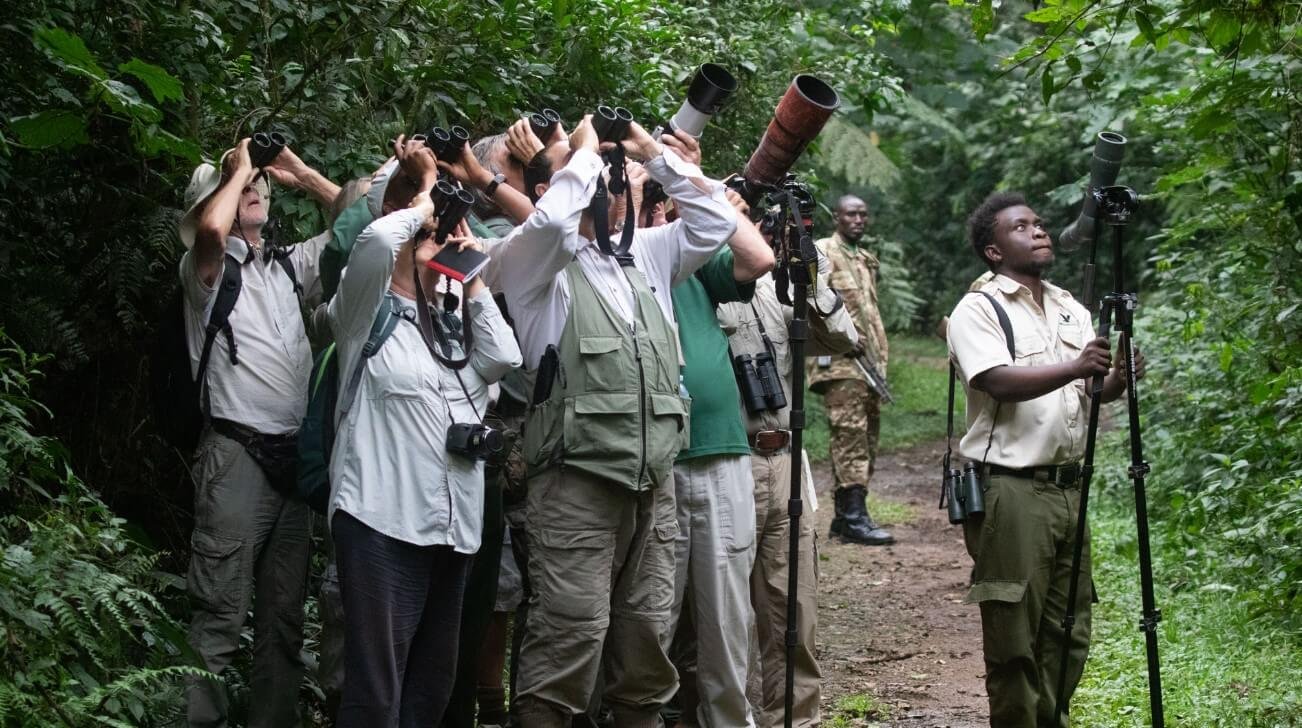
Binoculars that perform well in lower-light conditions can therefore be particularly useful.
A configuration such as 8×42 is popular among many birdwatchers because it combines useful magnification with a relatively bright image and manageable field of view.
A wider field of view can also make it easier to locate small birds moving rapidly through foliage.
Camera Rain Protection
If you are carrying a camera into the forest, assume that rain is possible.
Use a dedicated camera rain cover, waterproof pouch or other suitable protective system.
A microfiber lens cloth is also worth carrying for dealing with moisture on exterior optical surfaces.
Drinking Water
Forest birding can involve several hours of walking.
Carry sufficient drinking water for the planned activity while keeping the overall weight of your daypack manageable.
Forest Birding vs Savannah Birding
In forests, priorities tend to be waterproofing, footwear, lightweight layers and good low-light optics.
In savannah environments, sun protection, heat management and longer-distance observation become more important.
Packing according to habitat rather than using exactly the same setup everywhere can make your safari considerably more comfortable.
What to Pack for Wetland Birding and Shoebill Tours
Uganda’s wetlands offer a very different birding experience from its forests.
Destinations such as Mabamba Wetland are particularly associated with searches for the iconic Shoebill, while areas such as Bigodi Wetland Sanctuary offer opportunities to combine wetland and forest-edge birding.
A typical wetland birding kit should include:
- Binoculars
- Camera
- Telephoto lens
- Hat
- Sunscreen
- Lightweight rain jacket
- Drinking water
- Waterproof phone protection
- Waterproof camera protection
- Small dry bag
- Field guide or bird identification app
Binoculars for Wetland Birding
Wetlands frequently offer longer viewing distances than forests.
Binoculars help scan reeds, papyrus edges, open water and surrounding vegetation for birds.
A spotting scope may also be useful for specialist birders where observation conditions and the activity permit it.
Camera and Telephoto Lens
Wetlands can provide excellent opportunities for bird photography.
A telephoto lens helps photograph birds without needing to approach them unnecessarily closely.
Keep your camera ready because opportunities can appear quickly.
Protect Equipment During Canoe and Boat Excursions
Water protection deserves special attention whenever your birding excursion involves a canoe or boat.
Keep vulnerable electronics in waterproof pouches or dry bags when they are not being used.
Camera straps should be secure, and small items such as memory cards and spare batteries should be stored safely rather than loosely in pockets.
Avoid unnecessarily changing lenses while exposed to water, spray, dust or rain.
Sun Protection
Wetland excursions can involve extended exposure to direct sunlight.
Pack:
- Sunscreen
- Hat
- Sunglasses
- Drinking water
- Lightweight breathable clothing
Even when the morning begins cloudy, sun protection should remain accessible.
Suggested image: shoebill-birding-mabamba-packing.jpg

Alt text: Birdwatching equipment for a Shoebill tour at Mabamba Wetland Uganda
What to Pack for Savannah Birding Safaris
Uganda’s savannah national parks add another dimension to a birding itinerary.
Important destinations include:
- Murchison Falls National Park
- Queen Elizabeth National Park
- Lake Mburo National Park
- Kidepo Valley National Park
Birding in these areas may take place from a safari vehicle, during approved guided activities, at viewpoints or around water bodies.
The open landscape makes sun and heat protection particularly important.
Essential Savannah Birding Gear
Consider packing:
- Binoculars
- Camera and telephoto lens
- Field guide
- Bird checklist
- Hat
- Sunglasses
- Sunscreen
- Lightweight breathable clothing
- Water
- Light fleece for early mornings
- Rain jacket
- Small daypack
Keep Binoculars Accessible
Do not place your binoculars in luggage at the back of the safari vehicle.
Birding opportunities can appear suddenly. Raptors may fly overhead, a colorful species may perch beside the track, or a guide may spot something in the distance.
Keep binoculars within easy reach.
The same applies to your camera.
Prepare for Early Starts
Morning birding can begin when temperatures are relatively cool.
A lightweight fleece or sweater can be useful during the first part of a game drive and removed as temperatures increase.
What to Pack for High-Altitude Birding
Some of Uganda’s most exciting birding areas occur at higher elevations.
Bwindi, Mgahinga and the Rwenzori region can experience cooler conditions than lower-lying wetlands and savannahs, particularly early in the morning, during rainfall and at higher elevations.
Pack Warm Layers
Rather than bringing one very heavy jacket, use layers.
A practical combination might include:
- Lightweight base shirt
- Long-sleeved shirt
- Fleece
- Waterproof outer jacket
Layers can be removed as temperatures rise.
Waterproof Clothing
Montane conditions can change quickly.
A reliable waterproof jacket and quick-drying trousers are particularly useful.
Reliable Footwear
Good hiking footwear becomes increasingly important on steep, muddy or uneven trails.
Traction and comfort should take priority over appearance.
Albertine Rift Birding
The Albertine Rift is an important focus for specialist birders visiting southwestern Uganda.
Birders visiting destinations such as Bwindi and Mgahinga may be searching for regional specialties while navigating forest and montane environments.
This makes good optics, waterproof clothing, suitable hiking footwear and a lightweight daypack particularly valuable.
Combining Birding and Gorilla Trekking
Bwindi and Mgahinga also create opportunities to combine birdwatching with mountain gorilla trekking.
Travelers planning both activities can use much of the same practical clothing:
- Hiking boots
- Long trousers
- Long-sleeved shirts
- Rain jacket
- Daypack
- Water
However, check the specific requirements and guidance for each booked activity before departure.
Packing for a 1-Day vs Multi-Day Uganda Birding Safari
The duration of your safari has a major influence on what you need to pack.
One-Day Birding Tour
For a one-day excursion, keep equipment simple.
The essentials usually include:
- Binoculars
- Camera
- Field guide or birding app
- Water
- Rain jacket
- Hat
- Sunscreen
- Insect repellent
- Notebook/checklist
- Personal medication
For a wetland excursion, add waterproof protection for your electronics.
There is little benefit in carrying equipment you are unlikely to use during a few hours in the field.
3–7 Day Uganda Birding Safari
A multi-day itinerary requires more preparation.
In addition to everyday birding equipment, consider:
- Sufficient lightweight clothing
- Second pair of footwear
- Spare camera batteries
- Extra memory cards
- Power bank
- Charging cables
- Travel adapter
- Laundry considerations
- Personal toiletries
- First-aid essentials
- Document backups
- Equipment cleaning supplies
Avoid packing seven completely different field outfits simply because you are traveling for seven days. Lightweight clothing that can be washed and reused helps control luggage weight.
14–21+ Day Specialist Birding Safari
A specialist expedition lasting two or three weeks requires more careful organization.
Your equipment may include:
- Primary binoculars
- Field guide
- Digital birding resources
- Detailed checklist
- Camera equipment
- Several batteries
- Multiple memory cards
- Portable backup storage
- Camera cleaning kit
- Lens cloths
- Rain protection
- Several lightweight clothing layers
- Hiking boots
- Backup walking shoes
- Power bank
- Chargers and cables
- Personal medication
- Secure document storage
Photographers should establish a regular backup routine during longer safaris rather than allowing thousands of photographs to accumulate on one memory card.
Travelers interested in an extended itinerary can internally link this section to the Wild Planet Safaris 21 Days Uganda Specialist Birding Safari.
What NOT to Pack for a Uganda Birding Safari
Knowing what to leave behind can be just as important as knowing what to bring.
Excessive Luggage
Large amounts of luggage can become inconvenient during an itinerary involving frequent lodge changes and vehicle transfers.
Pack for practicality rather than every possible scenario.
Too Many Heavy Camera Accessories
Photography equipment can quickly become the heaviest part of your luggage.
Think realistically about what you will use.
Three lenses that remain in the vehicle for the entire safari provide little benefit while adding considerable weight.
Uncomfortable New Footwear
Never make a demanding forest walk the first time you wear new hiking boots.
Break footwear in before departure.
Excessive Brightly Colored Field Clothing
Bright clothing is unnecessary for most field birding.
Neutral, practical clothing is generally easier to integrate into a safari wardrobe and less conspicuous during wildlife observation.
Unnecessary Valuables
Leave expensive jewelry and other valuables that have no practical safari purpose at home where possible.
Equipment You Have Never Tested
A Uganda safari is not the ideal place to discover that you do not understand your new camera’s autofocus system or that your binoculars are uncomfortable after 30 minutes.
Test equipment before departure.
Excessive Single-Use Items
Where practical, choose reusable alternatives.
A refillable water bottle, reusable dry bags and durable travel containers can reduce unnecessary waste while also helping keep your equipment organized.
Packing Tips for Bird Photographers
Bird photographers have additional equipment requirements, but careful organization is essential.
The objective should be to have the equipment you need ready when the bird appears.
Camera Cleaning Kit
Dust, moisture and everyday handling can affect camera equipment.
A compact cleaning kit might include:
- Lens blower
- Appropriate lens-cleaning materials
- Microfiber cloth
- Protective storage pouch
Avoid unnecessary sensor cleaning in field conditions unless you know how to perform it safely.
Lens Cloth
Carry more than one clean microfiber cloth.
Keep at least one in a dry location so you have a clean cloth available if another becomes wet or dirty.
Lens Hood
A lens hood can help manage stray light and also provides some physical protection to the front of the lens.
Make sure it fits securely before traveling.
Rain Cover
A dedicated camera rain cover is highly recommended for photographers spending time in Uganda’s forests.
Keep it accessible rather than packed in your main suitcase.
Extra Memory Cards
Carry enough memory capacity for the entire safari, with additional capacity as a safety margin.
High-resolution RAW images and burst sequences can consume storage quickly.
Store cards in a protective case and develop a clear system for distinguishing empty cards from cards containing photographs.
Multiple Batteries
Begin each day with charged batteries.
On productive photography days, autofocus, image stabilization and high-speed shooting can consume power quickly.
Carry spare batteries safely according to the manufacturer’s and airline’s requirements.
Portable Backup Storage
For long birding safaris, consider a method of creating additional copies of important photographs.
Depending on your workflow, this could involve a laptop, portable storage device or another suitable backup method.
The principle is more important than the specific technology: do not rely on a single copy of irreplaceable safari photographs whenever a practical backup is available.
Beanbag
A beanbag can be extremely useful for photographing birds from a safari vehicle.
It provides support for a long lens without requiring the space of a full tripod.
Comfortable Camera Strap
A heavy camera becomes uncomfortable surprisingly quickly.
A comfortable strap or appropriate carrying system can distribute weight more effectively during long birding sessions.
Test your carrying setup before traveling.
Keep Photography Equipment Accessible in the Safari Vehicle
Do not pack your primary camera inside a closed suitcase during game drives.
Bird photography opportunities often last only seconds.
Arrange frequently used equipment so you can safely reach:
- Camera
- Binoculars
- Spare battery
- Memory card
- Lens cloth
- Field guide
without repeatedly unpacking luggage.
At the same time, avoid leaving loose cameras, lenses and other equipment where they could fall or become damaged as the vehicle moves.
Final Photography Packing Principle
More equipment does not automatically produce better bird photographs.
A camera and lens combination that you can carry comfortably, operate quickly and protect from Uganda’s variable weather is often more useful than a large collection of equipment that slows you down.
For photography-focused trips, inform Wild Planet Safaris during itinerary planning. A bird photographer may benefit from a different pace than a traveler primarily interested in building a species checklist, with more time allocated to observation, positioning and waiting for suitable photographic opportunities.
How to Pack Your Birding Equipment for International Flights
Preparing your Uganda Bird Watching Safari Packing List should begin before you arrive in Uganda. Cameras, binoculars, lenses, batteries and other specialist equipment can be expensive, fragile and difficult to replace during a safari, so careful packing for your international flight is important.
Where airline rules permit, keep your most valuable and delicate birding equipment in your cabin baggage rather than checked luggage.
Cameras and Lenses
Camera bodies and lenses are usually among the most valuable items a bird photographer carries.
Use padded compartments or a dedicated camera bag to prevent equipment from moving around during travel. Lens caps and body caps should be securely fitted, and heavier equipment should be arranged so that it does not press against smaller accessories.
Before departure, check that your camera bag complies with your airline’s current cabin baggage dimensions and weight limits.
These restrictions differ between airlines and ticket classes, so never assume that a camera backpack accepted by one airline will automatically be accepted by another.
Binoculars
Binoculars are another item worth protecting carefully.
They are precision optical instruments and should be stored in a protective case or padded section of your hand luggage.
Avoid placing heavy objects directly on top of them.
Keeping binoculars in your cabin baggage also means they are immediately available if your checked luggage is delayed.
Batteries and Power Banks
Camera batteries and power banks require particular attention because airlines regulate the transport of lithium batteries.
Requirements may specify:
- Whether batteries must travel in cabin baggage
- How spare batteries should be protected
- Battery capacity limits
- Rules for power banks
- Restrictions on damaged batteries
Do not rely on a generic safari packing guide for these requirements.
Check the current battery policy of every airline operating your flights before departure, particularly if your journey includes multiple carriers.
Protect spare battery terminals from accidental short circuits and follow the airline’s instructions for transporting them.
Memory Cards
Memory cards are tiny, valuable and easy to lose.
Store them in a dedicated protective case rather than loose in a camera bag or pocket.
Develop a simple organization system so you can distinguish:
- Empty cards
- Cards currently being used
- Cards containing photographs that have not yet been backed up
- Cards containing backed-up photographs
For longer birding safaris, carrying several cards can provide more flexibility than relying entirely on one storage device.
Important Documents
Keep essential documents securely accessible during international travel.
These may include:
- Passport
- Visa/eVisa documentation where applicable
- Flight confirmations
- Travel insurance information
- Safari confirmation
- Accommodation details
- Emergency contact information
- Copies of important documents
Digital copies can provide useful backup, but make sure essential information can be accessed even when you do not have an internet connection.
Personal Medication
Essential medication should be packed carefully and carried according to airline and destination requirements.
If you rely on prescription medication, bring an appropriate supply for your trip and obtain professional advice where necessary regarding documentation, storage or transportation requirements.
Before Leaving for the Airport
Carry out a final equipment check:
- Is the camera working?
- Are batteries charged?
- Are memory cards packed?
- Are binoculars protected?
- Is the Type G adapter packed?
- Are chargers included?
- Is the power bank charged?
- Are important documents accessible?
- Is essential medication packed?
- Does the cabin bag meet airline restrictions?
A few minutes spent checking equipment at home can prevent significant inconvenience later.
Uganda Bird Watching Safari Packing List by Category
Use this master checklist while preparing for your trip. Not every traveler will require every item, so adjust it according to your itinerary, season, destinations and personal birding interests.
Birding Equipment
☐ Binoculars
☐ Uganda/East Africa bird field guide
☐ Bird identification app
☐ Bird checklist
☐ Notebook and pens
☐ Spotting scope if appropriate
☐ Lightweight tripod for scope if required
☐ Binocular strap or harness
Photography Equipment
☐ Camera body
☐ Telephoto lens
☐ Appropriate additional lens if required
☐ Spare camera batteries
☐ Battery charger
☐ Extra memory cards
☐ Memory-card case
☐ Camera rain cover
☐ Lens hood
☐ Lens cloths
☐ Camera cleaning kit
☐ Beanbag, monopod or tripod where appropriate
☐ Comfortable camera strap
☐ Portable backup solution for longer trips
Clothing
☐ Lightweight long-sleeved shirts
☐ Lightweight long trousers
☐ Neutral-colored field clothing
☐ Fleece or light sweater
☐ Comfortable clothes for evenings
☐ Underwear
☐ Comfortable socks
☐ Sun hat or wide-brimmed hat
☐ Sleepwear
Footwear
☐ Waterproof hiking boots
☐ Comfortable walking shoes
☐ Gaiters for forest birding if desired
☐ Sandals or lightweight casual footwear
Weather Protection
☐ Lightweight waterproof rain jacket
☐ Poncho if preferred
☐ Backpack rain cover
☐ Dry bags
☐ Waterproof electronics pouch
☐ Resealable bags
☐ Quick-drying clothing
☐ Camera rain protection
Health and Personal Items
☐ Prescription medication
☐ Small personal first-aid kit
☐ Insect repellent
☐ Sunscreen
☐ Sunglasses
☐ Hand sanitizer
☐ Tissues
☐ Lip balm
☐ Personal toiletries
☐ Rehydration products if personally required
☐ Travel insurance information
Documents
☐ Passport
☐ Uganda visa/eVisa documents where required
☐ Travel insurance documents
☐ Flight confirmations
☐ Safari itinerary
☐ Accommodation information
☐ Emergency contacts
☐ Copies of passport and important documents
☐ Activity permits where applicable
☐ Payment cards
☐ Appropriate cash
Electronics
☐ Smartphone
☐ Type G Uganda travel adapter
☐ Power bank
☐ Camera charger
☐ Phone charger
☐ USB cables
☐ Headlamp or small torch
☐ Spare torch batteries if required
☐ Laptop/tablet and charger if genuinely needed
Daypack Essentials
☐ Binoculars
☐ Camera
☐ Spare camera battery
☐ Extra memory card
☐ Field guide or birding app
☐ Bird checklist
☐ Notebook and pen
☐ Drinking water
☐ Rain jacket
☐ Sunscreen
☐ Insect repellent
☐ Hat
☐ Small snack where appropriate
☐ Lens cloth
☐ Essential medication
☐ Waterproof pouch or small dry bag
Packing tip: Do not automatically carry every item from your main luggage into the field. Prepare your daypack each morning according to the destination and planned activities.
Why Book Your Uganda Birding Safari with Wild Planet Safaris?
A successful birding safari depends on more than carrying the right binoculars and clothing. The route, habitats visited, time allocated to each destination and interests of the individual traveler can all influence the experience.
Wild Planet Safaris can plan Uganda birding itineraries around different travel durations and interests, including dedicated birdwatching, bird photography and combinations with Uganda’s other wildlife experiences.
Customized Birding Itineraries
Not every birdwatcher travels with the same objectives.
Some visitors may have only a few days and want to concentrate on a small number of productive birding areas. Others may want a longer journey through forests, wetlands, savannahs and montane habitats.
An itinerary can be planned according to factors such as:
- Number of available days
- Arrival and departure points
- Preferred destinations
- Target habitats
- Particular bird interests
- Photography priorities
- Desired travel pace
- Other safari activities
A traveler interested primarily in forest birds, for example, may spend more time around Bwindi, Kibale, Budongo or other forest habitats, while someone interested in combining many habitat types may include wetlands and savannah national parks as well.
Target-Species Birding
Experienced birdwatchers often arrive in Uganda with a list of species they particularly hope to see.
Target-species planning starts by considering where those birds occur, their preferred habitats and how those locations can fit logically into the safari route.
Depending on the itinerary and current conditions, birding interests may include species associated with:
- Albertine Rift forests
- Papyrus wetlands
- Tropical forests
- Savannahs
- Lakes and river systems
- Montane environments
Travelers can send Wild Planet Safaris their target bird list during the planning stage so that relevant destinations and habitats can be considered when designing the itinerary.
Wildlife sightings can never be guaranteed, but careful route planning can ensure that the safari visits appropriate habitats for the species being sought.
Private Uganda Birding Safaris
Private arrangements can provide useful flexibility for birdwatchers.
Instead of following the pace of a large general-interest group, a private birding itinerary can allow more time for observation, photography and bird identification.
This can be particularly valuable when:
- Waiting for a difficult forest bird
- Photographing a particular species
- Checking mixed-species flocks
- Making roadside birding stops
- Spending longer at productive wetlands
- Following an individual target list
Photographers may also prefer a slower pace because obtaining a photograph often requires considerably more time than simply confirming a sighting.
Birding and Gorilla Trekking Safaris
Uganda provides opportunities to combine birdwatching with mountain gorilla trekking.
Bwindi Impenetrable National Park is particularly important because travelers can include both forest birding and gorilla trekking within the wider itinerary.
Mgahinga Gorilla National Park can also form part of a southwestern Uganda journey combining birding with primate experiences.
These combinations work particularly well for travelers who want more than one major wildlife experience without abandoning specialist birding interests.
The same practical equipment—including hiking boots, long trousers, rain protection and a comfortable daypack—can be useful for both activities, although travelers should prepare according to the specific requirements of each excursion.
Birding, Chimpanzee and Wildlife Combinations
Birdwatching can also be incorporated into a broader Uganda wildlife itinerary.
Depending on the route, a safari can combine birding with:
- Chimpanzee tracking
- Gorilla trekking
- Savannah game drives
- Boat safaris
- Guided nature walks
- Wetland excursions
- Primate experiences
For example, a longer itinerary might combine forest birding with primate experiences before continuing to Queen Elizabeth or Murchison Falls for savannah birds and traditional wildlife viewing.
This approach can be particularly suitable for couples, families or groups where travelers have different wildlife interests.
Plan Your Uganda Birding Safari
Planning a Uganda birding safari? Send Wild Planet Safaris your travel dates, preferred destinations and target bird list, and we can help you plan an itinerary around your birding interests.
CTA: SEND US YOUR TARGET BIRD LIST
Frequently Asked Questions About Packing for a Uganda Birding Safari
What should I pack for a birding safari in Uganda?
The essentials include binoculars, suitable field clothing, comfortable walking or hiking footwear, rain protection, a field guide or birding app, drinking water, sunscreen, insect repellent and a lightweight daypack.
Bird photographers should also consider a camera, telephoto lens, spare batteries, memory cards and weather protection for their equipment.
Your final packing list should reflect your itinerary. Forest birding requires more emphasis on waterproof footwear and rain protection, while wetland and savannah birding requires stronger preparation for sun exposure.
What are the best binoculars for birdwatching in Uganda?
There is no single binocular specification that is ideal for every traveler, but 8×42 and 10×42 binoculars are common birdwatching choices.
An 8×42 model can provide a useful combination of brightness, field of view and manageable magnification, making it particularly practical for forest birding.
A 10×42 model provides additional magnification that some birders prefer for open wetlands and savannah environments.
Comfort, optical quality, weather resistance and familiarity with your binoculars are more important than simply choosing the highest magnification.
Do I need a spotting scope for a Uganda birding safari?
Not necessarily.
Binoculars are sufficient for many birdwatchers and are much easier to carry.
A spotting scope can, however, be valuable for specialist birding around wetlands, lakes and open habitats where birds may be observed at considerable distances.
If your itinerary is heavily focused on forest birding, the additional weight of a scope and tripod may not always justify carrying them.
What clothes should I wear for birdwatching in Uganda?
Wear lightweight, comfortable and breathable field clothing.
Long trousers and long-sleeved shirts provide useful protection from sunlight, insects and vegetation.
Neutral shades such as khaki, olive, beige, brown and grey are practical for wildlife observation.
Also pack a fleece or light sweater for cooler mornings and higher-altitude destinations.
What shoes are best for birdwatching in Uganda?
Waterproof hiking boots with good traction are particularly useful for forest birding in destinations such as Bwindi and Mgahinga.
For easier trails, lodge grounds and less demanding excursions, comfortable walking shoes may be sufficient.
Whatever footwear you choose, break it in before traveling.
Do I need waterproof clothing for birding in Uganda?
Yes, carrying lightweight rain protection is advisable.
Rain can occur in Uganda’s tropical and montane environments even outside the wetter periods.
A waterproof jacket, backpack rain cover and suitable protection for cameras and electronics can be particularly useful during forest birding.
What camera lens is suitable for bird photography in Uganda?
A telephoto lens is useful because many birds are small or cannot be approached closely.
There is no single focal length that every photographer must carry. Your choice should balance reach, image quality, weight and portability.
For forest birding involving significant walking, a lighter telephoto setup can be easier to manage than very large professional lenses.
What should I pack for birding in Bwindi?
For birding in Bwindi, prioritize:
- Binoculars with good low-light performance
- Waterproof hiking boots
- Long trousers
- Long-sleeved shirt
- Rain jacket
- Gaiters if desired
- Small daypack
- Water
- Field guide
- Camera rain protection
- Light fleece or sweater
Bwindi’s forest environment can be cool, wet, muddy and shaded, so waterproofing and reliable footwear deserve particular attention.
What should I bring for a Shoebill tour at Mabamba Wetland?
For a Mabamba Shoebill excursion, consider bringing:
- Binoculars
- Camera and telephoto lens
- Hat
- Sunscreen
- Sunglasses
- Drinking water
- Lightweight rain jacket
- Waterproof pouch
- Dry bag for electronics
- Field guide or birding app
Because birding may involve travel on the water, protect cameras, phones and other electronics from splashes and rain.
Should I bring a bird field guide to Uganda?
A Uganda or East Africa bird field guide can be extremely useful, particularly for travelers interested in identifying species independently.
You may choose a printed guide, digital guide or both.
If relying on a digital resource, download the required content for offline use before traveling because mobile connectivity may be limited in some birding areas.
What should I carry in my birding daypack?
Keep your daypack light.
A practical setup includes binoculars, camera, field guide, phone, rain jacket, water, sunscreen, insect repellent, notebook, spare battery, memory card, essential medication and a waterproof pouch.
Avoid filling the bag with equipment you are unlikely to use that day.
How much luggage should I bring on a Uganda birding safari?
Pack as lightly as your itinerary reasonably allows.
Longer safaris often involve repeated transfers between destinations, so excessive luggage can become inconvenient.
Lightweight clothing that can be washed and reused, versatile footwear and carefully selected camera equipment are usually more practical than bringing multiple alternatives for every situation.
Always check the baggage limits applying to your international flights and any regional or domestic transport included in your journey.
Final Uganda Bird Watching Safari Packing Checklist
Before closing your suitcase, use this shorter checklist for one final review:
☐ Binoculars
☐ Field guide/birding app
☐ Camera and telephoto lens
☐ Batteries and memory cards
☐ Lightweight daypack
☐ Long-sleeved shirts
☐ Long trousers
☐ Fleece/light sweater
☐ Waterproof hiking boots
☐ Comfortable second pair of shoes
☐ Rain jacket
☐ Hat and sunglasses
☐ Sunscreen
☐ Insect repellent
☐ Water bottle
☐ Personal medication
☐ Type G travel adapter
☐ Chargers and cables
☐ Power bank
☐ Headlamp
☐ Passport
☐ Visa documentation where applicable
☐ Travel insurance
☐ Safari itinerary
☐ Required activity documents
☐ Copies of important travel documents
A carefully prepared Uganda Bird Watching Safari Packing List helps you stay comfortable and organized while moving between Uganda’s forests, wetlands, savannahs and montane birding habitats.
The goal is not to carry as much equipment as possible. It is to bring the right equipment for your itinerary—reliable binoculars, practical clothing, suitable footwear, weather protection and the photography or identification tools you genuinely expect to use.
Ready to Plan Your Uganda Birding Safari?
Whether you are planning a short birdwatching extension, a dedicated multi-day safari or a longer specialist expedition, Wild Planet Safaris can help structure an itinerary around your available time, preferred destinations and birding interests.
Send us your travel dates, number of travelers and target bird list to start planning your Uganda birding safari.
CTA: PLAN MY UGANDA BIRDING SAFARI