
Ultimate Uganda Birding Safari Guide: Everything You Need to Know
Uganda is an exceptional destination for travelers who want to experience African birdlife across remarkably varied landscapes. Within one journey, birdwatchers can move from papyrus-fringed wetlands and the shores of Lake Victoria to tropical forests, Albertine Rift highlands, open savannahs, acacia woodland and the drier landscapes of northeastern Uganda.
This variety allows a Uganda birding safari to be much more than simply adding species to a checklist. A carefully designed itinerary can include early-morning forest birding, canoe excursions through wetlands, boat trips along wildlife-rich waterways, savannah game drives, mountain trails and searches for highly sought-after species.
Uganda Wildlife Authority describes the country as a year-round birding destination, particularly because much of the birding interest comes from resident species. It highlights Bwindi Impenetrable and Mgahinga Gorilla national parks for Albertine Rift endemics, while Semuliki provides access to many species associated with the Guinea-Congo region.
For travelers interested in combining birdwatching with other African wildlife experiences, Uganda offers another advantage. Birding itineraries can be combined with mountain gorilla trekking in Bwindi or Mgahinga, chimpanzee trekking around Kibale, boat safaris, game drives and general wildlife viewing.
This Ultimate Uganda Birding Safari Guide explains what you need to know when planning a birdwatching trip, including the best birding destinations, important species, suitable travel periods, recommended safari durations, different types of birding tours and practical equipment.
You will also discover how to combine birdwatching with gorilla trekking, chimpanzee trekking and traditional wildlife safaris, as well as how Wild Planet Safaris can help customize an itinerary around your target species, available time and preferred destinations.
Why Choose Uganda for a Birding Safari?
Uganda’s attraction to birdwatchers comes from the combination of diverse habitats within a relatively compact country. A single extended safari can include equatorial forests, mountains, wetlands, lakes, rivers, woodland and savannah.
That diversity is especially useful for birders who want to experience several different bird communities rather than concentrating on only one ecosystem.
Exceptional Bird Diversity
Uganda supports an impressive variety of birds, ranging from conspicuous waterbirds and savannah species to secretive forest birds.
However, birders should be cautious with claims that Uganda has an exact fixed number of species. Bird taxonomy changes as scientific research leads to species being split, lumped or renamed, while national checklists can also change as new records are accepted.
BirdLife International explains that different global taxonomic lists have historically recognized somewhat different sets of species. The first unified AviList was released in 2025, and BirdLife has said it is working toward alignment with that taxonomy.
For this reason, serious birders planning a target-species safari should use an up-to-date checklist close to their travel dates rather than relying entirely on an old published species total.
For current conservation and taxonomy information, travelers can consult BirdLife International DataZone and Uganda’s BirdLife partner, Nature Uganda.
Remarkable Habitat Diversity
One of Uganda’s greatest strengths as a birding destination is the variety of ecosystems that can be incorporated into one itinerary.
Montane Forests
Southwestern Uganda contains important montane and highland forest habitats. Bwindi and Mgahinga are particularly important for birders interested in species associated with the Albertine Rift.
Uganda Wildlife Authority identifies both parks among the country’s most accessible areas for searching for Albertine Rift endemics.
Lowland and Tropical Forests
Uganda also offers birding in lower-elevation tropical forest environments.
Semuliki is particularly important because of its connection to the wider Guinea-Congo forest system. Uganda Wildlife Authority describes Semuliki as the only location in East Africa where many Guinea-Congo regional species can be encountered.
Kibale and Budongo add further opportunities for forest birding.
Papyrus Wetlands
Papyrus wetlands provide an entirely different birding environment.
These habitats can support birds adapted to dense wetland vegetation and make excellent additions to itineraries dominated by forests and savannahs.
Mabamba Bay on Lake Victoria is one of the best-known examples. Its extensive marsh includes large areas dominated by papyrus, and the wetland supports birds of international conservation importance.
Lakes and Rivers
Uganda’s numerous lakes, channels and rivers create excellent opportunities for waterbird observation.
Birders can explore environments associated with Lake Victoria, Lake Mburo, Lake Bunyonyi, the Kazinga Channel and the Nile.
Boat-based birding can be particularly productive because it allows travelers to observe species associated with shorelines, open water, papyrus, riverbanks and waterside vegetation.
Savannah Grasslands
Uganda’s savannah national parks add an entirely different collection of birds.
Queen Elizabeth, Murchison Falls, Lake Mburo and Kidepo Valley can produce raptors, ground birds, grassland species, kingfishers, bee-eaters, hornbills and numerous other groups.
These destinations also make it easy to combine birdwatching with traditional African wildlife viewing.
Acacia Woodland
Acacia-dominated environments provide another valuable habitat.
Lake Mburo National Park is particularly useful for adding woodland and savannah species to an itinerary that has already covered Uganda’s forests and wetlands.
Albertine Rift Highlands
For specialist birders, the Albertine Rift is one of the most important reasons to visit southwestern Uganda.
Mountain ranges, valleys and isolated highland forests have created habitats occupied by birds with comparatively restricted geographical distributions.
Bwindi is particularly significant. Uganda Wildlife Authority reports more than 350 bird species in the park, including 23 Albertine Rift endemics, and specifically mentions species such as the African Green Broadbill and Shelley’s Crimsonwing.
Semi-Arid Northeastern Uganda
Traveling to northeastern Uganda introduces yet another birding environment.
Kidepo Valley’s drier landscapes allow a longer Uganda birding itinerary to include species associated with environments quite different from the humid forests of the southwest.
This geographical contrast is one reason longer birding expeditions can be particularly rewarding.
Uganda’s Location Between Different Ecological Regions
Uganda’s geographic position helps explain its varied birdlife.
The country sits where different African ecological influences meet. Birders can encounter species associated with East African savannah environments alongside birds connected with Central African forests and the highlands of the Albertine Rift.
A well-designed itinerary therefore focuses not simply on visiting as many national parks as possible, but on selecting destinations that represent different habitats.
For example, an extended route might combine:
Mabamba Wetland → Murchison Falls/Budongo → Kibale/Bigodi → Queen Elizabeth → Bwindi → Mgahinga → Lake Mburo.
Each stop adds a different habitat and therefore a different birding experience.
Albertine Rift Birding
The Albertine Rift should be a major consideration for experienced birders planning a Uganda safari.
This branch of the East African Rift extends through parts of several countries, and its mountains and forests support numerous restricted-range species.
In Uganda, Bwindi Impenetrable National Park and Mgahinga Gorilla National Park are particularly important.
Bwindi’s forests support birds such as the African Green Broadbill and other Albertine Rift specialties, while Mgahinga provides montane and bamboo-associated habitats. Uganda Wildlife Authority specifically highlights both parks as important accessible locations for Albertine Rift endemic birding.
A specialist itinerary may therefore dedicate several days to southwestern Uganda instead of treating Bwindi merely as a one-night stop before gorilla trekking.
Birding Beyond the Checklist
A successful Uganda birding safari does not have to revolve entirely around maximizing a species total.
The same journey can include:
- Mountain gorilla trekking
- Chimpanzee trekking
- Game drives
- Boat safaris
- Nature walks
- Bird photography
- Primates
- Mammals
- Wetland excursions
- Forest walks
- Community-based tourism experiences
- Scenic landscapes
This makes Uganda particularly suitable for couples, families and small private groups where not everyone has the same level of birding experience.
An experienced birder may spend considerable time searching for a particular forest species while another traveler is equally interested in primates, landscapes or photography.
A customized itinerary can balance those interests.
How Good Is Birdwatching in Uganda?
Uganda can suit everyone from travelers buying their first pair of binoculars to experienced birders arriving with detailed target lists.
The key is choosing the right itinerary.
A beginner does not necessarily need the same route as a specialist looking for Albertine Rift species, and a photographer may need significantly more time at individual locations than someone primarily interested in maintaining a checklist.
Uganda for First-Time African Birders
Uganda can be a rewarding introduction to African birdwatching because many different bird families can be encountered within a single trip.
A first-time birder might begin with conspicuous species around wetlands, waterways and savannahs before progressing to more challenging forest birding.
Species such as kingfishers, bee-eaters, hornbills, African Fish Eagles, African Jacanas and Great Blue Turacos can provide memorable sightings while the traveler gradually becomes familiar with less conspicuous species.
A beginner-focused itinerary should generally emphasize:
- Comfortable pacing
- Different habitats
- Time for identification
- Good viewing opportunities
- Photography
- Wildlife and primate combinations
- Fewer long transfer days
There is no requirement to arrive with advanced identification skills. A guided safari can also serve as a practical introduction to African bird families, habitats, calls and field identification.
Uganda for Experienced Birdwatchers
Experienced birders can approach Uganda very differently.
Instead of concentrating on easily observed species, the itinerary can be built around particular habitats and a predetermined target list.
Priority areas might include:
- Bwindi for Albertine Rift forest species
- Mgahinga for montane and bamboo-associated birds
- Semuliki for Guinea-Congo-associated species
- Kibale for specialist forest birding
- Mabamba for wetland birds and Shoebill
- Kidepo for dry-country species
- Murchison Falls and Lake Mburo for savannah and woodland birding
Experienced birders should consider spending multiple nights in important forest destinations. Difficult forest birds may require repeated searches, favorable weather and considerable patience.
Uganda for Bird Photographers
Bird photography requires a somewhat different safari rhythm.
Finding a bird is not the same as obtaining a good photograph of it.
A photographer may need additional time to wait for:
- Better light
- An unobstructed perch
- Closer positioning
- Interesting behavior
- A suitable background
- A bird to emerge from dense vegetation
Wetlands and open habitats can sometimes offer easier photography conditions than dense tropical forests.
Boat excursions can also provide valuable opportunities for photographing waterbirds, kingfishers, herons, African Fish Eagles and other species associated with waterways.
Uganda for Target-Species Birding
Target-species birding reverses the usual approach to itinerary planning.
Instead of asking, “How many species can we see?”, the first question becomes:
“Which birds do you most want to find?”
The itinerary is then designed around the habitats and destinations associated with those targets.
Someone primarily interested in Shoebill may require a very different route from a birder targeting Albertine Rift species.
A serious target list should ideally be shared with Wild Planet Safaris before the itinerary is finalized so that suitable destinations and sufficient birding time can be considered.
No ethical birding operator should guarantee sightings of wild birds. Weather, season, habitat conditions, bird movement and simple chance can all influence results.
Uganda for Long Birding Expeditions
Travelers who want to experience Uganda’s birdlife in greater depth should consider a longer expedition.
A 14- to 21-day or longer birding safari creates opportunities to cover significantly more habitats without turning every day into a long-distance transfer.
A comprehensive itinerary might incorporate:
Mabamba → Murchison Falls → Budongo → Kibale → Bigodi → Queen Elizabeth → Bwindi → Mgahinga → Lake Mburo.
Additional time can be used to incorporate specialist locations or more distant destinations such as Kidepo and Semuliki.
Longer itineraries are particularly suitable for:
- Experienced birders
- Bird photographers
- Travelers with substantial target lists
- Repeat visitors
- Birding clubs
- Travelers combining birds with gorillas, chimpanzees and wildlife
Most Sought-After Birds to See in Uganda
Uganda’s appeal does not rest on one iconic species. Different ecosystems provide opportunities to search for dramatically different birds.
The following are among the species and groups that can shape a Uganda birding itinerary.
Shoebill
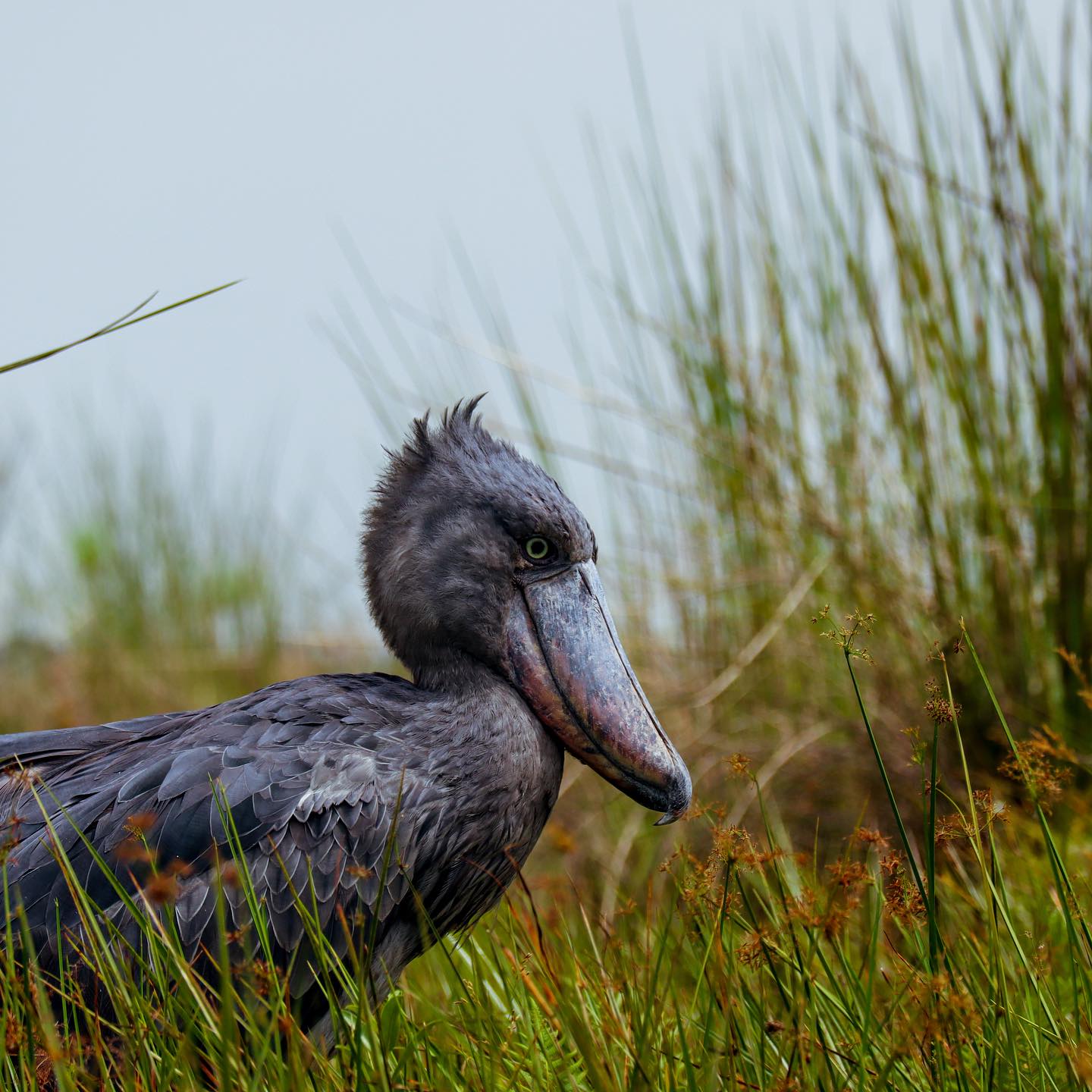
The Shoebill (Balaeniceps rex) is one of the most recognizable birds sought by visitors to Uganda.
Its enormous bill, prehistoric appearance and preference for extensive freshwater wetlands make encountering one a memorable birding experience.
Mabamba Bay Wetland on Lake Victoria is a major destination for Shoebill searches and is especially convenient for travelers starting or ending a safari around Entebbe.
Mabamba is a Ramsar wetland characterized by extensive marsh and papyrus habitat. Ramsar documentation identifies the Shoebill among the globally threatened birds supported by the wetland.
Birding is commonly conducted from small boats or canoes through channels in the wetland, allowing guides to search suitable feeding areas while birders also watch for numerous other wetland species.
The Shoebill should never be treated as guaranteed. It is a wild bird, and sightings depend on natural movements and conditions.
Green-breasted Pitta
The Green-breasted Pitta is a prized target for forest birders visiting Uganda.
Kibale National Park is strongly associated with searches for this secretive forest species.
Finding pittas can be considerably more challenging than observing conspicuous wetland or savannah birds. Dense vegetation, low light and seasonal behavior mean that birders may need patience, early starts and experienced local guidance.
For serious birders, this is a good reason not to rush Kibale.
Rather than arriving solely for chimpanzee trekking and departing immediately afterward, a specialist itinerary can allocate additional time for forest birding.
African Green Broadbill
The African Green Broadbill is one of the important targets associated with the Albertine Rift.
Bwindi is a particularly significant destination for birders interested in this species. Uganda Wildlife Authority includes the African Green Broadbill among the notable Albertine Rift birds occurring in the park.
Searching for specialist forest birds requires a different style of birding from watching waterbirds or savannah species.
Birders may spend extended periods walking slowly through forest habitat, listening carefully for calls and checking the canopy and understory.
This is one reason a serious Bwindi birding trip should allow adequate time.
Great Blue Turaco
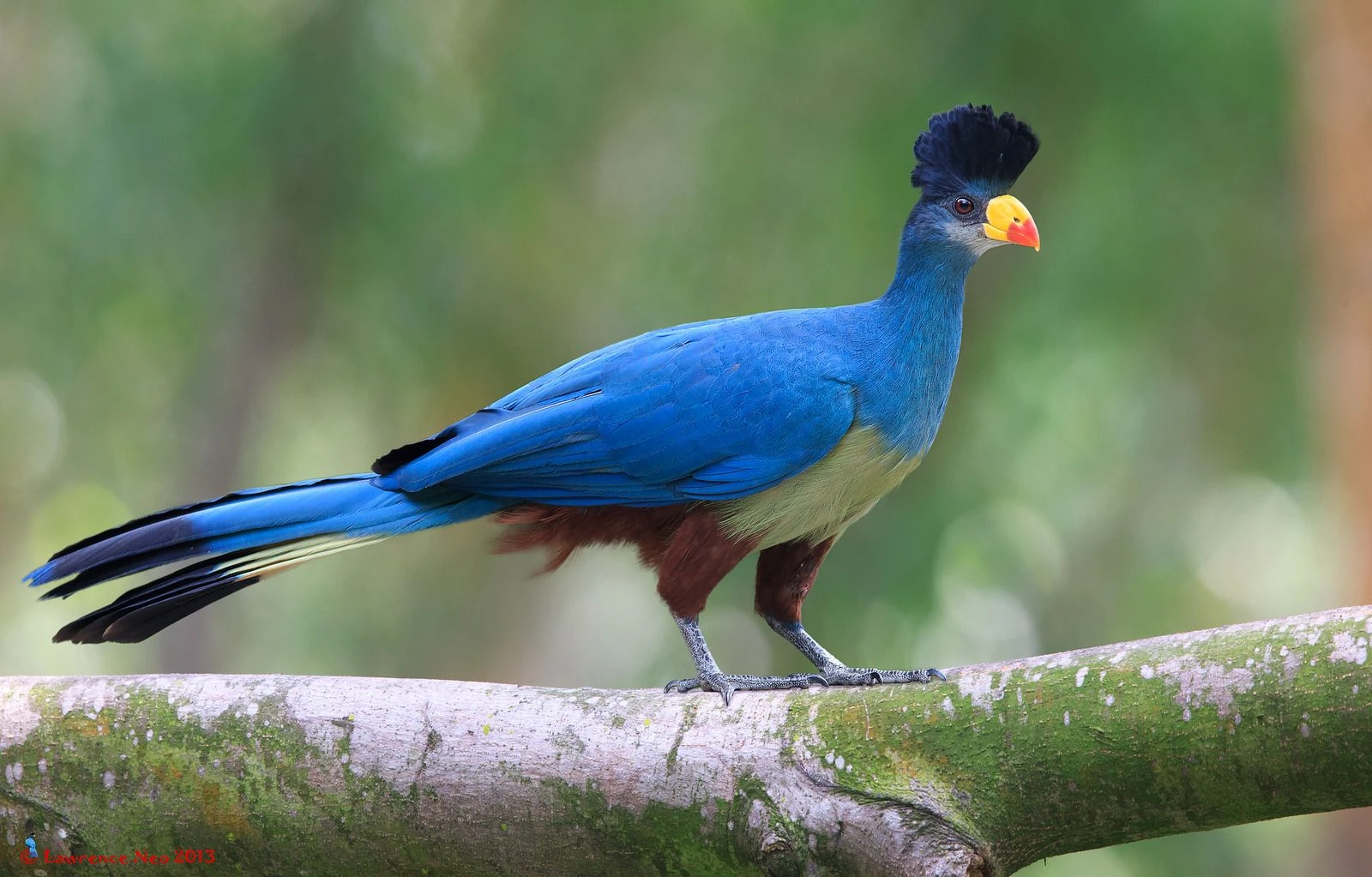
The Great Blue Turaco is one of Uganda’s most visually striking forest birds.
Its large size, colorful plumage and distinctive shape make it a memorable species for both experienced birders and first-time visitors.
It can be associated with several forested environments, making it an excellent representative of Uganda’s tropical forest birdlife.
Unlike some highly localized targets, the Great Blue Turaco can potentially be incorporated into broader forest-focused itineraries.
Rwenzori Turaco
The Rwenzori Turaco represents the highland character of southwestern Uganda’s birding.
It is associated with montane environments of the Albertine Rift and is therefore of particular interest to birders exploring Uganda’s higher-elevation forests and mountain habitats.
A search for species such as the Rwenzori Turaco can be combined with other Albertine Rift targets when designing routes through southwestern Uganda.
Papyrus Gonolek
The striking Papyrus Gonolek demonstrates why wetlands should not be treated simply as stops for waterbirds.
Papyrus specialists occupy dense wetland vegetation, and locating them often involves listening carefully for calls and patiently watching openings in the papyrus.
Including papyrus wetlands therefore adds an important habitat type to a Uganda birding itinerary.
A route containing forests, savannah and mountains but no wetland birding would miss an important component of the country’s avian diversity.
Grey Crowned Crane
The Grey Crowned Crane (Balearica regulorum) is Uganda’s national bird and one of the country’s most recognizable avian symbols.
Uganda’s 2026 State of Wildlife Resources report describes the first countrywide Grey Crowned Crane census, conducted in 2023. Survey teams visited 1,305 locations across 131 districts and recorded 10,077 cranes, with western and central Uganda identified as major strongholds. The report also highlights threats including wetland and grassland loss, agricultural chemicals, power-line collisions and illegal capture.
Seeing Grey Crowned Cranes in their natural environment therefore offers more than a photographic opportunity. It can also provide an introduction to the conservation challenges affecting wetlands and agricultural landscapes.

grey crowned cranes
Other Birds Worth Searching For
Uganda’s birding experience extends far beyond a handful of headline species.
Depending on the destinations included in your itinerary, birders can search for many additional species and groups.
African Finfoot is an attractive target associated with suitable wooded waterways and is of particular interest on itineraries incorporating places such as Lake Mburo.
Standard-winged Nightjar provides a completely different experience, demonstrating the value of considering evening and nocturnal birding where appropriate.
African Fish Eagles are among the most recognizable birds associated with Uganda’s lakes, rivers and channels.
African Jacanas can be encountered around suitable freshwater wetlands, where their elongated toes allow them to move across floating vegetation.
Malachite Kingfishers add brilliant color to wetland and waterside birding, while Pied Kingfishers are conspicuous around many aquatic environments.
Bee-eaters provide some of the most colorful sightings on savannah and open-country birding days.
Hornbills can be encountered across several habitat types, from forests to woodland and savannah depending on the species.
Sunbirds reward birders who pay attention to flowering vegetation and different elevation zones.
Weavers are another diverse group that beginners can enjoy learning to identify.
Barbets contribute their distinctive calls and colorful plumage to many birding environments.
And Uganda’s turacos are among the birds most likely to leave a lasting impression on first-time visitors because of their colors, vocalizations and association with forest environments.
The important point is not to attempt to see every possible bird in one safari. A better approach is to determine your priorities and then build the itinerary around the habitats most likely to provide the experience you want.
Planning Around Your Target Birds
Before booking a Uganda birding safari, consider creating three categories:
Priority birds – species you would particularly like to search for.
Secondary targets – species you would be pleased to encounter but would not redesign the entire itinerary around.
General birding interests – forest birds, raptors, wetland birds, photography, Albertine Rift species or simply seeing as much variety as possible.
Providing this information to Wild Planet Safaris can help shape a more purposeful itinerary.
A traveler whose main priorities are Shoebill, papyrus specialists and wetland photography may need a very different safari from someone whose priorities are African Green Broadbill, Rwenzori Turaco and other Albertine Rift-associated birds.
Wild Planet Safaris can customize a private Uganda birding safari around your available travel days, target birds, preferred habitats and additional interests such as gorilla trekking, chimpanzee trekking and wildlife viewing.
Best Birding Destinations in Uganda
Uganda’s birding strength comes from the ability to explore remarkably different habitats within one country. A well-planned Uganda birding safari can move from papyrus wetlands around Lake Victoria to lowland tropical forest, Albertine Rift montane forest, acacia woodland, open savannah, riverine habitat and high-altitude mountain ecosystems.
For birders, this means choosing destinations should not simply be about visiting the largest number of national parks. A stronger itinerary combines different habitats, giving travelers opportunities to search for different groups of birds.
Uganda Wildlife Authority highlights Murchison Falls for its broad variety of birds and sought-after species such as the Shoebill, Bwindi and Mgahinga as particularly accessible locations for Albertine Rift endemics, and Semuliki for species associated with the Guinea-Congo region.
The destinations below can form the foundation of anything from a short Uganda birding holiday to a comprehensive three-week expedition.
Bwindi Impenetrable National Park
Bwindi Impenetrable National Park should be high on the itinerary of birders interested in forest species and the Albertine Rift.
The park’s rugged terrain, elevation changes and extensive montane forest create excellent habitat for forest birds. Uganda Wildlife Authority reports about 350 bird species in Bwindi, including 23 Albertine Rift endemics.
For specialist birders, however, the attraction is not simply the total number. Bwindi provides opportunities to search for localized forest species that cannot be approached in the same way as conspicuous birds of Uganda’s open savannahs.
Montane Forest Birding in Bwindi
Birding in Bwindi often means walking slowly through forest trails, listening carefully to calls and scanning different levels of vegetation.
Dense foliage can make forest birding challenging. A bird may be calling nearby without immediately becoming visible, so patience and experienced guidance become particularly important.
Potential highlights vary with sector, altitude, season and conditions.
Albertine Rift Specialties
The Albertine Rift is one of Africa’s important centers of restricted-range bird diversity.
Bwindi is particularly valuable for travelers searching for Albertine Rift-associated species. The African Green Broadbill is among the park’s notable targets, and Uganda Wildlife Authority specifically identifies the Mubwindi Swamp Trail and Ruhija’s Bamboo Trail as important for Albertine Rift endemics.
For serious birders, this makes Ruhija especially valuable.
Best Birding Areas and Trails in Bwindi
Several sectors and trails deserve consideration.
Ruhija is particularly important for specialist birding. The Mubwindi Swamp Trail is well known among birders interested in Albertine Rift species.
Buhoma provides forest-edge and interior birding. UWA recommends the Munyaga River Trail and the River Ivi Trail between Buhoma and Nkuringo for birding opportunities.
The best sector depends heavily on your target list. Travelers should therefore share priority species before the itinerary is finalized.
Combining Bwindi Birding with Gorilla Trekking
One of Bwindi’s biggest advantages is the opportunity to combine specialist forest birding with mountain gorilla trekking.
UWA currently identifies four principal gorilla trekking sectors in Bwindi: Buhoma, Ruhija, Rushaga and Nkuringo.
A traveler could therefore dedicate one day to gorilla trekking and additional days to birding rather than visiting Bwindi solely for gorillas.
How Many Days Should Birders Spend in Bwindi?
For general birding, two or three nights can provide a useful introduction. Serious birders should consider three to five nights or longer, particularly when specific Albertine Rift targets are priorities.
Bird photographers may also benefit from additional time because forest photography can be slow and technically challenging.
Mabamba Wetland
For travelers arriving through Entebbe, Mabamba Bay Wetland is one of the most practical places to begin or end a Uganda birding safari.
The wetland lies on the Lake Victoria system and is particularly famous for searches for the Shoebill.
Mabamba is internationally recognized as a Ramsar Site. Ramsar documentation describes it as an extensive marsh dominated by papyrus and notes its importance for Shoebill and other birds of conservation concern.
Searching for the Shoebill at Mabamba
The Shoebill is the headline target for most visitors.
Birding typically involves exploring wetland channels in a small boat or canoe with a local guide. Rather than moving quickly through the swamp, guides search feeding areas and openings in the vegetation.
No wild Shoebill sighting should be guaranteed, even at a location strongly associated with the species.
Mabamba Is More Than the Shoebill
Birders should avoid treating Mabamba as a one-species destination.
Its papyrus, marshes, channels and open-water environments support a wider wetland bird community. Ramsar documentation records conservation-interest species including African Jacana, Goliath Heron and other wetland birds.
A dedicated birder should therefore continue birdwatching even after finding the main target.
Mabamba from Entebbe or Kampala
Its location makes Mabamba particularly convenient for:
- Arrival-day birding
- Final-day birding before departure
- Short Uganda birding trips
- Shoebill-focused excursions
- Travelers with limited safari time
Half-Day or Full-Day Mabamba Birding?
A half-day excursion can work well for travelers primarily interested in a Shoebill search.
A fuller birding day is better for travelers who want to pay attention to the broader wetland community and avoid rushing the experience.
Kibale National Park
Kibale is widely known internationally for chimpanzees, but it is also an important forest birding destination.
Uganda Wildlife Authority currently lists approximately 370 bird species for Kibale.
For birders, the attraction lies in exploring a tropical forest environment very different from Uganda’s savannah parks and open wetlands.
Forest Birding in Kibale
Kibale rewards patient birding.
Dense forest means birds can be heard before they are seen. Mixed-species flocks can suddenly produce intense periods of activity, while quieter periods may require careful listening and slow movement.
Birders should therefore resist judging forest birding solely by the number of species recorded per hour.
Searching for the Green-breasted Pitta
The Green-breasted Pitta is one of the species strongly associated with specialist birding trips to Kibale.
It is not a bird that should be promised.
Successful searches can depend on season, behavior, local conditions and patience. Travelers specifically targeting the species should discuss timing and the number of birding days before confirming their safari.
Birds and Primates
Kibale is also particularly rewarding for travelers interested in primates.
This allows couples or groups with mixed interests to combine serious birding with chimpanzee trekking and general primate watching.
Combining Birding with Chimpanzee Trekking
A strong Kibale itinerary might include:
- One morning dedicated to chimpanzee trekking
- One or more dedicated forest birding sessions
- A Bigodi Wetland walk
- Additional time for photography or target-species searches
This gives travelers a much broader understanding of the Kibale ecosystem than visiting solely for chimpanzees.
Bigodi Wetland Sanctuary
Located close to Kibale, Bigodi Wetland Sanctuary provides a useful contrast to the national park’s closed forest.
The sanctuary incorporates wetland, papyrus, forest-edge and other vegetation, allowing birders to encounter species associated with transitional habitats.
Bigodi is also known as a community-based tourism initiative, making it an interesting addition for travelers who want to connect birdwatching with locally managed tourism.
Birding at Bigodi
Potential attractions include colorful and recognizable birds such as the Great Blue Turaco, alongside barbets, kingfishers, robin-chats, swamp-associated species and other forest-edge birds.
The experience differs significantly from deeper forest birding in Kibale.
Primates at Bigodi
Birdwatchers should keep an eye on the trees as well as the birdlife. Several primate species can occur around the sanctuary and surrounding habitat.
Combining Bigodi and Kibale
This is one of the easiest birding combinations in western Uganda.
A traveler could undertake forest birding or chimpanzee trekking in Kibale in the morning and visit Bigodi later, although dedicated birders may prefer separate sessions to avoid rushing.
Queen Elizabeth National Park
Queen Elizabeth National Park is particularly valuable because birders can explore several different ecosystems without leaving the broader protected area.
Uganda Wildlife Authority reports more than 600 bird species for the park.
The birding experience ranges from open savannah and crater landscapes to wetlands, woodland and the shores of the Kazinga Channel.
Kazinga Channel
A boat safari on the Kazinga Channel is one of the most accessible ways to combine birdwatching with wildlife observation.
The slower pace of a boat trip can be particularly useful for bird photographers, allowing attention to be given to waterbirds and species using shorelines and waterside vegetation.
Mweya Peninsula
The Mweya area provides another useful mixture of open habitat, woodland, scrub and nearby aquatic environments.
Birders staying around Mweya can incorporate birdwatching before or after game drives and boat trips.
Kasenyi Plains
The open landscapes around Kasenyi introduce grassland and savannah species.
Raptors are particularly worth watching for in open country, while birding can take place alongside searches for Uganda kob and other mammals.
Ishasha Sector
Ishasha is famous for its tree-climbing lions, but birders should not treat it merely as a transfer route between Queen Elizabeth and Bwindi.
Its woodland, savannah and riverine environments add further habitat variety.
Crater and Wetland Birding
Queen Elizabeth’s crater areas, lakes and wetlands further increase the variety available to birdwatchers.
This diversity is what makes the park particularly useful on a comprehensive Uganda birding itinerary.
Murchison Falls National Park
Murchison Falls combines savannah, woodland, riverine habitat and the Victoria Nile, creating one of Uganda’s broadest birding experiences.
Uganda Wildlife Authority currently reports more than 550 recorded bird species and identifies the Shoebill among notable birds associated with the park, particularly around the Albert Delta.
Savannah Birding
Game drives through Murchison should be treated as birding opportunities rather than solely mammal-viewing excursions.
Open habitats can produce raptors, ground birds, bee-eaters, hornbills and numerous other savannah species.
Nile Birding
The Victoria Nile introduces an entirely different habitat.
Birders can watch for kingfishers, herons, storks, African Fish Eagles and other water-associated species while also encountering hippos, crocodiles and mammals along the banks.
Shoebill Searches
Shoebills may be encountered around suitable delta habitat, but sightings should always be presented as possibilities rather than guarantees. UWA specifically identifies the Albert Delta as an important area for the species.
Combining Murchison with Budongo
Adding Budongo Forest transforms a Murchison safari into a more complete birding experience by combining open-country and aquatic birds with forest specialists.
Budongo Forest
Budongo is an important forest addition to a Murchison Falls itinerary.
Instead of concentrating entirely on savannah birds, visitors can enter a tropical forest environment and search for a very different community of species.
The Royal Mile
The Royal Mile is one of Budongo’s well-known birding locations.
Forest birding here emphasizes listening, slow walking and scanning different levels of the canopy and understory.
Forest-Edge Birding
Edges and clearings can sometimes make bird observation easier than deep forest because visibility improves and different habitat types meet.
Budongo and Murchison Falls Combination
The pairing is particularly effective because the two areas contribute contrasting habitats:
Budongo: forest specialists
Murchison: savannah, woodland, riverine and aquatic species
Allowing several days across both destinations can therefore significantly diversify a Uganda birding checklist.
Mgahinga Gorilla National Park
Despite being Uganda’s smallest national park, Mgahinga Gorilla National Park is extremely valuable for specialist birders.
The park lies between roughly 2,227 and 4,127 metres above sea level and contains several ecosystems along the slopes of the Virunga volcanoes. UWA reports more than 180 bird species and notes Albertine Rift endemics among its birdlife.
High-Altitude Birding
Elevation is one of Mgahinga’s major advantages.
Moving through different altitude zones introduces birders to vegetation and species assemblages that differ from Uganda’s lowland forests and savannahs.
Bamboo and Montane Habitats
The combination of bamboo zones, montane vegetation and volcanic landscapes makes Mgahinga particularly useful for birders seeking highland species.
Albertine Rift Birds
Uganda Wildlife Authority identifies Mgahinga, together with Bwindi, as one of the country’s most accessible areas for Albertine Rift endemic birding.
Birding and Gorilla Trekking
Mgahinga is also a mountain gorilla trekking destination.
Travelers can therefore dedicate separate days to birding and gorilla trekking.
Those interested in primates can also consider golden monkey tracking.
Semuliki National Park
For experienced birders, Semuliki National Park adds something very different to a Uganda birding safari.
Located west of the Rwenzori Mountains, Semuliki protects the eastern extension of the Ituri Forest and has a much stronger Central African biological character than many other Ugandan destinations.
Guinea-Congo Forest Birding
This is the main reason specialist birders include Semuliki.
UWA reports more than 430 bird species and highlights dozens associated with the Guinea-Congo forest biome.
This means Semuliki can add species that are difficult or impossible to find on a standard Bwindi–Queen Elizabeth–Lake Mburo circuit.
Who Should Visit Semuliki?
Semuliki is particularly suitable for:
- Experienced birders
- Repeat visitors to Uganda
- Travelers with detailed target lists
- Forest-bird specialists
- Longer 14–21+ day expeditions
Forest birding can be demanding, so serious birders should allow sufficient time rather than attempting a rushed visit.
Lake Mburo National Park
Lake Mburo National Park is an excellent complement to Uganda’s forest destinations.
Its landscape includes savannah, woodland, riparian habitat and papyrus swamp. UWA reports more than 315 bird species and highlights the park’s acacia-associated birdlife.
Acacia Woodland Birding
Acacia and woodland habitats are among Lake Mburo’s most important contributions to a birding circuit.
UWA identifies the Rwonyo area as particularly useful for observing acacia-associated species.
Wetland Birding
The lakes and swamp systems introduce water-associated birds alongside the woodland species.
African Finfoot
The African Finfoot is one of the birds that serious birders may hope to search for around suitable wooded waterways. As with all wild-bird targets, sightings should never be guaranteed.
Walking and Vehicle-Based Birding
Lake Mburo is particularly interesting because birding can be incorporated into different activities, including walking, game drives and boat excursions where available.
UWA confirms that visitors can explore the park on foot, by boat and on game drives.
Kidepo Valley National Park
Travelers wanting to expand beyond Uganda’s western birding circuit should consider Kidepo Valley National Park.
Its remote northeastern location and drier environment create a dramatic contrast with Bwindi, Kibale and Semuliki.
UWA reports more than 470 bird species in Kidepo and notes that several species found there are not recorded in other Ugandan national parks.
Dry-Country Birding
Kidepo’s dry savannah and semi-arid landscapes introduce species associated with habitats that are largely absent from southwestern Uganda.
This makes it particularly valuable for experienced birders trying to broaden their Uganda checklist.
Raptors
The park’s open landscapes make raptor watching an important component of birding here.
Birders should regularly scan the sky, isolated trees and rocky outcrops rather than concentrating solely on smaller species.
Savannah Birding
Kidepo also offers excellent opportunities to combine birds with large mammals and classic open-country landscapes.
Why Kidepo Changes a Uganda Birding Itinerary
A southwestern circuit concentrates heavily on forests, mountains and wetter savannah systems.
Kidepo introduces a different ecological character.
For that reason, it is most practical on longer birding expeditions, particularly for travelers who have enough time to justify the additional distance.
Rwenzori Mountains National Park
The Rwenzori Mountains provide a completely different birding environment from Uganda’s lowland parks.
The range rises to 5,109 metres and contains montane forest, bamboo, heath and high-altitude vegetation zones. UWA reports 217 bird species in the park, including 19 Albertine Rift endemics.
Altitudinal Birding
The attraction of Rwenzori birding comes partly from elevation.
As birders climb, vegetation changes dramatically, producing different bird communities at different heights.
Montane Species
Lower and intermediate elevations provide opportunities for montane forest birding, while longer treks allow travelers to experience increasingly specialized high-altitude environments.
Trekking Requirements
A birding visit does not necessarily require climbing Margherita Peak.
UWA notes that the Rwenzoris offer shorter non-technical treks and nature walks in addition to the demanding 9–12-day summit expeditions.
Birders should therefore choose a route according to their fitness, target species and available time.
Echuya Forest Reserve
Echuya Forest Reserve can be an excellent specialist addition to a southwestern Uganda birding route.
Its position between the broader Bwindi–Kabale–Kisoro birding areas makes it particularly useful for travelers already visiting Bwindi, Mgahinga or Lake Bunyonyi.
The forest’s high-altitude environment provides a different experience from Uganda’s lowland forests.
Rather than treating Echuya as a substitute for Bwindi or Mgahinga, specialist birders can use it as an additional habitat within a wider Albertine Rift-focused itinerary.
A possible southwestern sequence could be:
Bwindi → Lake Bunyonyi/Echuya → Mgahinga
This approach reduces the need to travel large distances between every birding session while still exposing visitors to different habitats.
Mabira Forest
Mabira Forest is particularly useful for travelers who want forest birding without immediately traveling to western Uganda.
Located within practical reach of the Kampala–Jinja travel corridor, it can be incorporated into shorter itineraries or used as an additional forest stop at the beginning or end of a longer safari.
Uganda Wildlife Authority includes Mabira among the country’s identified Important Plant Areas, alongside protected landscapes such as Bwindi, Kibale, Semuliki and Budongo.
Why Include Mabira?
Mabira can work particularly well for:
- Short Uganda birding holidays
- Travelers based around Kampala
- Forest birding before heading west
- Birders combining Uganda with Jinja
- Travelers who cannot fit Bwindi or Kibale into a short itinerary
Forest-edge habitats and trails provide opportunities to practice identifying forest birds before visiting more demanding destinations.
Lake Bunyonyi
Lake Bunyonyi provides a quieter, more relaxed birding experience than Uganda’s major national parks.
Its combination of open water, islands, cultivated hillsides, gardens, woodland patches and shoreline vegetation makes it useful for general birdwatching and photography.
Rather than being included primarily for difficult specialist targets, Bunyonyi often works best as a slower-paced stop between intensive birding destinations.
Relaxed Birding
After several days of early starts and demanding forest walks, birders may appreciate watching birds around the lakeshore, lodge grounds and surrounding hills without maintaining the pace of a target-species expedition.
Water-Associated Birds
The lake environment adds opportunities to watch species associated with shorelines, open water and nearby vegetation.
Photography
Open landscapes can also make photography easier than in dense rainforest, while the terraced hills and islands provide attractive backgrounds.
Strategic Location
Lake Bunyonyi’s greatest value on a longer birding itinerary is its position in southwestern Uganda.
It can fit naturally between destinations such as:
Bwindi → Lake Bunyonyi → Echuya → Mgahinga
This allows travelers to combine intensive forest birding with a more relaxed stop without leaving the broader southwestern circuit.
Which Uganda Birding Destinations Should You Choose?
There is no single itinerary that suits every birder.
A traveler mainly interested in Shoebill and wetland birds might prioritize Mabamba and suitable Nile or wetland habitats.
Someone interested in Albertine Rift specialties should give considerably more attention to Bwindi, Mgahinga and other southwestern highland habitats.
A birder interested in Central African forest species should consider Semuliki, while someone seeking dry-country birds may benefit from extending the trip to Kidepo.
First-time African birders may prefer a balanced route combining forests, wetlands and savannahs rather than building the entire safari around difficult targets.
Example Comprehensive Birding Route
For travelers with sufficient time, a route could follow:
Entebbe → Mabamba → Murchison Falls → Budongo → Kibale → Bigodi → Queen Elizabeth → Bwindi → Lake Bunyonyi → Echuya → Mgahinga → Lake Mburo → Entebbe
Kidepo, Semuliki or the Rwenzori Mountains can be incorporated when the traveler’s available time and target list justify extending the route.
The most effective approach is to choose destinations according to target species, habitats, travel time and preferred pace rather than trying to visit every birding site in Uganda.
Plan Your Uganda Birding Route with Wild Planet Safaris
Wild Planet Safaris can customize a Uganda birding itinerary according to your target birds, available days, preferred habitats and additional interests.
Your safari can also combine birdwatching with mountain gorilla trekking, chimpanzee trekking, wildlife game drives, boat safaris and photography.
For serious birders, sharing a target-species list before the itinerary is designed can help determine which destinations deserve the most time.
REQUEST A CUSTOM UGANDA BIRDING SAFARI
Best Time for Birding in Uganda
There is no single month that is universally the best time for birding in Uganda. The right travel period depends on the habitats you want to explore, the species you hope to find, your tolerance for rain, road conditions, photography priorities and whether you plan to combine birdwatching with gorilla trekking, chimpanzee trekking or a traditional wildlife safari.
Uganda Wildlife Authority (UWA) describes Uganda as a year-round birding destination, particularly because much of the country’s main birding interest involves resident species. However, UWA also notes that rainfall can affect road and forest-trail conditions and reduce available birding time during wetter periods. It identifies late May through September as a generally favorable birding period because rainfall is lower and food is abundant.
This means the question should not simply be, “What is the best month?”
A better question is:
“What is the best time for the particular Uganda birding experience I want?”
Is Uganda Good for Birding Year-Round?
Yes. Birdwatching is possible throughout the year in Uganda.
Resident birds form the foundation of the country’s birding experience, so visitors do not have to travel during one narrow migration window to enjoy a productive safari. UWA specifically states that Uganda is good for birdwatching throughout the year.
However, conditions vary considerably between months and destinations.
A traveler concentrating on Bwindi and Mgahinga may have different seasonal priorities from someone visiting Murchison Falls, Mabamba or Kidepo.
Similarly, an experienced birder targeting breeding activity may intentionally accept some rain, while a photographer carrying expensive equipment may place greater value on drier conditions.
Year-round birding can include:
- Forest species
- Savannah birds
- Wetland birds
- Albertine Rift specialties
- Raptors
- Kingfishers
- Bee-eaters
- Hornbills
- Turacos
- Sunbirds
- Weavers
- Waterbirds
- Resident species
- Seasonal migrants
Therefore, the best travel dates should be chosen around your target species and itinerary, not simply a generic “best season.”
Birding During the Drier Periods
Drier periods can be particularly convenient for travelers covering several destinations by road.
UWA identifies December and January as good birding months because rainfall is generally lower in the south while northern Uganda has not yet reached its hottest conditions. It also identifies late May through September as a generally favorable birding period.
The major practical advantages of relatively dry conditions can include:
- Easier walking on forest trails
- More predictable road conditions
- Less disruption from prolonged rainfall
- More comfortable photography
- Easier combination with wildlife viewing
- More convenient long-distance safari travel
The drier months can be particularly attractive for travelers who want a broad safari combining birding, mammals and primates.
UWA also notes that the main dry periods are favorable for primate tracking and wildlife viewing in savannah reserves, particularly June–August and December–February.
However, dry weather does not automatically mean every bird species becomes easier to find. Bird activity depends on food, breeding behavior, habitat and local weather, among other factors.
Birding During the Rainier Periods
Rain should not automatically discourage serious birdwatchers from visiting Uganda.
Wet periods can produce lush landscapes, abundant food resources and interesting breeding activity. Forests become intensely green, flowering plants can attract nectar-feeding birds and insects become abundant.
The trade-off is practical.
Heavy rain can:
- Interrupt birding sessions
- Make forest trails muddy
- Make photography more challenging
- Reduce visibility temporarily
- Affect some unpaved roads
- Slow down long transfers
UWA specifically warns that roads and forest trails may be in poorer condition during wetter periods and that rainfall can reduce birding time.
Yet rain can also coincide with important biological activity.
For example, UWA identifies May and June as the principal nesting period in Bwindi and Mgahinga, although rainfall can still be heavy from mid-April to mid-May.
For an experienced birder, therefore, “wet” does not necessarily mean “bad.”
It means the itinerary should be designed differently.
Migratory Birds in Uganda
Migration adds another dimension to Uganda’s birdlife.
Uganda’s wetlands, lakes and other ecosystems provide feeding, roosting and stopover habitat for both resident and migratory waterbirds.
NatureUganda’s African Waterfowl Census monitors these patterns at wetlands and open-water sites across Uganda and contributes information about movements along flyways connecting Africa with breeding areas in Asia, Eastern Europe and Siberia.
Mabamba Bay is particularly interesting in this context. NatureUganda describes the wetland as supporting large congregations of migratory birds, including White-winged Terns, alongside resident wetland specialists and the Shoebill.
The Murchison Falls–Albert Delta wetland system is another important area for migratory birds. NatureUganda identifies the wetland as a convergence point for migratory birds and an important habitat for both resident and visiting species.
Travelers especially interested in migrants should discuss their target species when choosing travel dates rather than assuming every migrant follows exactly the same schedule.
Best Time for Forest Birding
Forest birding requires a different strategy from savannah or wetland birding.
Important destinations include:
- Bwindi Impenetrable National Park
- Kibale National Park
- Budongo Forest
- Semuliki National Park
- Mgahinga Gorilla National Park
- Mabira Forest
- Echuya Forest Reserve
Forest birds may be difficult to see even when they are nearby because of dense vegetation.
Birders therefore rely heavily on:
- Calls
- Movement in the canopy
- Mixed-species feeding flocks
- Local knowledge
- Repeated visits
- Patience
Weather matters because prolonged rainfall can interrupt walking sessions.
For Bwindi and Mgahinga specifically, UWA identifies May and June as the main nesting period and notes that mid-April to mid-May can still experience substantial rainfall.
Serious forest birders should therefore balance biological activity against walking conditions.
Best Time for Bird Photography
The best birding period and the best bird-photography period are not always identical.
Photographers need to consider:
- Light
- Rain
- Vegetation density
- Bird activity
- Backgrounds
- Accessibility
- Time available at each location
Relatively dry conditions can make equipment management and travel easier.
However, wetter periods can produce lush landscapes and dramatic environmental photographs.
Early mornings and late afternoons often provide attractive light, while overcast conditions can sometimes help when photographing birds in forest environments where bright patches and deep shadows create difficult exposure conditions.
Photographers should generally plan slower itineraries than checklist-focused birders.
Seeing a bird for five seconds may be enough to record it on a checklist but not enough to obtain a strong photograph.
Best Time for Shoebill Birding
The Shoebill is a resident bird, so a Uganda safari does not depend on a short international migration season to search for it.
Mabamba Bay remains one of Uganda’s important Shoebill habitats. NatureUganda describes its approximately 17,000 hectares of papyrus marshland as an important refuge for the species.
Other suitable wetland systems, including the Murchison Falls–Albert Delta, also support Shoebills.
At Mabamba, early starts are often practical because they allow plenty of time to explore wetland channels before the day becomes busier and hotter.
However, Wild Planet Safaris should never promise a Shoebill sighting. These are wild birds whose movements vary naturally.
Uganda Birding Month-by-Month Summary
| Month | General Birding Conditions | What to Consider |
|---|---|---|
| January | Generally favorable | Lower rainfall in many areas can make road travel and mixed birding/wildlife safaris convenient. |
| February | Often relatively dry | Can work well for combined birding, primates and wildlife; UWA notes Toro-Semliki is relatively dry in February and early March. |
| March | Transition toward wetter conditions in many areas | Forest and wetland birding remains possible; expect increasingly variable rainfall. |
| April | Wetter conditions can affect some routes | Lush landscapes and bird activity, but rain may interrupt forest walks. |
| May | Important nesting activity in some southwestern forests | UWA identifies May–June as the main nesting period in Bwindi and Mgahinga. |
| June | Generally excellent | Less rain in many areas, nesting activity in southwestern forests and good conditions for broader safari combinations. |
| July | Generally favorable | Popular for dry-season travel, birding, primates and wildlife combinations. |
| August | Generally favorable | Useful for multi-destination road safaris and broad habitat coverage. |
| September | Often still favorable | Good option for extensive birding circuits, although conditions vary by region. |
| October | Wetter conditions in many areas | Productive birding remains possible, but allow flexibility for rain. |
| November | Variable and often wet | Wetlands and lush landscapes can be rewarding; road and trail conditions should be considered. |
| December | Generally favorable | UWA identifies December and January as good birding months, with less rain in the south and moderate conditions in the north. |
These are broad planning guidelines rather than guarantees. Uganda’s weather varies by region, altitude and year.
Internal link: Read our complete Uganda Birding Month by Month guide for a more detailed January-to-December analysis.
How Many Days Do You Need for a Uganda Birding Safari?
The ideal duration depends on how seriously you want to bird, how many habitats you want to explore and whether you want to combine birdwatching with primates and wildlife.
Uganda’s birding destinations are spread across the country. Trying to include Mabamba, Murchison, Kibale, Queen Elizabeth, Bwindi, Mgahinga and Lake Mburo within a very short itinerary would create too much driving and too little actual birding.
For most travelers, it is better to visit fewer destinations properly.
1–3 Days: Short Birding Trips
A short birding trip works well for travelers with limited time in Uganda.
Possible experiences include:
- Mabamba Shoebill excursion
- Entebbe-area birding
- Selected wetlands
- Mabira Forest
- Short forest or wetland combinations
A one-day excursion can concentrate on a specific objective such as searching for the Shoebill at Mabamba.
Two or three days allow greater habitat variety.
This duration is particularly suitable for:
- Business travelers with spare days
- Travelers in transit
- First-time casual birders
- Visitors adding birding before or after another safari
4–7 Days: Focused Birding Safari
Four to seven days allow travelers to move beyond a single destination.
Rather than trying to cover the entire country, choose two or three complementary ecosystems.
For example:
Mabamba → Lake Mburo → Bwindi
could combine wetland, acacia/savannah and montane forest birding.
Another possibility is:
Murchison Falls → Budongo
which combines Nile, savannah, woodland and forest habitats.
This duration works well for travelers who have a specific regional focus.
8–14 Days: Comprehensive Uganda Birding Safari
Around 8–14 days allows a much stronger multi-habitat itinerary.
A route could incorporate:
- Mabamba
- Murchison/Budongo
- Kibale/Bigodi
- Queen Elizabeth
- Bwindi
- Lake Mburo
Not every destination needs to be included.
The main advantage is having enough time to experience wetlands, forests, savannahs and woodland without spending the entire safari moving between hotels.
Fourteen days also makes it much easier to add gorilla or chimpanzee trekking.
15–21+ Days: Specialist Birding Expedition
Serious birders should consider 15–21 days or longer.
Additional time allows:
- Repeat searches for difficult species
- More forest birding
- Slower photography
- Distant destinations
- Kidepo extensions
- Semuliki birding
- Rwenzori or specialist highland areas
- More Albertine Rift birding
- Multiple wetland systems
A longer expedition also reduces pressure to abandon a destination after one unsuccessful morning.
That matters when searching for secretive forest birds.
Recommended Duration for First-Time Birders
For a first birding safari in Uganda, approximately 7–10 days can provide a good introduction.
The itinerary can combine several habitats without becoming exhausting.
A first-time route might include:
- Mabamba
- Kibale/Bigodi
- Queen Elizabeth
- Bwindi
- Lake Mburo
The emphasis should be on enjoying different ecosystems rather than chasing an enormous target list.
Recommended Duration for Experienced Birders
Experienced birders with significant target lists should consider approximately 14–21 days or longer.
The additional time allows routes to be determined by species rather than famous tourist attractions.
A specialist itinerary might incorporate Semuliki, Budongo, Bwindi, Mgahinga, Mabamba and other sites selected specifically around the target list.
Recommended Duration for Bird Photographers
Bird photographers should generally travel more slowly.
A 10–14-day itinerary can work well for a moderate photography safari, while serious photographers may prefer 14–21 days or longer.
Photography requires waiting.
A birder can identify a species and continue walking. A photographer may need to remain in position waiting for:
- Better light
- A closer approach
- An unobstructed perch
- Feeding behavior
- Flight
- Courtship
- Interaction between birds
Internal link: Read How Many Days Do You Need for a Uganda Birding Safari? for a complete duration guide.
Types of Uganda Birding Safaris
There is no single way to experience Uganda’s birds. Wild Planet Safaris can design the trip around the traveler’s experience, target species, photography interests, available time and additional safari activities.
Private Uganda Birding Safaris
A private birding safari provides a dedicated vehicle and itinerary for the traveler or their own group.
Advantages include:
- Flexible departure times
- Longer stops when birds are active
- More control over photography time
- Target-species searches
- Flexible meal arrangements
- Easier itinerary adjustments
Private arrangements are particularly useful for experienced birders and photographers.
Guided Birdwatching Tours
Guided birding places identification and local habitat knowledge at the center of the safari.
A knowledgeable guide can help with:
- Visual identification
- Bird calls
- Habitat selection
- Locating difficult species
- Understanding bird behavior
- Choosing appropriate birding sites
Target-Species Birding Safaris
These itineraries begin with the bird list, not the tourism circuit.
If the priorities include Shoebill, Green-breasted Pitta and Albertine Rift specialties, the itinerary should be constructed around habitats associated with those targets.
Sightings of wild birds should never be guaranteed.
Bird Photography Safaris
Photography safaris allow longer observation periods and fewer rushed transfers.
They work particularly well around:
- Wetlands
- Boat excursions
- Savannahs
- Forest edges
- Lakes
- Open woodland
Forest Birding Safaris
Forest-focused safaris can concentrate on:
- Bwindi
- Kibale
- Budongo
- Semuliki
- Mabira
- Echuya
These trips generally involve slower walking, listening carefully and spending more time searching dense vegetation.
Wetland Birding Safaris
Wetland-focused itineraries can include Mabamba, Lake Victoria habitats, the Albert Delta, Kazinga Channel and other freshwater environments.
They are particularly rewarding for travelers interested in:
- Shoebill
- Kingfishers
- Herons
- Storks
- Jacanas
- Papyrus-associated species
- Migratory waterbirds
NatureUganda’s long-running waterbird monitoring demonstrates the importance of Uganda’s wetlands for both resident and migratory birds.
Albertine Rift Birding Safaris
These are specialist itineraries focusing heavily on southwestern Uganda.
Priority destinations can include:
- Bwindi
- Mgahinga
- Rwenzori
- Echuya
These trips are particularly suitable for experienced birders interested in restricted-range species.
Uganda Birding Safaris from Kigali
Travelers arriving in Rwanda can cross into southwestern Uganda for birding around:
- Mgahinga
- Bwindi
- Echuya
- Lake Bunyonyi
- Queen Elizabeth
This can be practical for travelers focusing on southwestern Uganda rather than undertaking a full-country circuit from Entebbe.
Birding and Gorilla Trekking Safaris
Bwindi and Mgahinga make Uganda particularly attractive for travelers wanting both birding and mountain gorillas.
A good itinerary should dedicate separate time to each activity rather than attempting to treat birding as an afterthought on gorilla day.
Birding and Chimpanzee Trekking Safaris
Kibale provides a natural combination of forest birding and chimpanzee trekking.
Bigodi can add wetland and forest-edge birding nearby.
Birding and Wildlife Safaris
Travelers do not need to choose between birds and traditional African wildlife.
Queen Elizabeth, Murchison Falls, Lake Mburo and Kidepo can combine birding with opportunities to observe mammals and broader ecosystems.
Uganda Birding Safari Itinerary Ideas
These sample routes are starting points rather than fixed packages. Actual itineraries should account for target birds, road travel, accommodation availability, permits and the traveler’s preferred pace.
3-Day Uganda Birding Safari
Day 1 – Entebbe and Local Birding
Begin with relaxed birdwatching around suitable Entebbe habitats.
Day 2 – Mabamba Wetland
Early transfer for a canoe-based Shoebill search and general wetland birding.
Day 3 – Additional Wetland or Forest Birding
Use the final day for another nearby habitat before returning to Entebbe.
Best for: short-stay visitors, beginners and Shoebill-focused travelers.
7-Day Uganda Birding Safari
A possible route could be:
Day 1: Arrival in Entebbe
Day 2: Mabamba Wetland
Day 3: Transfer toward Lake Mburo with birding en route
Day 4: Lake Mburo birding
Day 5: Transfer toward Bwindi
Day 6: Bwindi forest birding
Day 7: Additional birding or onward journey
This provides a useful contrast between wetland, woodland/savannah and montane forest habitats.
10-Day Uganda Birding Safari
A longer route could include:
Days 1–2: Entebbe and Mabamba
Days 3–4: Kibale and Bigodi
Days 5–6: Queen Elizabeth National Park
Days 7–8: Bwindi
Day 9: Lake Mburo
Day 10: Return to Entebbe
This itinerary can also be modified to include chimpanzee or gorilla trekking.
14-Day Uganda Birding Safari
Fourteen days allows a more substantial birding circuit.
A sample framework could be:
Day 1: Arrival in Entebbe
Day 2: Mabamba Wetland
Days 3–4: Murchison Falls
Day 5: Budongo Forest
Days 6–7: Kibale and Bigodi
Days 8–9: Queen Elizabeth National Park
Days 10–11: Bwindi
Day 12: Mgahinga or additional southwestern birding
Day 13: Lake Mburo
Day 14: Return to Entebbe
The exact sequence should be adjusted to avoid excessive driving and to reflect the traveler’s highest-priority species.
21-Day Uganda Birding Expedition
A three-week expedition allows birders to explore Uganda in considerably greater depth.
A route might incorporate:
Entebbe → Mabamba → Murchison Falls → Budongo → Kibale → Semuliki → Bigodi → Queen Elizabeth → Bwindi → Lake Bunyonyi/Echuya → Mgahinga → Lake Mburo → Entebbe
Kidepo can also be considered, but because of its northeastern location it should be incorporated carefully to avoid turning too much of the expedition into road transfers.
A 21-day itinerary is especially suitable for:
- Experienced birders
- Target-species travelers
- Bird photographers
- Repeat visitors
- Birding clubs
- Travelers combining birding with primates and wildlife
The greatest advantage is time. Difficult birds can be searched for more patiently, photographers can remain longer at productive locations and poor weather on one morning does not necessarily compromise the entire safari.
Build Your Uganda Birding Safari Around Your Interests
There is no need to copy a standard itinerary if it does not match your birding priorities.
Before requesting a safari, consider sending Wild Planet Safaris:
- Your available travel dates
- Number of days
- Target-species list
- Previous African birding experience
- Photography interests
- Preferred accommodation level
- Gorilla trekking interest
- Chimpanzee trekking interest
- Wildlife priorities
- Preferred arrival point: Entebbe or Kigali
This allows the route to be designed around what you actually want to experience, rather than simply adding more destinations.
Planning a Uganda birding safari? Wild Planet Safaris can customize your route according to your available days, preferred accommodation, target species, photography interests and additional wildlife or primate experiences.
REQUEST A CUSTOM UGANDA BIRDING SAFARI
How Much Does a Uganda Birding Safari Cost?
The cost of a Uganda birding safari varies considerably because birdwatching trips can range from a one-day Shoebill excursion near Entebbe to a three-week specialist expedition covering forests, wetlands, savannahs and Albertine Rift habitats.
There is therefore no single price that accurately represents every Uganda birding safari.
A traveler spending three days around Entebbe and Mabamba will have very different costs from a serious birder undertaking a private 21-day expedition through Mabamba, Murchison Falls, Budongo, Kibale, Semuliki, Queen Elizabeth, Bwindi, Mgahinga and Lake Mburo.
The final safari price is normally influenced by:
- Number of safari days
- Number of travelers
- Accommodation category
- Destinations visited
- Distance traveled
- Vehicle and fuel requirements
- Birding-guide arrangements
- National park entrance fees
- Guided birding activities
- Boat excursions
- Gorilla or chimpanzee permits
- Domestic flights where used
- Meals and accommodation plan
- Private versus shared arrangements
- Additional wildlife or primate activities
For this reason, travelers should compare what is included rather than selecting a birding safari based only on the lowest advertised price.
Internal link: Read our complete Uganda Birding Safari Cost guide for a more detailed explanation of budgeting for your trip.
What Determines the Cost of a Uganda Birding Safari?
Several components combine to determine the final price.
Safari Duration
Duration is one of the biggest cost factors.
A longer safari requires additional:
- Accommodation nights
- Meals
- Guide days
- Vehicle use
- Fuel
- Park entries
- Activities
However, a longer trip can be worthwhile for serious birders because it allows more habitats to be covered without rushing from destination to destination.
A 14-day birding itinerary, for example, can provide substantially more time for difficult forest species than a seven-day itinerary covering similar distances.
Number of Travelers
Private safari costs are often more economical per person when two or more travelers share the vehicle and other common trip expenses.
A solo traveler generally carries the entire cost of:
- Vehicle
- Fuel
- Driver-guide
- Some transfers
A couple or small group can divide many of these costs.
However, very large groups are not always ideal for serious birdwatching. Smaller groups can move quietly, respond quickly to sightings and position themselves more easily on narrow forest trails.
Accommodation Level
Accommodation can significantly influence the overall safari price.
Uganda offers options ranging from simple guesthouses and budget lodges to comfortable mid-range properties and high-end safari lodges.
The most expensive lodge is not necessarily the best choice for every birder.
Serious birders may place greater value on:
- Location close to birding trails
- Early breakfast availability
- Packed breakfast or lunch arrangements
- Quiet surroundings
- Access to productive habitat
- Flexible meal times
A strategically located mid-range lodge may sometimes be more practical for birding than a luxurious property requiring a long drive to the day’s birding site.
Safari Vehicle and Fuel
Most multi-day Uganda birding safaris require substantial road travel.
Vehicle costs are influenced by:
- Number of days
- Total distance
- Fuel consumption
- Vehicle type
- Road conditions
- Number of passengers
A suitable safari vehicle is particularly important on long routes and when accessing national parks or more remote birding areas.
Private vehicles also give birders the flexibility to stop for unexpected roadside sightings.
Birding Guide Arrangements
Specialist birding requires a different level of guiding from a general sightseeing safari.
A knowledgeable birding guide can assist with:
- Identification by sight
- Identification by call
- Habitat selection
- Target-species searches
- Bird behavior
- Locating productive birding areas
- Maintaining an appropriate birding pace
Some protected areas may also require or benefit from site-specific guides or ranger-guides.
The guiding arrangement should therefore be clearly explained in the safari quotation.
National Park Entrance Fees
Trips incorporating national parks such as Bwindi, Mgahinga, Queen Elizabeth, Murchison Falls, Lake Mburo, Semuliki, Kidepo or Rwenzori may include park entrance and/or activity charges.
These fees can change.
Uganda Wildlife Authority publishes official conservation tariffs and has indicated tariff changes for the 2026–2027 period. Always check the current UWA tariff before displaying specific park or activity prices on a permanent webpage.
Boat and Canoe Activities
Some of Uganda’s most rewarding birding experiences involve water.
Examples can include:
- Mabamba canoe/boat birding
- Kazinga Channel boat safari
- Nile boat excursions
- Lake Mburo boat trips
- Other wetland birding activities
These activities may be charged separately or incorporated into the package price.
Gorilla and Chimpanzee Permits
Adding primate trekking can significantly increase the total safari cost.
Birders frequently combine Bwindi or Mgahinga birding with mountain gorilla trekking and Kibale birding with chimpanzee trekking.
Because permit prices and conditions can change, the current amount should be confirmed with Uganda Wildlife Authority when preparing the quotation.
Advance reservation is particularly important when traveling during busy periods.
Domestic Flights
Most Uganda birding safaris operate by road, but domestic flights can be incorporated into selected itineraries.
Flights may be useful for travelers:
- With limited time
- Seeking to reduce long transfers
- Combining geographically distant destinations
- Choosing higher-end safari arrangements
They increase the trip price but can save considerable travel time on certain routes.
Private Versus Shared Safari Arrangements
A private safari generally costs more per traveler than joining a larger shared departure, particularly for solo travelers.
However, private birding offers important advantages:
- Flexible starting times
- Longer stops for target species
- More photography time
- Ability to respond to unexpected sightings
- Flexible meal times
- Greater control over the daily pace
For experienced birders and photographers, this flexibility can be particularly valuable.
Budget Uganda Birding Safaris
A budget birding safari aims to keep unnecessary costs down while maintaining access to the main birding experience.
It may use:
- Simple lodges or guesthouses
- Standard safari transportation
- Carefully selected destinations
- Fewer premium activities
- Efficient routing
Budget should not mean sacrificing appropriate guiding or basic safety.
For serious birders, knowledgeable guiding and sufficient time in productive habitats are usually more important than luxury accommodation.
A budget safari can therefore still be highly rewarding if the itinerary is intelligently designed.
Mid-Range Uganda Birding Safaris
Mid-range arrangements often provide the best balance between comfort, birding access and overall cost.
Typical accommodation may include:
- Comfortable private rooms
- En-suite bathrooms
- Reliable meals
- Convenient locations
- Good access to birding areas
This category works particularly well for longer trips because travelers can remain comfortable without pushing accommodation costs into the luxury range.
For many Wild Planet Safaris clients undertaking 7–14-day birding trips, mid-range accommodation can provide a practical foundation for the itinerary.
Luxury Uganda Birding Safaris
A luxury Uganda birding safari combines specialist birdwatching with higher-end accommodation and enhanced comfort.
Depending on the itinerary, this can include:
- Premium safari lodges
- Spacious rooms or cottages
- Scenic properties
- High service levels
- Private transportation
- Carefully planned meals
- Selected fly-in sectors where practical
- Additional private activities
Luxury birding should still remain focused on the birds.
A beautiful lodge cannot compensate for an itinerary that leaves too little time in productive habitats.
The best luxury itinerary therefore balances comfort with access to the birding sites that matter most.
Private Uganda Birding Safari Costs
Most customized Wild Planet Safaris birding itineraries can be designed as private trips.
Private safari pricing depends particularly on the number of travelers.
For example, one traveler may pay a higher per-person rate because vehicle, fuel and guide expenses are not being shared.
Two or four travelers sharing the same vehicle can distribute those common expenses.
Private safaris can be especially worthwhile for:
- Bird photographers
- Experienced birders
- Couples
- Families
- Small birding groups
- Travelers with target lists
Rather than selecting a trip based only on price, ask whether the itinerary provides enough actual birding time.
Additional Permit and Activity Costs
Depending on the itinerary, additional costs can include:
- Gorilla trekking permits
- Chimpanzee trekking permits
- Golden monkey tracking
- Guided nature walks
- Specialist birding walks
- Boat safaris
- Canoe excursions
- Night walks
- Community activities
- Domestic flights
These should be clearly identified in your Wild Planet Safaris quotation so you know which activities are included and which remain optional.
What Is Normally Included in a Uganda Birding Safari?
Exact inclusions depend on the itinerary and quotation.
A Wild Planet Safaris birding package may include:
- Accommodation specified in the itinerary
- Meals according to the stated meal plan
- Private safari vehicle
- Fuel for the planned itinerary
- Driver-guide
- Birding-guide arrangements where specified
- National park entrance fees where stated
- Scheduled birding walks
- Scheduled boat excursions
- Airport transfers
- Drinking water during safari travel
- Activities specifically listed in the itinerary
Always read the individual quotation carefully.
If a particular activity is important to you—especially gorilla trekking, chimpanzee trekking or a specialist birding excursion—confirm that it is explicitly included.
What Is Normally Excluded?
Items commonly excluded from Uganda birding safari prices can include:
- International flights
- Uganda visa where required
- Travel insurance
- Personal purchases
- Laundry unless specifically included
- Tips and gratuities
- Alcoholic and premium beverages unless stated
- Optional activities
- Additional hotel nights
- Activities not shown in the itinerary
- Gorilla or chimpanzee permits unless specifically included
- Changes caused by circumstances outside the agreed itinerary
International visitors should check current entry requirements before travel. Uganda’s Directorate of Citizenship and Immigration Control says visa-prone travelers must apply online through the official electronic immigration system and obtain travel authorization before traveling; visa exemptions apply to specified nationalities. (immigration.go.ug)
Travelers should also purchase suitable travel insurance covering their planned safari activities.
What to Pack for a Uganda Birding Safari
Packing correctly can make a substantial difference to the comfort and success of a Uganda birding safari.
You do not need to carry excessive equipment, but several items are particularly useful when spending long mornings in forests, wetlands and savannah environments.
Binoculars
Binoculars are arguably the most important personal equipment for a birding safari.
Choose binoculars that are:
- Comfortable to hold
- Bright enough for forest conditions
- Easy to focus
- Weather-resistant where possible
Common birding configurations include 8×42 and 10×42.
An 8×42 model generally provides a wider field of view and can be easier to hold steady, while 10×42 provides greater magnification.
The best choice depends on personal preference.
Practice using your binoculars before arriving in Uganda. Being able to quickly raise them and locate a bird is more valuable than owning expensive binoculars that you struggle to use.
Camera and Telephoto Lens
Bird photographers should carry a camera system appropriate to their experience and travel style.
A telephoto lens is valuable because many birds cannot ethically or practically be approached closely.
Also consider:
- Lens hood
- Spare batteries
- Memory cards
- Cleaning equipment
- Rain protection
- Comfortable camera strap
- Beanbag or support where useful
Avoid carrying so much equipment that walking forest trails becomes uncomfortable.
Uganda or East Africa Bird Field Guide or App
A current bird guide helps with:
- Identification
- Distribution
- Plumage differences
- Similar species
- Habitat information
Digital birding applications can also be useful where they provide reliable identification references and calls.
However, avoid excessive playback of bird calls, particularly around sensitive, nesting or territorial birds.
Comfortable Hiking Shoes
Forest birding may involve:
- Mud
- Roots
- Uneven ground
- Slopes
- Wet vegetation
- Long walking sessions
Comfortable, broken-in walking or hiking footwear is therefore essential.
Do not arrive with brand-new hiking boots that have never been worn.
Lightweight Neutral Clothing
Choose lightweight, breathable clothing suitable for warm days and early-morning conditions.
Neutral shades such as:
- Khaki
- Olive
- Brown
- Beige
- Grey
are generally practical for birdwatching.
Long trousers and long-sleeved shirts can also provide some protection from vegetation and insects.
Rain Jacket
Uganda’s forests can receive rain at any time of year.
A lightweight waterproof jacket should therefore remain in your daypack even during relatively dry travel periods.
A compact rain cover for cameras and binoculars is also useful.
Hat and Sunscreen
Savannah and wetland birding can involve prolonged exposure to direct sun.
Carry:
- A comfortable hat
- Sunscreen
- Sunglasses where appropriate
Sun protection becomes particularly important on boat excursions and open-country birding days.
Insect Repellent
Mosquitoes and other insects occur in many tropical environments.
Pack an effective repellent appropriate to your needs and follow current travel-health advice from qualified health authorities.
Daypack
A small daypack is useful for carrying:
- Water
- Rain jacket
- Field guide
- Notebook
- Snacks
- Batteries
- Camera accessories
- Personal essentials
Choose something comfortable enough for several hours of walking.
Reusable Water Bottle
Birding can involve long periods outdoors, so staying hydrated is important.
A reusable bottle is practical and helps reduce reliance on disposable plastic bottles.
Notebook or Bird Checklist
Many birders enjoy maintaining a daily list.
Your checklist can record:
- Species
- Location
- Date
- Habitat
- Interesting behavior
- Photography notes
Digital checklist applications can also be used.
Spare Batteries, Chargers and Memory Cards
Remote safari locations may not always provide continuous electricity.
Carry sufficient:
- Camera batteries
- Power banks
- Chargers
- Plug adapters
- Memory cards
Back up important photographs whenever practical.
What Is a Typical Day on a Uganda Birding Safari Like?
A Uganda birding safari often begins earlier than a standard sightseeing holiday.
Bird activity can be particularly rewarding in the morning, so some days may start before sunrise.
Early Morning Departure
Depending on the destination, you may wake around dawn or earlier.
Some lodges can arrange:
- Early tea or coffee
- Packed breakfast
- Early breakfast
- Packed snacks
The exact arrangement should be planned according to the day’s birding location.
Morning Birding Session
The first few hours can be some of the most productive.
In a forest, the group may move slowly along trails listening for calls.
In a savannah park, birding may take place from the safari vehicle.
At Mabamba, the morning might involve exploring wetland channels by boat.
There is no single daily routine because habitat determines birding style.
Breakfast Arrangements
On intensive birding days, breakfast may be taken:
- Before departure
- As a packed meal
- During a break
- Back at the lodge after an early session
Flexibility is particularly valuable for target-species trips.
Forest Walks Versus Vehicle-Based Birding
Forest birding typically requires:
- Walking slowly
- Listening carefully
- Frequent stops
- Scanning canopy and understory
Savannah birding can involve considerably more vehicle-based observation.
Both styles should be included on a comprehensive Uganda birding safari.
Midday Rest or Transfer
Bird activity may slow during the hottest part of the day in some habitats.
This period can be used for:
- Lunch
- Rest
- Transfers
- Photography
- Reviewing photographs
- Updating checklists
Serious birders may still continue searching where conditions remain productive.
Afternoon Birding
Activity often increases again later in the afternoon.
The group may explore a different habitat, return to a productive site or combine birding with a boat excursion or game drive.
Evening and Night Birding
Where permitted and appropriate, evening birding can reveal species that are rarely encountered during daylight.
Potential targets can include nightjars, owls and other nocturnal birds.
Activities must follow protected-area rules and guide instructions.
Evening Checklist Review
At the end of the day, birders can review sightings with their guide.
This is particularly useful when:
- Several similar species were observed
- Identification requires discussion
- Calls were heard but birds were not seen
- Photographs need checking
- The following day’s targets need adjustment
For many birders, this evening review becomes an enjoyable part of the safari.
Birding Guides in Uganda
A knowledgeable guide can transform a Uganda birding safari from simply seeing birds into understanding where they occur, how to identify them and why particular habitats matter.
Why a Specialist Birding Guide Matters
Birding guides can assist with much more than pointing at visible birds.
They may help visitors:
- Recognize calls
- Separate similar species
- Locate productive habitats
- Understand bird behavior
- Plan target-species searches
- Choose suitable times for specific sites
This is particularly valuable in dense forests where birds are often heard before they are seen.
Bird Identification by Sight and Call
Visual identification is only part of birding.
Calls can reveal birds hidden in:
- Forest canopy
- Dense understory
- Papyrus
- Grass
- Woodland
An experienced birder may hear a species long before anyone sees it.
A guide familiar with local calls can therefore substantially improve the efficiency of forest and wetland birding.
Local Knowledge and Habitat Experience
Knowing that a species occurs in Uganda is not enough.
The guide must also understand:
- Which habitat it prefers
- Which locations are productive
- What elevation it uses
- When it tends to be active
- How local conditions affect searches
This becomes particularly important when pursuing Albertine Rift and forest specialties.
Target-Species Planning
Experienced birders should provide a target list before arriving.
The list can then be divided into:
- High-priority targets
- Secondary targets
- Opportunistic species
This helps determine where time should be allocated.
No guide or tour operator should guarantee sightings of wild birds.
What to Ask Before Booking a Birding Guide
Useful questions include:
- Does the guide specialize in birdwatching?
- Which regions of Uganda does the guide know particularly well?
- Can the itinerary be built around a target list?
- Will local site guides be used where appropriate?
- How large will the birding group be?
- Can early departures be arranged?
- Is the itinerary suitable for photographers?
- Can additional birding time be added when necessary?
- How will birding be balanced with gorilla, chimpanzee or wildlife activities?
The objective is not to find someone described as “the best.” It is to find a guiding arrangement suited to your experience, priorities and itinerary.
Uganda Birding Safari for Beginners
You do not need to be an expert ornithologist to enjoy birdwatching in Uganda.
A first birding safari can simply be about learning to notice birds and understanding how species relate to different habitats.
Learning to Use Binoculars
Beginners should practice locating birds through binoculars.
A simple technique is to:
- Look directly at the bird with your eyes.
- Keep your eyes on the bird.
- Raise the binoculars to your eyes.
- Focus only after the bird appears in view.
With practice, this becomes automatic.
Understanding Bird Calls
You do not need to memorize hundreds of calls.
A guide can gradually introduce important sounds during the safari.
Over several days, visitors often begin recognizing distinctive species without consciously trying to memorize them.
Starting a Bird Checklist
Keeping a checklist can make the safari more engaging.
Record:
- Bird name
- Location
- Date
- Habitat
Don’t worry about achieving a huge number.
The purpose is to remember what you encountered.
Choose a Slower Itinerary
Beginners often enjoy a safari more when it includes several habitats but does not chase difficult target species every hour.
A 7–10-day introductory itinerary can combine wetlands, forests and savannahs at a comfortable pace.
Combine Birds with Wildlife and Primates
Beginners do not need to choose a bird-only safari.
A trip can combine:
- Mabamba Shoebill search
- Kibale chimpanzee trekking
- Bigodi birding
- Queen Elizabeth wildlife
- Bwindi gorilla trekking and forest birding
- Lake Mburo birding and game viewing
This can be particularly suitable for couples where only one traveler is a keen birder.
Internal link: Read our complete Uganda Birding Safari for First-Time Bird Watchers guide.
Uganda Birding Safari for Experienced Birders
Experienced birders generally require a different approach.
Instead of concentrating on Uganda’s most recognizable species, the itinerary can be constructed around habitats, regional specialties and a detailed target list.
Build the Safari Around a Target List
Send your target list before the safari.
This allows the itinerary to prioritize appropriate destinations rather than following a standard tourist route.
Albertine Rift Specialties
Birders interested in Albertine Rift species should allocate significant time to southwestern Uganda.
Important areas can include:
- Bwindi
- Mgahinga
- Rwenzori
- Echuya and other suitable highland habitats
Uganda Wildlife Authority specifically identifies Bwindi and Mgahinga among the country’s most accessible sites for Albertine Rift endemics. (ugandawildlife.org)
Forest Specialists
Forest-focused birders should consider:
- Bwindi
- Kibale
- Budongo
- Semuliki
- Mabira
Semuliki is especially significant because UWA identifies it as the only East African location where many Guinea-Congo regional species can be found. (ugandawildlife.org)
Wetland Species
Wetland targets can lead the itinerary toward:
- Mabamba
- Albert Delta
- Kazinga Channel
- Lake Mburo
- Papyrus systems
- Lake Victoria habitats
These areas can complement forest-heavy itineraries.
Dry-Country Species
Experienced birders seeking greater ecological diversity can consider extending the trip to northeastern Uganda.
Kidepo Valley provides dry savannah and semi-arid habitats quite different from the humid forests of southwestern Uganda.
Allow More Days
A serious target-species expedition should not be rushed.
Approximately 14–21 days or longer allows more time to explore geographically separated habitats.
Accept Early Starts
Specialist birding frequently means:
- Pre-dawn wake-ups
- Packed breakfasts
- Long forest sessions
- Waiting quietly
- Changing plans according to activity
Travelers should be prepared for a more intensive schedule than a conventional safari.
Repeat Difficult Habitats
One unsuccessful morning does not mean a species is absent.
Forest birds in particular may require repeated searches.
A good specialist itinerary therefore includes buffer time at important destinations instead of scheduling a new park every day.
Spend More Time at Each Destination
For experienced birders, three productive days in one forest can be more valuable than visiting three different parks for a few hours each.
The itinerary should prioritize quality birding time over the number of destinations visited.
Plan Your Specialist Uganda Birding Safari
If you already have a life list or target-species spreadsheet, share it with Wild Planet Safaris before the itinerary is finalized.
Your route can then be designed around the habitats and destinations most relevant to your targets while incorporating gorilla trekking, chimpanzee trekking, photography or general wildlife viewing where desired.
REQUEST A CUSTOM UGANDA BIRDING SAFARI
Uganda Birding Safari for Photographers
Uganda can be particularly rewarding for bird photographers because a single safari can provide opportunities to photograph birds in dramatically different environments. Depending on the itinerary, photographers may work from forest trails, safari vehicles, boats, wetland canoes, lakeshores and open savannahs.
The photographic experience can range from attempting to capture a secretive forest bird in the dim understory of Bwindi to photographing kingfishers beside a wetland or watching raptors against the open skies of Kidepo.
Photography-focused birding should generally be planned at a slower pace than checklist-focused birding. Finding a species and obtaining a satisfying photograph are two different objectives.
Choosing an Appropriate Lens
Birds are often small, active and difficult to approach closely, so a telephoto lens is normally the most useful choice for bird photography.
There is no single perfect focal length for every traveler. Equipment should be selected according to:
- Camera system
- Photography experience
- Weight tolerance
- Budget
- Type of birding
- Whether photography will involve substantial hiking
A lighter telephoto setup may be easier to manage during long forest walks, while larger lenses can be useful when photography takes place primarily from a safari vehicle or boat.
A practical bird-photography kit may also include:
- Spare batteries
- Several memory cards
- Lens-cleaning equipment
- Rain protection
- Lens hood
- Comfortable camera strap or harness
- Power bank
- Appropriate plug adapter
- Small beanbag or other support where practical
Photographers should avoid carrying so much equipment that it becomes difficult to walk comfortably or react quickly when a bird appears.
Vehicle-Based Bird Photography
Uganda’s savannah parks provide excellent opportunities for photographing birds from a safari vehicle.
Suitable destinations include:
- Queen Elizabeth National Park
- Murchison Falls National Park
- Lake Mburo National Park
- Kidepo Valley National Park
Vehicle-based photography offers several advantages.
The vehicle can carry heavier equipment, provide a stable position and allow photographers to cover larger areas than they could on foot.
It can also act as a partial hide. Some birds may tolerate a stationary vehicle more readily than approaching people on foot.
Photographers should remain patient rather than asking the driver to continually move closer. Allowing a bird to behave naturally can produce more interesting images and reduces unnecessary disturbance.
A private safari is especially useful because photographers can spend longer at productive sightings without pressure to move on.
Forest Bird Photography
Forest photography is considerably more demanding.
Destinations such as Bwindi, Kibale, Budongo, Semuliki and Mgahinga can offer fascinating subjects, but photographers must contend with:
- Low light
- Dense vegetation
- Fast-moving birds
- Obstructed views
- Strong contrasts between sunlight and shadow
- Limited working space
- Wet conditions
A bird may remain partly hidden behind leaves even when it is only a short distance away.
Forest photography therefore requires patience.
Rather than chasing birds through vegetation, photographers should work with their guide to identify productive locations and wait for natural opportunities.
Higher ISO settings, image stabilization and lenses capable of working effectively in lower light can be useful, but fieldcraft remains just as important as equipment.
Wetland and Boat Photography
Wetlands provide some of Uganda’s most accessible bird-photography opportunities.
Locations such as Mabamba Wetland, Kazinga Channel, the Victoria Nile and Lake Mburo can provide opportunities to photograph birds from boats or canoes.
Potential subjects can include:
- Shoebill
- African Fish Eagle
- African Jacana
- Pied Kingfisher
- Malachite Kingfisher
- Herons
- Egrets
- Storks
- Cormorants
- Other waterbirds
Boat photography presents its own challenges because the platform moves.
Fast shutter speeds can help compensate for both bird movement and boat movement.
Photographers should protect equipment from spray and avoid changing lenses unnecessarily while on the water.
At Mabamba, photographers should respect the wetland and allow guides to determine safe and responsible positioning around Shoebills and other birds.
Why Bird Photographers May Need a Slower Itinerary
A birder may identify a target species within seconds and be ready to continue.
A photographer may need considerably longer.
The bird may be:
- Facing away
- Hidden behind vegetation
- Too distant
- Poorly lit
- Against a distracting background
- Inactive
- Moving too quickly
Photography-focused itineraries should therefore include fewer rushed transfers and longer stays at productive destinations.
For serious photographers, spending three nights at one excellent location may be more valuable than visiting three locations in three days.
A private itinerary also provides greater flexibility to return to a productive site when light or weather conditions improve.
Combining Birding with Gorilla Trekking
One of Uganda’s most distinctive safari combinations is birdwatching and mountain gorilla trekking.
The combination works particularly well because two of Uganda’s important Albertine Rift birding destinations—Bwindi Impenetrable National Park and Mgahinga Gorilla National Park—are also mountain gorilla habitats.
Uganda Wildlife Authority identifies both Bwindi and Mgahinga as gorilla trekking destinations and also highlights them as important locations for Albertine Rift birding. (ugandawildlife.org)
This means travelers do not necessarily need two completely separate journeys for gorillas and specialist birding.
Bwindi Birding and Gorilla Trekking
Bwindi is particularly suitable for combining the two experiences.
Uganda Wildlife Authority reports approximately 350 bird species and 23 Albertine Rift endemics in Bwindi. (ugandawildlife.org)
The park also contains multiple gorilla trekking sectors, including:
- Buhoma
- Ruhija
- Rushaga
- Nkuringo
A combined itinerary might include:
Day 1: Arrive in the Bwindi region
Day 2: Gorilla trekking
Day 3: Full-day forest birding
Day 4: Additional birding or continue to the next destination
Serious birders should consider allocating more time, particularly around Ruhija and other productive birding areas.
Trying to complete serious birding on the same day as gorilla trekking is generally not ideal because trekking duration is unpredictable.
Mgahinga Birding and Gorilla Trekking
Mgahinga offers a different environment.
The park rises from approximately 2,227 to 4,127 metres and includes montane forest, bamboo and higher-altitude vegetation. UWA reports more than 180 bird species and highlights Albertine Rift endemics among its birdlife. (ugandawildlife.org)
This makes Mgahinga particularly valuable for travelers interested in:
- Mountain gorillas
- Albertine Rift birds
- High-altitude birding
- Bamboo-zone species
- Golden monkeys
- Volcanic landscapes
A longer southwestern itinerary can combine Bwindi + Echuya + Mgahinga, providing several complementary birding habitats.
How Many Extra Days Should You Add?
If gorilla trekking is added to an existing birding itinerary, allow at least one dedicated additional day for the trek itself.
In practice, adding two or more days can be more comfortable because the itinerary also needs to account for accommodation, transfers and sufficient forest birding time.
For serious birders, consider:
- 1 dedicated gorilla day
- 2–3 dedicated birding days in Bwindi or Mgahinga
- Additional travel time between sectors or destinations
This avoids sacrificing valuable birding time for the gorilla experience.
Combining Birding with Chimpanzee Trekking
Uganda also provides excellent opportunities to combine birdwatching with chimpanzee trekking.
Kibale National Park is the most natural destination for this combination.
UWA describes Kibale as Uganda’s leading primate destination and reports approximately 370 bird species alongside 13 primate species. (ugandawildlife.org)
A combined Kibale itinerary might include:
Day 1: Arrive near Kibale and undertake introductory birding
Day 2: Chimpanzee trekking + afternoon birding
Day 3: Dedicated forest birding
Day 4: Bigodi Wetland birding before continuing to Queen Elizabeth
This allows travelers to experience several different aspects of the region.
Kibale Forest Birding
Kibale provides opportunities for specialist forest birding.
The Green-breasted Pitta is among the sought-after targets associated with the forest, although sightings should never be guaranteed.
Serious birders should allocate dedicated time rather than expecting to search properly for difficult forest species during a chimpanzee trek.
Bigodi Wetland Sanctuary
Nearby Bigodi Wetland Sanctuary adds another habitat.
Wetland, forest-edge and community-managed environments complement Kibale’s deeper forest birding.
Bigodi can also provide opportunities to encounter primates and other wildlife.
Together, Kibale + Bigodi form one of the strongest birding-and-primate combinations on a western Uganda itinerary.
Combining Birding with a Wildlife Safari
Choosing a birding safari does not mean giving up Uganda’s classic wildlife experiences.
Several of the country’s major wildlife parks are also important birding destinations.
This allows travelers to search for birds while watching elephants, buffaloes, antelopes, giraffes, hippos, crocodiles and predators depending on the parks visited.
Queen Elizabeth National Park
Queen Elizabeth combines:
- Savannah birding
- Wetlands
- Woodland
- Kazinga Channel
- Game drives
- Boat safaris
UWA reports more than 600 bird species for the park. (ugandawildlife.org)
A morning game drive can therefore be both a mammal safari and a birding excursion.
The afternoon Kazinga Channel boat trip adds waterbirds and excellent opportunities for general wildlife observation.
Murchison Falls National Park
Murchison combines:
- Savannah
- Woodland
- Victoria Nile
- Riverine habitats
- Game drives
- Boat safaris
UWA currently reports more than 550 recorded bird species. (ugandawildlife.org)
The park is particularly useful for travelers wanting to combine birds with large mammals and dramatic Nile scenery.
Adding nearby Budongo Forest creates an even stronger birding itinerary.
Lake Mburo National Park
Lake Mburo offers:
- Acacia woodland
- Savannah
- Wetlands
- Lake birding
- Walking opportunities
- Game drives
UWA reports more than 315 bird species. (ugandawildlife.org)
Its location also makes it a useful stop between southwestern Uganda and Entebbe.
Kidepo Valley National Park
Kidepo introduces a completely different environment.
Its northeastern location, dry savannah and semi-arid landscapes can add species not encountered on a standard southwestern birding circuit.
UWA reports more than 470 bird species and notes that some species occurring in Kidepo are not recorded in Uganda’s other national parks. (ugandawildlife.org)
Kidepo is therefore particularly suitable for longer birding-and-wildlife expeditions.
Uganda Birding Safari from Kigali
Not every Uganda birding safari needs to begin in Entebbe.
Travelers arriving at Kigali International Airport in Rwanda can travel overland into southwestern Uganda, making Kigali particularly relevant for itineraries concentrating on Bwindi, Mgahinga, Echuya and Lake Bunyonyi.
This can be useful for travelers combining Rwanda and Uganda or those whose main targets are concentrated in the Albertine Rift region.
Kigali to Bwindi
A Kigali–Bwindi itinerary can provide access to one of Uganda’s most important forest birding destinations.
Once in Bwindi, travelers can combine:
- Albertine Rift birding
- Montane forest birding
- Gorilla trekking
- Photography
The exact transfer time depends on the border crossing, road conditions and the Bwindi sector being visited.
Kigali to Mgahinga
Mgahinga’s location in Uganda’s far southwest makes it particularly relevant to Kigali-starting itineraries.
Birders can explore:
- Montane habitats
- Bamboo zones
- Albertine Rift species
They can also add gorilla trekking or golden monkey tracking.
Kigali to Echuya
Echuya can complement a specialist southwestern itinerary.
Rather than visiting it as an isolated destination, it can be incorporated into a route connecting Bwindi, Lake Bunyonyi and Mgahinga.
Kigali to Lake Bunyonyi
Lake Bunyonyi provides a relaxed stop between more intensive birding destinations.
Travelers can enjoy:
- Lakeside birding
- Photography
- Scenic landscapes
- Rest between forest-birding days
Kigali to Queen Elizabeth National Park
Travelers with additional time can continue beyond southwestern Uganda to Queen Elizabeth National Park.
This changes the safari from primarily montane and forest birding to a broader combination involving:
- Savannah
- Wetlands
- Kazinga Channel
- Wildlife
- Raptors
- Waterbirds
Cross-Border Travel Considerations
Cross-border itineraries require more planning than domestic safaris.
Travelers should check:
- Passport validity
- Rwanda entry requirements
- Uganda entry requirements
- Visa requirements for their nationality
- East Africa Tourist Visa eligibility where relevant
- Border procedures
- Vehicle documentation
- Gorilla/chimpanzee permit arrangements
- Travel insurance
Requirements can change, so travelers should confirm current immigration rules before departure rather than relying on old travel articles.
Uganda’s official immigration information is available through the Directorate of Citizenship and Immigration Control.
Internal link: Read our complete Birding Safaris in Uganda from Kigali guide.
Responsible Birdwatching in Uganda
Birdwatching should contribute to appreciation and conservation of birds rather than disturbing the animals people have traveled to see.
Responsible behavior becomes especially important around nesting birds, rare species and heavily visited locations.
Keep a Respectful Distance from Birds
Do not continually approach a bird simply to obtain a closer photograph.
If a bird:
- Changes its behavior
- Moves repeatedly away
- Gives alarm calls
- Stops feeding
- Appears distressed
you may already be too close.
Use binoculars and telephoto lenses instead of forcing closer encounters.
Avoid Disturbing Nests
Nesting birds are particularly vulnerable.
Do not:
- Touch nests
- Move vegetation around nests
- Approach eggs or chicks unnecessarily
- Remain beside a nest for prolonged periods
- Reveal sensitive nest locations publicly without considering conservation implications
Photography should never take priority over successful breeding.
Responsible Use of Playback
Recorded bird calls can sometimes help locate difficult species, but playback should be used cautiously.
Repeated playback can interfere with natural territorial and breeding behavior.
Avoid excessive playback, particularly:
- Around nests
- During breeding periods
- With threatened or sensitive species
- Where park rules prohibit it
Follow the guidance of experienced local birding guides and protected-area staff.
Follow Park and Reserve Regulations
National parks, forest reserves and community-managed sites may have specific rules regarding:
- Trail access
- Guides
- Vehicles
- Photography
- Night activities
- Drones
- Wildlife approach distances
- Opening and closing times
Follow these regulations even when breaking them appears likely to produce a better photograph or sighting.
Follow Your Guide’s Instructions
Local guides understand the terrain, wildlife behavior and site regulations.
Their instructions may also protect visitors from hazards such as:
- Difficult terrain
- Wildlife
- Wetland channels
- Weather
- Restricted areas
Responsible birding is a partnership between visitors, guides and the landscapes being explored.
Support Conservation and Community-Based Tourism
Bird tourism can create economic reasons to maintain forests, wetlands and other habitats.
Where possible, travelers can support:
- Community birding guides
- Locally managed tourism initiatives
- Conservation organizations
- Responsible lodges
- Protected-area programs
Community-based sites such as Bigodi demonstrate how tourism and habitat appreciation can be connected to local livelihoods.
Why Book Your Uganda Birding Safari with Wild Planet Safaris?
A successful birding safari begins with understanding what the traveler wants to see and how they prefer to travel.
Wild Planet Safaris can design Uganda birding itineraries around the traveler’s available time, destinations, target birds and additional interests.
Customized Uganda Birding Itineraries
Not every birder needs the same route.
An itinerary can be designed according to:
- Number of available days
- Target species
- Preferred habitats
- Previous African birding experience
- Photography interests
- Accommodation preference
- Physical activity level
- Additional wildlife experiences
Private Birding Safari Options
Private arrangements provide greater control over:
- Departure times
- Birding pace
- Photography stops
- Meal schedules
- Target-species searches
- Daily routing
This can be particularly useful for couples, families, photographers and experienced birders.
Target-Species Itineraries
Travelers with specific target birds can share their list before the safari is finalized.
The itinerary can then prioritize relevant habitats and destinations.
Wild bird sightings cannot be guaranteed, but thoughtful route planning can ensure that appropriate habitats receive sufficient time.
Birding and Gorilla Trekking Combinations
Wild Planet Safaris can combine birding with gorilla trekking in Bwindi or Mgahinga, subject to permit availability and current regulations.
Birding and Chimpanzee Combinations
Kibale provides a practical opportunity to combine forest birding with chimpanzee trekking, while nearby Bigodi adds another birding environment.
Birding and Wildlife Safari Combinations
Birding itineraries can also include game drives and boat safaris in destinations such as:
- Queen Elizabeth
- Murchison Falls
- Lake Mburo
- Kidepo Valley
Flexible Safari Durations
Trips can range from:
- One-day Shoebill excursions
- Short 3–5-day birding tours
- 7–10-day birding safaris
- 14-day comprehensive circuits
- 21-day or longer specialist expeditions
Uganda and Kigali Starting Options
Depending on the itinerary, travelers can begin from Entebbe/Kampala or Kigali, making it possible to design both full-country Uganda circuits and focused southwestern birding trips.
Request a Customized Uganda Birding Itinerary
Tell Wild Planet Safaris:
- When you want to travel
- How many days you have
- Number of travelers
- Target birds
- Accommodation preference
- Photography interests
- Gorilla/chimpanzee interests
- Preferred arrival airport
PLAN MY UGANDA BIRDING SAFARI
Frequently Asked Questions About Uganda Birding Safaris
Is Uganda good for birdwatching?
Yes. Uganda combines an unusually wide range of birding habitats, including tropical forests, Albertine Rift highlands, papyrus wetlands, lakes, rivers, woodland, savannah and semi-arid landscapes.
Uganda Wildlife Authority describes the country as a year-round birding destination and highlights Bwindi and Mgahinga for Albertine Rift endemics and Semuliki for many Guinea-Congo regional species. (ugandawildlife.org)
How many bird species are found in Uganda?
Uganda supports more than 1,000 recorded bird species, but readers should be cautious with one permanent exact number.
National totals can change because of new records and taxonomic revisions. BirdLife International notes that global bird taxonomy continues to evolve, including through the unified AviList launched in 2025. (datazone.birdlife.org)
Use a current checklist when planning a specialist safari.
What is the best time for birdwatching in Uganda?
Birdwatching is possible throughout the year.
UWA identifies December–January and broadly late May through September as favorable periods, while also noting that wetter months can bring nesting activity and abundant food. (ugandawildlife.org)
The ideal month therefore depends on target birds, destinations and other safari activities.
What are the best birding destinations in Uganda?
Important destinations include:
- Bwindi
- Mabamba Wetland
- Kibale
- Bigodi
- Queen Elizabeth
- Murchison Falls
- Budongo
- Mgahinga
- Semuliki
- Lake Mburo
- Kidepo Valley
- Rwenzori Mountains
- Echuya
- Mabira
The best combination depends on your target species.
Where can I see a Shoebill in Uganda?
Mabamba Bay Wetland is one of Uganda’s best-known Shoebill-search locations.
The Murchison Falls–Albert Delta wetland system is another important Shoebill habitat. NatureUganda identifies both landscapes as significant for the species. (natureuganda.org)
Sightings of wild birds cannot be guaranteed.
How many days do I need for a Uganda birding safari?
A short Shoebill or local birding trip can take 1–3 days.
For a more varied experience, approximately 7–10 days can provide a useful introduction.
Experienced birders wanting multiple ecosystems and target species should consider 14–21 days or longer.
How much does a Uganda birding safari cost?
There is no single price.
Cost depends on:
- Duration
- Number of travelers
- Accommodation
- Vehicle
- Fuel
- Guiding
- Park fees
- Boat trips
- Permits
- Domestic flights
- Private/shared arrangements
Request a customized quotation based on your itinerary rather than relying on a generic price.
Can beginners go on a Uganda birding safari?
Absolutely.
Beginners do not need to identify birds independently or arrive with a long checklist.
A guided trip can introduce travelers to binocular use, bird families, calls, habitats and basic identification while also incorporating wildlife and primates.
Can I combine birding with gorilla trekking?
Yes.
Bwindi and Mgahinga are both important birding destinations and mountain gorilla habitats.
Allocate a dedicated day for gorilla trekking and separate time for birding.
Can I combine birding with chimpanzee trekking?
Yes.
Kibale is particularly suitable because travelers can combine forest birding with chimpanzee trekking and add nearby Bigodi Wetland Sanctuary.
Can I start a Uganda birding safari from Kigali?
Yes.
Kigali can be a practical starting point for southwestern Uganda itineraries incorporating destinations such as Bwindi, Mgahinga, Echuya and Lake Bunyonyi.
Travelers must meet the applicable Rwanda/Uganda immigration requirements.
Is Uganda suitable for bird photography?
Yes.
Uganda provides photography opportunities in forests, wetlands, savannahs, lakes and rivers.
Photographers should consider a slower private itinerary because obtaining a strong photograph often requires more time than simply identifying a bird.
What should I pack for a Uganda birding safari?
Important items include:
- Binoculars
- Camera and telephoto lens
- Field guide/app
- Comfortable walking shoes
- Lightweight clothing
- Rain jacket
- Hat
- Sunscreen
- Insect repellent
- Daypack
- Reusable water bottle
- Batteries
- Chargers
- Memory cards
Do I need a specialist birding guide?
A specialist guide is particularly valuable for serious birders.
Knowledge of calls, habitats and local sites can be extremely useful when searching for difficult forest or wetland species.
Beginners also benefit because the guide can assist with identification and learning.
Are private Uganda birding safaris available?
Yes. Wild Planet Safaris can arrange private itineraries based on travel time, target species, preferred destinations and additional activities.
Private trips are especially useful for photographers and travelers who want flexible daily schedules.
Which Uganda national park has the most rewarding birding for my interests?
That depends on what you want to see.
Choose Bwindi or Mgahinga for an emphasis on Albertine Rift birding.
Consider Semuliki for species associated with Central African/Guinea-Congo forest systems.
Choose Queen Elizabeth or Murchison Falls when you want extensive birding combined with classic wildlife viewing.
Consider Lake Mburo for acacia woodland and wetland habitats.
Add Kidepo when dry-country and northeastern Uganda species are priorities.
And remember that Mabamba, although not a national park, is particularly important for travelers whose primary target is the Shoebill.
Start Planning Your Uganda Birding Safari
Uganda’s greatest strength as a birding destination is not one bird or one national park.
It is the variety.
A single journey can take you from the papyrus wetlands of Lake Victoria to the forests of Kibale, the wildlife-rich savannahs of Queen Elizabeth, the Albertine Rift forests of Bwindi, the volcanic highlands of Mgahinga and the acacia landscapes of Lake Mburo.
Longer expeditions can reach Budongo, Semuliki, the Rwenzori Mountains and the dry landscapes of Kidepo Valley.
Along the way, birdwatching can be combined with:
- Mountain gorilla trekking
- Chimpanzee trekking
- Golden monkey tracking
- Game drives
- Boat safaris
- Nature walks
- Photography
- Community experiences
- General wildlife viewing
There is therefore no reason every traveler should follow exactly the same Uganda birding itinerary.
A first-time birder may want a relaxed introduction combining birds, wildlife and primates.
An experienced birder may arrive with a detailed target list and spend several days searching one forest.
A photographer may prefer fewer destinations and longer sessions.
Wild Planet Safaris can design the journey according to your:
- Available travel days
- Travel dates
- Target birds
- Preferred habitats
- Accommodation preference
- Budget range
- Photography interests
- Gorilla trekking plans
- Chimpanzee trekking plans
- Wildlife interests
- Preferred starting point in Uganda or Kigali
The earlier these priorities are shared, the easier it is to design an itinerary that allocates sufficient time to the destinations that matter most.
Ready to explore Uganda’s remarkable birdlife? Contact Wild Planet Safaris to create a private Uganda birding safari designed around your travel dates, target species, preferred destinations and additional wildlife or primate experiences.