
Why Choose Uganda for a Birding Safari? Complete Guide 2027
Uganda is one of Africa’s most rewarding destinations for travelers who want to experience a remarkable variety of birds within a relatively compact country. From papyrus wetlands along Lake Victoria to the montane forests of the Albertine Rift, Uganda’s changing landscapes allow birders to explore dramatically different habitats during a single safari.
Uganda Wildlife Authority currently describes the country as having more than 1,060 recorded bird species, highlighting the exceptional diversity available to visiting birdwatchers.
The country’s bird diversity is closely connected to its variety of ecosystems. A Uganda birding safari can move through tropical rainforest, Albertine Rift montane forest, papyrus wetlands, freshwater lakes, rivers, woodland, open savannah, bamboo zones and high-altitude mountain environments. Each habitat supports a different bird community, making Uganda attractive to both beginners and experienced birders.
For first-time birdwatchers, the experience can involve easily recognizable birds, guided identification and wildlife viewing. Experienced birders can concentrate on more specialized searches involving forest birds, papyrus-associated species, Albertine Rift restricted-range birds and other difficult targets.
Some of the birds that can attract visitors to Uganda include the Shoebill, African Green Broadbill, Green-breasted Pitta, Great Blue Turaco, Rwenzori Turaco and Papyrus Gonolek, alongside numerous other forest, wetland, woodland and savannah species. Uganda Wildlife Authority particularly highlights Bwindi and Mgahinga for Albertine Rift birding, Murchison Falls for a broad range of birds including the Shoebill, and Semuliki for many Guinea-Congo regional species.
Another advantage is that birdwatching does not have to be the only purpose of the journey. Travelers can combine a Uganda birding safari with mountain gorilla trekking, chimpanzee tracking, wildlife game drives, boat safaris and guided nature walks. This makes the country especially suitable for couples, families and small groups whose members may have different wildlife interests.
With Wild Planet Safaris, birding itineraries can be customized according to the number of available days, preferred destinations, target birds, accommodation category and additional activities such as gorilla trekking, chimpanzee tracking or traditional wildlife viewing. Wild birds remain free-ranging, so individual species sightings can never be guaranteed, but careful route planning can give travelers sufficient time in the habitats most relevant to their interests.
Why Choose Uganda for a Birding Safari?
There are several reasons to choose Uganda for a birding safari, but the strongest is the combination of bird diversity, habitat variety and the ability to include birdwatching alongside some of Africa’s most sought-after wildlife experiences.
A single itinerary can begin with wetland birding near Entebbe, continue into woodland and savannah, move into tropical forest and eventually reach the high-altitude forests of southwestern Uganda.
This means travelers do not have to choose between a wetland birding holiday, forest expedition or classic African wildlife safari. With careful planning, these experiences can be combined into one journey.
Exceptional Bird Diversity
Uganda’s exceptional bird diversity is one of the main reasons international birders choose the country.
Uganda Wildlife Authority currently reports more than 1,060 recorded bird species, a particularly impressive total considering the country’s relatively compact geographical size.
One reason for this diversity is Uganda’s position within a region where different ecological influences meet.
The country contains tropical forests with affinities to the Congo Basin, Albertine Rift mountain ecosystems in the west, extensive Lake Victoria wetlands, freshwater lakes and rivers, savannah landscapes and drier habitats toward the northeast.
These ecological transitions allow birders to encounter very different species over comparatively short geographical distances.
For example, a traveler can begin by searching for wetland birds around Lake Victoria before moving toward the woodlands and grasslands of Lake Mburo. The journey can then continue into the Albertine Rift forests of Bwindi before reaching Queen Elizabeth National Park’s savannah and wetland habitats.
For serious birders, this variety provides opportunities to build a substantial checklist without spending the entire safari in one type of ecosystem.
For beginners, it makes the experience visually interesting because each destination introduces new landscapes and bird communities.
Diverse Birding Habitats
Uganda’s birding appeal is not simply about the number of recorded species. The country’s habitat diversity is equally important.
Different habitats support different groups of birds, which means moving between ecosystems can dramatically change the birdwatching experience.
Tropical Rainforest
Forests such as Kibale, Budongo and Semuliki provide opportunities to search for forest specialists.
Forest birding requires patience because birds may remain concealed within dense vegetation. Guides frequently identify birds initially through calls before trying to locate them visually.
Montane Forest
The highland forests of Bwindi and Mgahinga are particularly important for birders interested in Albertine Rift species.
Uganda Wildlife Authority identifies both parks as key accessible locations for Albertine Rift endemic birding.
Birding here can involve steep terrain, dense vegetation, mixed-species feeding flocks and birds occupying different elevations within the forest.
Papyrus Wetlands and Swamps
Uganda’s wetlands provide habitat for waterbirds and papyrus-associated species.
Birders can explore wetlands around Mabamba, Lake Victoria, Lake Albert and other freshwater systems, searching for birds associated with shallow water, marshes and papyrus vegetation.
These habitats are particularly important for travelers interested in the Shoebill and Papyrus Gonolek.
Savannah
National parks such as Queen Elizabeth, Murchison Falls, Lake Mburo and Kidepo Valley introduce travelers to open-country birding.
Savannah birding can provide opportunities to observe raptors, ground birds, grassland species and birds using isolated trees and woodland patches.
It can also be combined easily with traditional wildlife game drives.
Woodland
Woodland environments create another layer of diversity between dense forest and open grassland.
Bird-focused game drives through woodland can reveal species that might be absent from both closed forest and open plains.
Lakeshores and Rivers
Uganda’s lakes and river systems provide productive birding environments.
Boat excursions can allow travelers to observe birds from a completely different perspective, particularly around the Kazinga Channel, Nile and Lake Victoria wetlands.
Kingfishers, herons, egrets, storks and other water-associated birds can form an important part of these excursions.
Riverine Forest
Vegetation growing along rivers can support birds that depend on the combination of water and forest cover.
Riverine habitats can therefore add additional species to a safari that already includes open savannah and woodland.
Bamboo Zones
Bamboo habitat is particularly relevant in Uganda’s southwestern mountains.
Around Mgahinga Gorilla National Park, birders can move between montane forest and bamboo environments while also having the option of combining birding with gorilla trekking and golden monkey tracking.
High-Altitude Environments
The Rwenzori Mountains and Virunga highlands introduce birders to cooler, higher-elevation environments.
As elevation changes, vegetation also changes, creating opportunities to encounter bird communities that differ considerably from those around Uganda’s lowland wetlands and savannahs.
This progression through multiple habitats is one of Uganda’s greatest strengths as a birding destination.
Uganda Is One of the Best Places to Search for the Shoebill
For many international birders, seeing a Shoebill is one of the major objectives of visiting Uganda.
This extraordinary wetland bird is immediately recognizable by its enormous shoe-shaped bill, prehistoric appearance and patient hunting behavior.
Uganda provides several important wetland environments where birding itineraries can include a search for wild Shoebills.
Mabamba Bay Wetland
Mabamba Bay Wetland System is particularly important for travelers beginning or ending a safari around Entebbe.
Located in the Lake Victoria region, Mabamba is an internationally recognized Ramsar wetland. The official Ramsar information describes it as an extensive papyrus-fringed marsh and identifies the Shoebill among the globally threatened birds supported by the wetland.
Birding at Mabamba is normally conducted from a small boat or canoe that allows visitors to move through wetland channels while searching shallow water and vegetation.
Although the Shoebill is usually the main objective, birders should pay attention to the wider wetland community. Depending on conditions, the excursion may also produce jacanas, herons, egrets, kingfishers and other water-associated birds.
Because Mabamba is relatively accessible from the Entebbe area, it can work particularly well:
- At the beginning of a longer Uganda birding safari
- At the end of a multi-day safari
- For travelers with one additional day in Entebbe
- For photographers interested in wetland birds
- As a dedicated one-day birdwatching excursion
Wild Shoebills move naturally through their habitat, so sightings should never be presented as guaranteed.
Explore Our 1-Day Mabamba Shoebill Birdwatching Tour:
Start your Uganda birding experience with Wild Planet Safaris and explore Mabamba’s papyrus wetlands in search of the Shoebill and other wetland birds.
Murchison Falls and the Albert Delta
The Albert Delta Wetland System in Murchison Falls National Park provides another important Shoebill habitat.
Uganda Wildlife Authority describes the delta, where the Nile reaches Lake Albert, as a shallow area important for waterbirds, particularly Shoebills, pelicans, darters and various herons.
This makes Murchison especially attractive because travelers can combine a Shoebill search with savannah birding, game drives, river-based birding and traditional wildlife viewing.
Rather than visiting a wetland solely for one target, birders can experience several habitats within the same broader destination.
Lake Albert-Associated Wetlands
The wider Lake Albert ecosystem adds further wetland and waterbird habitat to western Uganda.
For birders following a longer itinerary, this region can complement forest birding elsewhere in western Uganda and provide opportunities to observe species associated with lakeshores, river systems, marshes and open water.
Why the Shoebill Strengthens a Uganda Birding Safari
The Shoebill is important commercially because some travelers arrive in Uganda specifically hoping to see it.
However, a well-designed birding itinerary should not end after finding one famous species.
A Shoebill excursion can serve as the beginning of a much larger journey.
A traveler might follow a route such as:
Entebbe → Mabamba → Lake Mburo → Bwindi → Queen Elizabeth → Kibale → Entebbe
This progression moves from papyrus wetland birding to woodland and savannah, Albertine Rift forest, open wildlife habitats and tropical forest.
For travelers with additional time, Murchison Falls, Budongo, Semuliki, Mgahinga and the Rwenzori Mountains can be incorporated to increase habitat diversity further.
CTA – Start With the Shoebill, Then Discover More:
Ask Wild Planet Safaris to combine a Mabamba Shoebill Birdwatching Tour with a longer Uganda birding safari covering forests, wetlands, savannahs, gorillas, chimpanzees and classic African wildlife.
Uganda’s Albertine Rift Birds
One of the strongest reasons to choose Uganda for a birding safari is its access to the Albertine Rift, a region of exceptional biological diversity stretching through parts of Uganda and neighboring countries.
For birders, the Albertine Rift is especially important because its isolated mountains and forests support a collection of birds with relatively restricted geographical ranges. Uganda Wildlife Authority identifies Bwindi Impenetrable and Mgahinga Gorilla National Parks as key accessible locations for Albertine Rift endemic birding.
A birding safari concentrating on this region therefore offers something very different from a conventional savannah safari. Instead of spending every day in an open safari vehicle, travelers may walk slowly through montane forest, listen for calls, follow mixed-species flocks and search the canopy, bamboo and understory for specialized birds.
What Is the Albertine Rift?
The Albertine Rift forms the western branch of the East African Rift and contains a chain of mountains, valleys, lakes and forests extending through western Uganda and neighboring parts of Central and East Africa.
In Uganda, important Albertine Rift landscapes include Bwindi Impenetrable National Park, Mgahinga Gorilla National Park and the Rwenzori Mountains, along with other western protected landscapes.
What makes the region particularly interesting to birdwatchers is its combination of elevation, geographic isolation and varied vegetation. Mountains rise sharply from lower valleys, and vegetation changes as altitude increases. Forests at different elevations therefore provide different ecological conditions.
Over long periods, this geographical complexity has contributed to the presence of birds whose distributions are concentrated within the Albertine Rift.
For visiting birders, this means that a Uganda safari can include searches for species that cannot simply be found on a typical open-savannah game drive.
Albertine Rift Endemic and Restricted-Range Birds
Uganda’s Albertine Rift forests contain several birds that feature prominently on specialist birding itineraries.
Among the species birders may search for are:
- African Green Broadbill
- Rwenzori Turaco
- Shelley’s Crimsonwing
- Handsome Francolin
- Regal Sunbird
- Blue-headed Sunbird
- Red-faced Woodland Warbler
- Yellow-eyed Black Flycatcher
- Dwarf Honeyguide
- Grauer’s Cuckooshrike
These species should not be treated as a simple checklist that every traveler will see. Their distributions, preferred elevations and habitats differ considerably.
Some are easier to locate than others, while certain forest birds can be exceptionally difficult to observe because of dense vegetation, weather, seasonal behavior and natural movement.
This is where an experienced birding guide becomes particularly useful.
A guide can listen for calls, recognize preferred habitats, identify mixed-species feeding flocks and help distinguish visually similar birds. In dense montane forest, hearing a bird is often the first step toward locating it.
Wild Planet Safaris can therefore build an Albertine Rift itinerary around a traveler’s priority species rather than promising individual sightings. Wild birds remain free-ranging, and sightings can never be guaranteed.
Best Places for Albertine Rift Birding
Uganda has several destinations that can be incorporated into an Albertine Rift birding itinerary, but Bwindi, Mgahinga and the Rwenzori Mountains are particularly valuable.
Bwindi Impenetrable National Park
Bwindi Impenetrable National Park should be a priority for travelers interested in Uganda’s montane forest birds.
Uganda Wildlife Authority currently reports more than 350 bird species in Bwindi, including 23 Albertine Rift endemics, and specifically mentions species such as the African Green Broadbill and Shelley’s Crimsonwing.
Birding can be undertaken from different parts of the park, but Ruhija is particularly important for serious birders.
UWA highlights the Bamboo Trail toward Rwamunyonyi Peak and the Mubwindi Swamp Trail for Albertine Rift endemics, including the localized African Green Broadbill. The River Ivi and Munyaga River trails are additional birding options elsewhere in Bwindi.
A typical birding day in Bwindi is much slower than a traditional wildlife game drive. Birders may stop repeatedly to listen to calls, scan dense foliage, follow mixed flocks and watch different levels of the forest from the understory to the canopy.
Travelers can also combine Bwindi birdwatching with mountain gorilla trekking, although dedicated birding and gorilla trekking are usually better scheduled as separate activities so neither experience is rushed.
Mgahinga Gorilla National Park
Mgahinga Gorilla National Park offers another important Albertine Rift birding experience in southwestern Uganda.
The park lies within the Virunga landscape and contains montane forest, bamboo and higher-elevation vegetation on the slopes of its volcanic mountains.
Uganda Wildlife Authority reports a checklist of more than 180 bird species, including Albertine Rift endemics, and highlights the park’s ecological diversity across the slopes of its three Virunga volcanoes.
One of the recognizable birds associated with this mountainous region is the Rwenzori Turaco.
Birding in Mgahinga can also be combined with two of Uganda’s major primate experiences: mountain gorilla trekking and golden monkey tracking. For bird-focused travelers, allowing separate days for these activities provides more time for slow, productive birding.
A southwestern birding route can therefore combine:
Bwindi → Mgahinga → Queen Elizabeth → Kibale
This creates a transition from Albertine Rift montane birding to savannah, wetlands and tropical forest.
Rwenzori Mountains
The Rwenzori Mountains add a different dimension to an Albertine Rift birding safari.
Instead of concentrating only on forest roads and relatively accessible trails, birding in the Rwenzori can involve hiking through vegetation zones that change substantially with altitude.
UWA’s management documentation describes the Rwenzori as supporting an important bird community with numerous rare, threatened and restricted-range species. Birds documented from the mountain environment include the Rwenzori Turaco, Shelley’s Crimsonwing, Dwarf Honeyguide and Grauer’s Cuckooshrike, among others.
The experience is particularly suitable for birders interested in montane ecosystems, hiking and high-altitude environments.
Because altitude, weather and trail difficulty can affect the experience, Rwenzori birding requires more careful planning than a straightforward roadside or wetland birding excursion.
Plan an Albertine Rift Birding Safari
For travelers whose priority is restricted-range and montane forest birds, combining Bwindi and Mgahinga provides a strong foundation for an Albertine Rift birding itinerary. More time allows the journey to incorporate the Rwenzori Mountains and other western Uganda birding destinations.
Plan an Albertine Rift Birding Safari with Wild Planet Safaris and customize the journey around your target birds, preferred number of days, photography interests and additional experiences such as gorilla trekking, golden monkey tracking, chimpanzee tracking and wildlife viewing.
Incredible Variety of Birding Habitats in Uganda
Uganda’s appeal to birdwatchers extends far beyond the Albertine Rift.
One of the country’s greatest advantages is the ability to travel between forest, wetland, savannah, woodland and mountain habitats during the same safari.
The experience can change completely within a few days. A traveler may begin in a canoe surrounded by papyrus, spend another morning walking through dense tropical forest, continue onto an open savannah game drive and later climb into cool montane forest.
Each transition introduces a different group of birds and a different style of birdwatching.
Forest Birding
Forest birding in Uganda is generally a slower and more patient experience than birdwatching in open habitats.
The vegetation can be dense, visibility may be restricted and some birds spend much of their time high in the canopy or hidden within the understory. Birders therefore use both their eyes and ears.
A forest birding walk may involve stopping after hearing an unfamiliar call, waiting quietly beside a fruiting tree, scanning a mixed-species flock or repeatedly checking a patch of vegetation where a difficult bird has been heard.
Some of Uganda’s most important forest birding destinations include:
Bwindi Impenetrable National Park
Bwindi is particularly important for montane forest and Albertine Rift birding.
The combination of altitude, dense forest and specialized birds makes it one of the country’s most important destinations for serious birdwatchers.
Kibale National Park
Kibale National Park provides tropical forest birding alongside one of Uganda’s best-known chimpanzee destinations.
Birding here involves exploring forest trails, edges and different vegetation layers while listening carefully for forest species. UWA currently describes Kibale as supporting approximately 370 bird species.
The forest is particularly attractive to birders searching for specialist targets such as the Green-breasted Pitta, although finding individual wild species can never be guaranteed.
Kibale also combines naturally with nearby Bigodi Wetland Sanctuary, allowing travelers to experience forest and wetland-edge birding within the same region.
Budongo Forest
Budongo provides another important forest experience and combines particularly well with Murchison Falls National Park.
This creates an excellent contrast: travelers can spend part of the itinerary concentrating on forest birds and then continue into open savannah, woodland and Nile-associated habitats.
Semuliki National Park
Semuliki offers one of Uganda’s most distinctive forest birding experiences.
UWA describes the park as the eastern limit of the Congo’s Ituri Forest, with numerous Congo-Guinea species reaching the eastern edge of their ranges there. UWA material records more than 400 bird species and emphasizes the park’s importance for Guinea-Congo forest birds.
This makes Semuliki particularly valuable for experienced birders wanting to add a Central African forest element to an otherwise East African birding itinerary.
Mabira Forest
Mabira can be incorporated into itineraries for travelers wanting additional forest birding without immediately traveling into western Uganda.
Its location makes it useful for certain itineraries beginning around Kampala or Entebbe, especially when combined with other central Uganda birding sites.
What Does Forest Birding Feel Like?
Travelers accustomed to open-country birding should expect forest birding to feel very different.
The pace is usually slow.
A guide may hear a bird long before anyone sees it. The group may then remain in one place while trying to locate movement among leaves, branches and vines.
Mixed-species feeding flocks can suddenly turn a quiet section of forest into an intense birding experience as several species move through the vegetation together.
Patience is therefore essential.
For specialist birders, spending several sessions or multiple days in an important forest can be more productive than trying to visit too many parks quickly.
Wetland Birding
Uganda’s extensive freshwater systems make wetland birding another major reason to visit the country.
Papyrus swamps, marshes, lakeshores, river channels and seasonal wetlands support a completely different bird community from Uganda’s forests.
Important wetland birding areas include:
- Mabamba Bay Wetland
- Bigodi Wetland Sanctuary
- Albert Delta
- Kazinga Channel
- Lake Mburo wetlands
- Lake Victoria wetlands
Wetland excursions may involve walking along wetland edges, watching from open viewpoints or exploring channels by boat.
The Shoebill is the headline target for many visitors, particularly around Mabamba and suitable Nile/Lake Albert wetlands. However, wetland birding can produce far more than one famous species.
Depending on location and conditions, birders may encounter kingfishers, herons, egrets, jacanas, storks and other waterbirds, as well as species associated with papyrus vegetation.
Papyrus habitats are especially interesting because birds such as the Papyrus Gonolek may remain concealed within dense vegetation. Calls can therefore be important for locating them.
Wetland birding also provides good opportunities for photography because many birds can be observed against relatively open backgrounds compared with dense forest.
Boat-based birding adds another advantage by allowing travelers to approach suitable habitat quietly while maintaining a responsible distance from birds.
Savannah Birding
Uganda’s national parks are famous for elephants, lions, buffaloes, giraffes and antelopes, but the same open landscapes can also provide excellent birdwatching.
Major savannah birding destinations include:
Queen Elizabeth National Park
Murchison Falls National Park
Lake Mburo National Park
Kidepo Valley National Park
Birding in these areas can be incorporated into normal game drives, although a dedicated birding game drive usually moves more slowly.
Instead of driving quickly from one large mammal sighting to another, a birding guide may stop for raptors perched on distant trees, investigate movement in roadside grass, examine woodland patches and scan open plains for terrestrial species.
Raptors
Open savannah and woodland provide opportunities to search for eagles, hawks, vultures, kestrels and other birds of prey.
Their visibility in open landscapes can make savannah birding particularly enjoyable for photographers and beginner birdwatchers.
Ground Birds
Grasslands and open plains support birds that spend significant amounts of time walking or feeding on the ground.
These can often be observed during game drives while travelers are simultaneously searching for mammals.
Grassland and Woodland Birds
The transition between open grassland, scattered trees and thicker woodland creates multiple habitats within one protected area.
This means a single morning game drive can produce birds associated with several different ecological niches.
Savannah birding is therefore ideal for travelers who want birds and traditional African wildlife in the same safari experience.
Mountain and High-Altitude Birding
Uganda’s mountains add yet another dimension to the country’s birding diversity.
The most important areas include:
- Mgahinga Gorilla National Park
- Rwenzori Mountains
- Higher-elevation areas of Bwindi
As elevation increases, temperature, moisture and vegetation change. Lower forest can give way to montane vegetation, bamboo and eventually high-altitude ecosystems.
Bird communities change along with these vegetation zones.
This makes elevation particularly important when planning a specialist birding safari. A species associated with lower forest may not occur in the same places as one adapted to high-altitude montane habitat.
Mgahinga
Mgahinga’s volcanic slopes provide a combination of montane forest, bamboo and higher-elevation habitats.
The park is particularly valuable for Albertine Rift birding and can be combined with gorilla trekking and golden monkey tracking.
Rwenzori Mountains
The Rwenzori offer the most adventurous high-altitude birding option.
Birders can encounter changing vegetation communities while climbing through different elevation zones. UWA documentation notes that bird abundance and composition vary with altitude in the mountains.
Longer walks require appropriate fitness, clothing, footwear and preparation for rapidly changing mountain weather.
High-Altitude Bwindi
Bwindi’s higher-elevation forests, particularly around Ruhija, add another important montane component.
Ruhija can be especially valuable for travelers whose itinerary is built around Albertine Rift forest birds rather than only gorilla trekking.
Why Uganda’s Habitat Diversity Matters to Birders
Uganda’s habitat diversity means travelers do not have to build an entire safari around one ecosystem.
A carefully designed route might progress through:
Mabamba wetlands → Lake Mburo woodland and savannah → Bwindi montane forest → Queen Elizabeth savannah and wetlands → Kibale tropical forest.
A longer specialist itinerary could add:
Murchison Falls → Budongo Forest → Semuliki → Rwenzori Mountains → Mgahinga.
Such a route gives birders access to wetland birds, forest specialists, Albertine Rift restricted-range species, savannah birds, raptors, waterbirds and high-altitude species during one journey.
That ecological variety is one of the strongest answers to the question: Why choose Uganda for a birding safari?
With Wild Planet Safaris, the route can be customized around the habitats and target birds that matter most to each traveler, while incorporating gorilla trekking, chimpanzee tracking, game drives, boat safaris and photography where desired.
Best Birding Destinations in Uganda
Uganda’s birding strength comes from the remarkable variety of destinations that can be combined within one journey. A birder can search for the Shoebill in papyrus wetlands, spend several days looking for Albertine Rift specialties in montane forest, explore lowland forest for Guinea-Congo species and then continue into open savannah for raptors, ground birds and waterbirds.
The best destination therefore depends on the birds and habitats a traveler wants to experience. Bwindi and Mgahinga are particularly important for Albertine Rift birding, Semuliki introduces birders to species associated with Central African forests, Mabamba is famous for Shoebill searches, while Queen Elizabeth, Murchison Falls, Lake Mburo and Kidepo Valley provide excellent savannah, woodland and wetland birding.
Wild Planet Safaris can combine several of these destinations into one customized Uganda birding safari.
Bwindi Impenetrable National Park
Bwindi Impenetrable National Park is one of Uganda’s most important destinations for serious forest birding, particularly for travelers interested in Albertine Rift endemic and restricted-range species.
Uganda Wildlife Authority identifies Bwindi and Mgahinga as two of the most accessible locations for Albertine Rift endemic birding in Uganda.
Unlike open-country birding, Bwindi requires patience. Birds can remain hidden within thick foliage, and a productive morning may involve listening carefully for calls, following mixed-species flocks and repeatedly scanning the forest canopy and understory.
Albertine Rift Specialties in Bwindi
One of the main reasons birders include Bwindi is the opportunity to search for birds with limited distributions in the Albertine Rift.
Potential targets include species such as the:
- African Green Broadbill
- Handsome Francolin
- Rwenzori Turaco
- Red-faced Woodland Warbler
- Yellow-eyed Black Flycatcher
- Regal Sunbird
- Blue-headed Sunbird
- Shelley’s Crimsonwing
Distribution varies considerably between species, and none should be treated as a guaranteed sighting.
Birding Around Ruhija
Ruhija is particularly important for dedicated birdwatchers.
Its higher elevation and montane forest provide access to habitats used by several Albertine Rift specialties. Serious birders may want to spend more than one birding session here rather than rushing through Bwindi simply to add another destination to an itinerary.
Mubwindi Swamp
The Mubwindi Swamp area is one of the important specialist birding locations associated with the Ruhija side of Bwindi.
The trail can require considerable walking, making appropriate hiking footwear, drinking water and reasonable fitness important.
The African Green Broadbill is among the highly sought-after birds associated with this part of Bwindi, although finding one depends on natural conditions and should never be guaranteed.
Forest Trail Birding
Different areas of Bwindi provide opportunities for guided forest walks. The experience is typically slow and observation-focused.
Rather than covering long distances quickly, birders may spend substantial time around productive feeding areas, forest edges or locations where a target species has been heard.
Combine Bwindi Birding With Gorilla Trekking
Bwindi is also one of Uganda’s principal mountain gorilla destinations, making it possible to combine two exceptional wildlife interests within the same journey.
For a bird-focused safari, it is better to allocate a separate day for gorilla trekking and another day—or several days—for birding. This prevents the forest birding experience from being rushed.
Mabamba Wetland
For travelers hoping to see the Shoebill, Mabamba is one of the most important destinations to consider.
Mabamba Bay forms part of Uganda’s network of internationally recognized Ramsar wetlands in the Lake Victoria region.
Its combination of papyrus, marsh vegetation, shallow water and wetland channels provides habitat for a variety of water-associated birds.
Shoebill Birding at Mabamba
The Shoebill is the headline attraction.
Birding usually involves entering the wetland in a small canoe or boat with a local guide, moving slowly through channels while searching suitable feeding areas.
The experience itself can be memorable even before a Shoebill is located. Narrow waterways surrounded by papyrus provide opportunities to listen for hidden wetland birds while watching more visible species around open water.
Because Shoebills are wild and free-ranging, sightings cannot be guaranteed.
More Than the Shoebill
Mabamba should not be treated as a one-bird destination.
Depending on conditions, birders may encounter kingfishers, jacanas, herons, egrets, weavers and other wetland species while exploring the marsh.
Bird Photography at Mabamba
The relatively open nature of some wetland areas can provide better photographic opportunities than dense tropical forest.
A telephoto lens is useful, but responsible distance should always take priority over obtaining a close photograph.
Birding From Entebbe
One of Mabamba’s biggest advantages is its accessibility from the Entebbe area.
It can be used as:
- A first birding excursion after arriving in Uganda
- A final activity before departure
- A standalone one-day birding trip
- The beginning of a longer Uganda birding safari
A longer route might continue:
Entebbe → Mabamba → Lake Mburo → Bwindi → Queen Elizabeth → Kibale
Internal link opportunity: Mabamba Shoebill Birdwatching Tour
Kibale National Park
Kibale National Park is widely associated with chimpanzee tracking, but it is also an important forest destination for birdwatchers.
The combination of mature tropical forest, forest edges and nearby community-managed habitats makes the wider Kibale region particularly useful for travelers interested in both birds and primates.
Forest Birding in Kibale
Birding involves slow walks through tropical forest while watching the canopy, mid-level vegetation and understory.
Calls are extremely important. Some forest birds may remain hidden even when they are relatively close to the trail.
Searching for the Green-breasted Pitta
The Green-breasted Pitta is one of the specialist targets associated with Kibale and is highly sought after by experienced birders.
It can be difficult to locate, however.
A serious search may require early starts, careful listening and considerable patience. Travelers whose main objective is finding difficult forest birds should therefore avoid giving Kibale only a few rushed hours.
Sightings cannot be guaranteed.
Birding and Chimpanzee Tracking
Kibale allows travelers to combine birding with chimpanzee tracking.
For dedicated birders, the activities should ideally be organized as separate sessions. This allows enough time for both the primate experience and slow forest birding.
Combine Kibale With Bigodi
Nearby Bigodi Wetland Sanctuary complements Kibale particularly well.
Together they introduce travelers to tropical forest, forest-edge vegetation, wetlands, community landscapes, birds and primates.
Bigodi Wetland Sanctuary
Located close to Kibale, Bigodi Wetland Sanctuary provides a different birding experience from the national park’s deeper forest.
The landscape includes wetland vegetation, forest edge, community land and walking trails, making it particularly suitable for relaxed guided birding.
Great Blue Turaco
The striking Great Blue Turaco is one of the birds many visitors hope to encounter around Bigodi.
Its large size and colorful appearance also make it a rewarding species for photographers when conditions allow.
Wetland and Forest-Edge Birding
The transition between wetland and forest-edge habitat can produce a varied birding experience.
Instead of concentrating entirely on dense forest specialists, visitors can watch birds moving between open vegetation, woodland and wetland areas.
Walking Birding Experience
Bigodi is primarily explored on foot.
This slower pace gives birders time to listen to calls, examine vegetation and stop for photographs without the restrictions of viewing everything from a safari vehicle.
Birds and Primates
The sanctuary is also known for primates, allowing visitors to observe more than birds during the walk.
This makes Bigodi especially useful for couples or groups where some travelers are dedicated birders while others have broader wildlife interests.
Community Conservation
Another important aspect of Bigodi is its community-based tourism model.
Including community-managed conservation initiatives in an itinerary helps broaden a Uganda birding safari beyond national parks while connecting tourism with local livelihoods and habitat conservation.
Queen Elizabeth National Park
Queen Elizabeth National Park is an excellent destination for travelers who want to combine serious birdwatching with a traditional African wildlife safari.
Its landscapes include open savannah, woodland, wetlands, lakes, channels and crater areas, creating numerous birding environments within one protected area.
Savannah Birding
Game drives provide opportunities to search for open-country birds while watching mammals.
Dedicated birding drives generally move more slowly than conventional wildlife drives because the guide may stop for relatively small birds, scan distant trees or investigate calls from roadside vegetation.
Raptors
Open landscapes provide good opportunities for watching birds of prey.
Birders should continually scan isolated trees, woodland edges and the sky for eagles, vultures and other raptors.
Wetland Birds
The park’s lakes and wetlands introduce a completely different bird community from the surrounding savannah.
This means travelers can experience both terrestrial and aquatic birding without leaving the wider protected area.
Kazinga Channel Birding
The Kazinga Channel is one of the park’s most valuable areas for waterbird observation.
A boat safari provides opportunities to watch birds along the banks and around shallow water while also encountering animals such as hippos, buffaloes and other wildlife.
Birding and Wildlife
Queen Elizabeth works particularly well within a route connecting Kibale and Bwindi:
Kibale → Queen Elizabeth → Bwindi
This allows travelers to move from tropical forest to savannah and wetlands before continuing into Albertine Rift montane forest.
Murchison Falls National Park
Murchison Falls National Park provides another outstanding combination of birdwatching and classic wildlife viewing.
Uganda Wildlife Authority specifically identifies Murchison as excellent for seeing a broad range of common birds and special targets, including the Shoebill.
The park combines savannah, woodland, riverine vegetation, wetlands and the Nile.
Savannah Birding
Game drives across open landscapes can produce raptors, ground birds and species associated with grassland and woodland.
The open environment can make birds easier to observe and photograph than in dense forest.
Nile Birding
The Nile introduces an entirely different habitat.
Birders can watch riverbanks, exposed branches, islands and shallow-water areas while traveling by boat.
Raptors
Murchison’s open country provides good opportunities for scanning for birds of prey.
Dedicated birders should allow enough time to stop frequently rather than treating the drive solely as a search for large mammals.
Riverine Birds
Vegetation along the Nile supports birds that may not be encountered far out on the open savannah.
This creates additional diversity within the same safari destination.
Shoebill Possibilities
The Albert Delta, where the Nile approaches Lake Albert, is important for waterbirds. UWA specifically identifies the delta as important for Shoebills, pelicans, darters and various herons.
Shoebills remain wild birds, so the possibility of encountering one should never be presented as a guarantee.
Boat Safaris
Boat birding is one of Murchison’s major advantages.
It can complement morning game drives and provide photographers with opportunities to observe waterbirds from a different perspective.
Combine Murchison With Budongo Forest
A particularly strong birding itinerary combines Murchison Falls with Budongo Forest.
The contrast is significant:
Budongo forest specialists → Murchison savannah birds → Nile and wetland birds
This combination provides several birding habitats within a relatively logical route.
Semuliki National Park
For experienced birders, Semuliki National Park deserves special attention.
It differs considerably from Uganda’s better-known montane forests because its birdlife has strong Central African and Guinea-Congo influences.
UWA describes Semuliki as one of Uganda’s premier birding destinations and notes that its forest supports wildlife more typical of Central than East Africa. The authority currently reports more than 435 recorded bird species in the park.
UWA also identifies Semuliki as the only place in East Africa where many Guinea-Congo regional bird species can be encountered.
Lowland Forest Birding
The experience is characterized by lowland tropical forest rather than the higher-elevation montane environment of Bwindi.
Birders should expect dense vegetation, calls from concealed birds and periods when patience is more important than covering distance.
Guinea-Congo Species
Semuliki becomes particularly valuable for experienced birders who have already explored East Africa’s more familiar habitats and want to search for species associated with the Congo Basin.
This gives a comprehensive Uganda birding itinerary much greater ecological depth.
Who Should Include Semuliki?
Semuliki is especially suitable for:
- Experienced birders
- Travelers with target-species lists
- Forest-bird specialists
- Repeat visitors to East Africa
- Longer Uganda birding expeditions
A specialist route might combine:
Kibale → Semuliki → Rwenzori → Queen Elizabeth → Bwindi
Mgahinga Gorilla National Park
Mgahinga Gorilla National Park is another essential destination for travelers interested in Albertine Rift birding.
UWA identifies Mgahinga, together with Bwindi, among Uganda’s most accessible sites for Albertine Rift endemic birds.
The park’s volcanic landscape introduces montane forest, bamboo and higher-elevation habitats.
Albertine Rift Birds

Mgahinga provides opportunities to search for restricted-range birds associated with the mountains of the Albertine Rift.
An experienced guide can help identify calls and select trails according to the habitats used by priority species.
Montane Forest
Birding in montane forest requires patience because birds may remain hidden within vegetation.
Cooler temperatures, changing elevation and forest structure make the experience very different from Uganda’s savannah parks.
Bamboo Habitat
Bamboo creates another specialized environment within the park.
Moving through different vegetation zones can change the bird community encountered during the day.
Rwenzori Turaco
The Rwenzori Turaco is one of the distinctive regional birds that birders may search for in Mgahinga’s montane environment.
Calls can be especially useful in locating turacos within forest vegetation.
Birding and Gorilla Trekking
Mgahinga also offers mountain gorilla trekking.
A traveler can therefore dedicate one day to gorilla trekking and another to specialist birding rather than trying to squeeze both into the same day.
Birding and Golden Monkeys
Golden monkey tracking provides another valuable combination.
A well-paced Mgahinga itinerary could include:
Day 1 – Arrival and introductory birding
Day 2 – Mountain gorilla trekking
Day 3 – Full-day birding
Day 4 – Golden monkey tracking and additional birding
Internal link opportunity: Mgahinga Birding and Gorilla Safari
Lake Mburo National Park
Lake Mburo National Park is particularly useful for birding itineraries traveling between central and southwestern Uganda.
UWA reports more than 315 bird species and highlights the park’s acacia-associated birds. Its habitats include savannah, riparian woodland and papyrus swamp.
Woodland Birding
Lake Mburo’s woodland is one of its greatest birding strengths.
Birders can search acacia and other wooded habitats for species that differ significantly from the forest birds of Bwindi or Kibale.
Savannah Birding
Open grasslands provide opportunities for ground birds, raptors and other open-country species.
Wetland Birding
The lake, papyrus swamps and other wetland environments add waterbirds to the park’s overall diversity.
Walking Birding
One feature that makes Lake Mburo particularly interesting is the possibility of exploring parts of the landscape on foot under appropriate guidance.
UWA highlights walking, boating and game drives among ways visitors can experience the park.
Walking encourages slower observation and can be particularly rewarding for birders.
Game-Drive Birding
Bird-focused game drives can combine birdwatching with zebras, antelopes and other wildlife.
Boat Birding
A boat excursion adds lakeshore and wetland species that may not be encountered during woodland game drives.
Lake Mburo therefore works well as an early stop on a route such as:
Entebbe → Mabamba → Lake Mburo → Bwindi
Kidepo Valley National Park
For travelers with enough time, Kidepo Valley National Park adds a very different birding environment to a Uganda itinerary.
Located in Uganda’s far northeast, Kidepo is characterized by open savannah, dry landscapes, valleys and rugged mountains.
UWA currently reports a checklist of more than 476 bird species and notes that several species are not found in any other Ugandan national park.
Dry-Country Birds
Kidepo’s drier environment gives birders opportunities to search for species that may be difficult or impossible to encounter on a purely southwestern Uganda itinerary.
Raptors
Its extensive open landscapes make scanning for raptors an important part of the birding experience.
Savannah Specialists
Grasslands, scattered trees and dry woodland support a bird community that complements Uganda’s forests and wetlands.
Birding and Wildlife
Kidepo is also an important wildlife destination, so birders can combine their searches with game viewing.
The Narus Valley is particularly important for wildlife during dry periods because remaining water attracts concentrations of animals.
Bird Photography
Wide landscapes, open habitats and large birds can provide excellent photographic possibilities.
Kidepo’s remoteness means it is generally better suited to longer Uganda birding expeditions rather than short tours.
Budongo Forest
Budongo Forest adds another valuable forest component to a Uganda birding safari.
Its greatest itinerary advantage is its natural combination with Murchison Falls National Park.
Birders can spend time slowly exploring forest habitats before moving into Murchison’s dramatically different savannah and Nile environments.
Forest birding here involves listening carefully for calls, watching the canopy and understory and following feeding flocks when encountered.
A combined itinerary provides:
Budongo forest birding → Murchison savannah birding → Nile boat birding → wetland birding
This is especially useful for travelers who want high habitat diversity without constantly making long transfers between unrelated destinations.
Rwenzori Mountains
The Rwenzori Mountains offer one of Uganda’s most adventurous birding experiences.
Rather than concentrating only on roadside birding or short forest walks, the Rwenzori can involve hiking through montane forest, bamboo and progressively higher-altitude vegetation.
UWA’s Rwenzori management documentation lists several restricted-range species associated with these mountain habitats, including Archer’s Robin-Chat, Blue-headed Sunbird, Dwarf Honeyguide, Handsome Francolin and Grauer’s Cuckooshrike, with species occupying different elevation ranges and vegetation types.
Montane Birding
Lower and middle elevations provide montane forest birding, where calls, mixed flocks and careful observation are important.
High-Altitude Birding
As elevation increases, vegetation and bird communities change.
This gives experienced birders an opportunity to explore habitats that cannot be replicated in Uganda’s lowland forests or savannah parks.
Hiking and Birdwatching
Rwenzori birding can be physically demanding.
Travelers should consider:
- Fitness level
- Hiking experience
- Weather
- Appropriate footwear
- Rain protection
- Number of trekking days
- Photography equipment weight
Birders do not necessarily need to attempt the highest peaks to appreciate the Rwenzori’s birdlife. The itinerary can instead be designed around appropriate elevations and habitats.
Longer Birding Expeditions
The Rwenzori Mountains fit particularly well into longer specialist journeys.
One comprehensive route could be:
Entebbe → Mabamba → Murchison Falls → Budongo → Semuliki → Rwenzori → Kibale → Queen Elizabeth → Bwindi → Mgahinga → Lake Mburo → Entebbe
Such an itinerary moves through papyrus wetlands, savannah, riverine habitats, lowland forest, montane forest, high-altitude ecosystems and Albertine Rift habitats, providing a much broader birding experience than visiting a single park.
Which Uganda Birding Destination Should You Choose?
There is no single destination that is best for every birder.
Travelers interested primarily in the Shoebill can prioritize Mabamba and suitable Murchison Falls wetlands. Those searching for Albertine Rift specialties should give more time to Bwindi and Mgahinga. Birders interested in Guinea-Congo forest species should consider Semuliki, while travelers wanting birds and classic African wildlife can concentrate on Queen Elizabeth, Murchison Falls, Lake Mburo and Kidepo Valley.
For a first comprehensive Uganda birding safari, a particularly practical route is:
Entebbe → Mabamba → Lake Mburo → Bwindi → Queen Elizabeth → Kibale → Entebbe
Experienced birders with more time can add Semuliki, Rwenzori, Budongo, Murchison Falls, Mgahinga and Kidepo according to their target list.
Plan Your Uganda Birding Safari With Wild Planet Safaris
Wild Planet Safaris can customize a Uganda birding itinerary according to your target birds, available travel days, preferred habitats, photography interests and accommodation level.
Your birding journey can also include mountain gorilla trekking, chimpanzee tracking, golden monkey tracking, game drives, boat safaris and guided nature walks.
Instead of trying to visit every destination, the strongest itinerary is one designed around the birds and experiences you genuinely want to find.
Send Wild Planet Safaris your target bird list and preferred number of safari days to start planning a customized Uganda birding safari.
Iconic Birds to Look for on a Uganda Birding Safari
One of the most exciting parts of a Uganda birding safari is the variety of highly sought-after species that can be searched for across very different habitats. Some are associated with papyrus wetlands, others with dense tropical forest, while several of Uganda’s most specialized birds occur in the mountains and forests of the Albertine Rift.
Uganda Wildlife Authority highlights Bwindi and Mgahinga as key locations for Albertine Rift endemic birding and identifies Murchison Falls as an important destination for broad bird diversity and special targets such as the Shoebill.
For serious birders, it is better to design an itinerary around habitat and target species rather than simply trying to visit as many national parks as possible.
Wild birds are free-ranging, and no individual species can be guaranteed. Weather, season, food availability, breeding behavior and natural movement can all affect sightings.
Shoebill
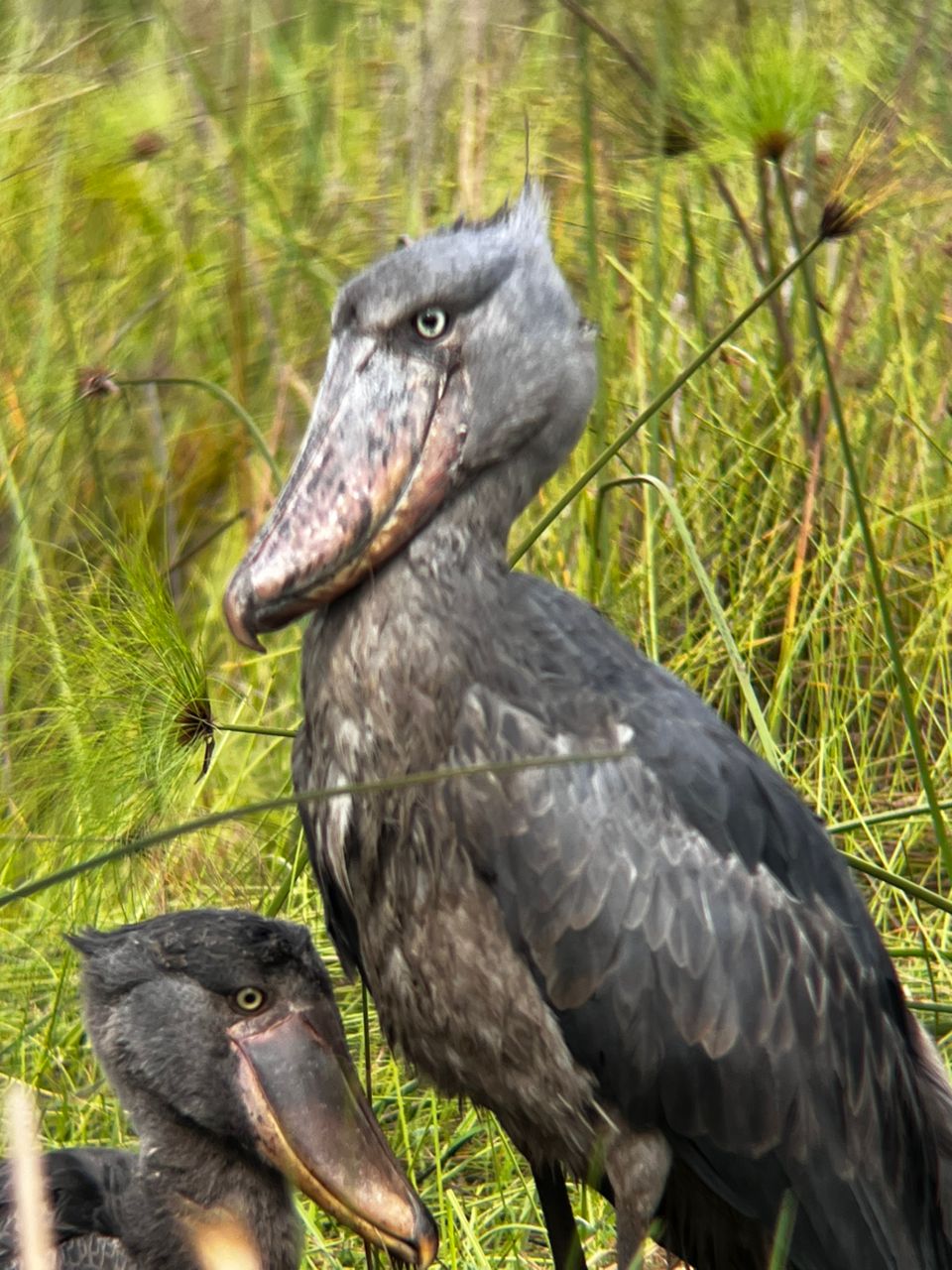
Few birds generate as much excitement on a Uganda birding safari as the Shoebill.
Its enormous shoe-shaped bill, tall body and almost prehistoric appearance make it one of Africa’s most recognizable wetland birds.
Where to look: Mabamba Wetland and suitable wetlands around the Nile–Lake Albert system, including the Albert Delta.
Habitat: Papyrus swamps, marshes, shallow wetlands and areas with floating vegetation.
Why birders want to see it: The Shoebill is visually extraordinary and frequently appears high on the target lists of international birders and wildlife photographers visiting Uganda.
Best tour: A dedicated Mabamba Shoebill birdwatching excursion is particularly convenient for travelers staying around Entebbe. On a longer safari, Shoebill searching can be combined with Murchison Falls, depending on the itinerary.
At Mabamba, birding is usually conducted from a small canoe or boat. The guide and boat operator move slowly through wetland channels while scanning open patches and vegetation.
Birders should also pay attention to the wider wetland community rather than concentrating entirely on one species.
African Green Broadbill
The African Green Broadbill is one of the specialist birds that makes southwestern Uganda particularly attractive to serious birders.
Its green plumage helps it blend remarkably well into forest vegetation, making experienced guidance particularly useful when searching for it.
Where to look: Bwindi Impenetrable National Park, particularly suitable habitat associated with the Ruhija and Mubwindi area.
Habitat: Montane forest within the Albertine Rift.
Why birders want to see it: Its restricted geographical distribution makes it a priority for birders building an Albertine Rift checklist.
UWA’s Bwindi birding information specifically highlights the Mubwindi Swamp Trail and Ruhija’s Bamboo Trail for Albertine Rift endemics, including the localized green broadbill.
Best tour: A dedicated Bwindi forest birding safari that allows sufficient time around Ruhija is more appropriate than a rushed visit.
Travelers whose primary objective is the African Green Broadbill should consider spending multiple birding sessions in Bwindi.
Green-breasted Pitta
The Green-breasted Pitta is another bird that can turn an ordinary forest walk into a memorable specialist birding experience.
Where to look: Kibale National Park is one of the principal destinations associated with searches for this species in Uganda.
Habitat: Tropical forest with dense understory and suitable forest-floor conditions.
Why birders want to see it: Pittas are particularly attractive to serious birders because of their striking appearance and often elusive behavior.
Finding a Green-breasted Pitta can require patience. Birding by ear can be important, and early starts may form part of a dedicated search.
Best tour: A Kibale specialist forest birding safari with enough time for repeated forest sessions.
The trip can also include chimpanzee tracking and a guided walk at Bigodi, but birders with the pitta high on their target list should reserve sufficient dedicated birding time.
Great Blue Turaco
The Great Blue Turaco is one of the most visually impressive birds travelers may encounter during a Uganda birding safari.
Its large size, colorful plumage and distinctive appearance make it popular with both beginner birders and photographers.
Where to look: Forests, forest edges and suitable wooded environments, including the wider Kibale–Bigodi area.
Habitat: Forest canopy, forest edges and mature woodland.
Why birders want to see it: Unlike some tiny forest specialists that can be difficult for beginners to appreciate, the Great Blue Turaco is large, colorful and memorable.
Best tour: A guided Bigodi and Kibale birding tour works particularly well.
A walking birding excursion around Bigodi also provides opportunities to look for primates and other forest-edge species.
Rwenzori Turaco
The Rwenzori Turaco represents the mountainous character of Uganda’s Albertine Rift.
Where to look: Mgahinga Gorilla National Park, the Rwenzori region and other suitable highland habitats within its range.
Habitat: Montane forest and high-elevation vegetation.
Why birders want to see it: It is strongly associated with the Albertine Rift and is therefore important to birders interested in the region’s restricted-range species.
Best tour: An Albertine Rift birding safari combining Bwindi and Mgahinga, with the Rwenzori Mountains added when time permits.
Because turacos can remain partially concealed by foliage, listening for calls can be an important part of locating them.
Papyrus Gonolek
The Papyrus Gonolek represents another side of Uganda’s bird diversity—the specialized birds associated with papyrus wetlands.
Where to look: Suitable papyrus wetlands around Uganda’s lakes, swamps and river systems.
Habitat: Dense papyrus and associated wetland vegetation.
Why birders want to see it: It is a specialized wetland bird, and locating it can demonstrate how valuable Uganda’s papyrus ecosystems are for bird diversity.
The challenge is that it may remain hidden even when relatively close.
Birding by ear therefore becomes particularly useful.
Best tour: A guided wetland birding safari visiting papyrus-rich habitats rather than a conventional game-drive-only itinerary.
African Finfoot
The African Finfoot is an interesting target for birders exploring Uganda’s quieter waterways.
Where to look: Suitable slow-moving rivers and waterways with dense bankside vegetation.
Habitat: Sheltered rivers, streams and vegetated waterways.
Why birders want to see it: Its secretive behavior and preference for quiet waters make a good observation particularly rewarding.
Unlike conspicuous waterbirds standing in open shallows, a finfoot may remain close to overhanging vegetation and disappear quickly.
Best tour: A birding itinerary that includes riverine habitat or carefully planned boat birding.
Patience, slow movement and careful scanning of shaded riverbanks can be more productive than moving quickly.
Standard-winged Nightjar
The Standard-winged Nightjar introduces travelers to an entirely different style of birdwatching.
It is particularly famous for the remarkable elongated wing feathers displayed by adult males during the breeding season.
Where to look: Suitable open and lightly wooded habitats within its Ugandan range.
Habitat: Open woodland, grassland and other suitable nightjar habitat.
Why birders want to see it: Its unusual breeding plumage and nocturnal behavior make it especially interesting to specialist birders.
Best tour: A specialist itinerary that permits responsible dusk, evening or early-morning birding in suitable habitat.
Night birding should always follow local regulations and the instructions of guides or rangers. Artificial light and playback should be used responsibly to avoid unnecessary disturbance.
Uganda’s Albertine Rift Specialties
For experienced international birders, Uganda’s Albertine Rift birds can be even more important than its famous individual species.
Uganda Wildlife Authority identifies Bwindi and Mgahinga as key sites for Albertine Rift endemic birding.
Potential targets across suitable habitats can include:
- African Green Broadbill
- Rwenzori Turaco
- Shelley’s Crimsonwing
- Handsome Francolin
- Regal Sunbird
- Blue-headed Sunbird
- Dwarf Honeyguide
- Grauer’s Cuckooshrike
- Red-faced Woodland Warbler
- Yellow-eyed Black Flycatcher
Not all of these birds occupy exactly the same habitat or elevation.
A specialist itinerary should therefore be built around a target list, allowing the guide to identify the parks, trails, elevations and number of days most appropriate for the priority species.
Best tour: A 7–14-day Albertine Rift birding safari concentrating on Bwindi, Mgahinga and other western Uganda habitats, with the Rwenzori Mountains incorporated into longer expeditions.
Planning Tip: Send Wild Planet Safaris your target bird list before arrival so the itinerary can be structured around the habitats most relevant to your priority species.
Uganda Is Excellent for Both Beginner and Experienced Birders
A traveler does not need to be an expert ornithologist to enjoy birdwatching in Uganda.
One of the country’s strengths is that itineraries can be adapted to completely different experience levels—from someone using binoculars for the first time to an experienced birder arriving with a detailed target list of Albertine Rift and Guinea-Congo species.
Uganda Birding Safaris for Beginners
For beginners, birdwatching should be enjoyable rather than intimidating.
A knowledgeable guide can introduce the basic characteristics used to identify birds, including:
- Size and body shape
- Bill shape
- Plumage and markings
- Flight pattern
- Calls
- Feeding behavior
- Habitat
The guide can also show travelers how to adjust and use binoculars correctly.
Beginner-friendly destinations can include Mabamba, Lake Mburo, Queen Elizabeth and Bigodi, where many birds can be observed in relatively open environments.
Mabamba introduces wetland birds and the possibility of searching for the Shoebill. Lake Mburo provides woodland, savannah and wetland birding, while Queen Elizabeth combines birdwatching with traditional wildlife viewing.
There is no requirement to keep a huge checklist. Beginners can simply enjoy learning how to recognize birds while experiencing Uganda’s landscapes and wildlife.
Recommended beginner route:
Entebbe → Mabamba → Lake Mburo → Queen Elizabeth → Bwindi → Entebbe
Uganda Birding Safaris for Experienced Birders
Experienced birders often approach Uganda differently.
Instead of asking, “How many birds can I see?” they may arrive with a detailed list of species they have never encountered before.
A specialist safari can therefore concentrate on several priorities.
Target-Species Birding
Before the safari, travelers can send their priority list to Wild Planet Safaris.
The itinerary can then be organized around the habitats where those birds may occur.
Birding by Ear
Forest birding often requires recognizing calls before a bird becomes visible.
This is particularly important in Bwindi, Kibale, Budongo and Semuliki, where dense foliage can make visual detection difficult.
Specialist Forest Birding
Experienced birders may spend hours in one productive forest area rather than trying to cover large distances.
Patience can be particularly important when searching for species such as the African Green Broadbill or Green-breasted Pitta.
Albertine Rift Targets
Bwindi and Mgahinga are important destinations for travelers interested in Albertine Rift birds.
Adding the Rwenzori region can make a longer specialist itinerary even more diverse.
Guinea-Congo Species
Semuliki introduces a different birding objective.
Its lowland forest has strong Central African affinities, making it particularly valuable for experienced birders interested in Guinea-Congo forest species.
Custom Bird Checklists
Birders can divide their list into:
Priority targets → secondary targets → birds already seen → photography targets → habitat specialties.
This helps guides understand where the most time should be spent.
Longer Birding Expeditions
Experienced birders should consider 10, 14 or 21-day itineraries when possible.
A comprehensive route might include:
Entebbe → Mabamba → Murchison Falls → Budongo → Kibale → Semuliki → Rwenzori → Queen Elizabeth → Bwindi → Mgahinga → Lake Mburo → Entebbe
Kidepo can be incorporated into even longer expeditions for additional dry-country birding.
Uganda Birding Safaris for Photographers
Bird photography often requires a different itinerary from checklist-focused birding.
A birder trying to identify as many species as possible may move on shortly after confirming an identification. A photographer may need considerably more time to wait for better light, a clear background or more favorable positioning.
Wetland Photography
Mabamba and other wetlands can provide relatively open views of waterbirds.
Boat-based birding can also create interesting low-angle photographic opportunities when conditions and regulations permit.
Savannah Photography
Queen Elizabeth, Murchison Falls, Lake Mburo and Kidepo provide more open landscapes.
Raptors, larger ground birds and birds perched on isolated trees can sometimes be easier to photograph than small forest species.
Forest Photography
Forest photography is more challenging.
Low light, dense vegetation, branches and fast-moving birds can make clear photographs difficult. Higher camera sensitivity, appropriate lenses and patience may be necessary.
Boat-Based Photography
Boat excursions along waterways such as the Nile and Kazinga Channel can provide opportunities to photograph birds along shorelines and riverbanks.
Why Choose a Private Photography Safari?
A private birding safari allows photographers to spend longer at productive locations without feeling pressured to keep pace with a larger group.
Wild Planet Safaris can build additional photography time into the itinerary while balancing birding with wildlife and primate experiences.
Combine Birdwatching With Gorilla Trekking
One of Uganda’s greatest advantages over many birding destinations is the opportunity to combine specialist birdwatching with mountain gorilla trekking.
Uganda’s mountain gorilla trekking takes place in Bwindi Impenetrable National Park and Mgahinga Gorilla National Park.
These are also important birding areas, allowing travelers to experience two very different wildlife interests during the same journey.
Birding and Gorillas in Bwindi
Bwindi provides perhaps the strongest combination of gorilla trekking and Albertine Rift forest birding.
UWA recognizes four main gorilla trekking sectors in Bwindi: Buhoma, Ruhija, Rushaga and Nkuringo.
For birders, areas around Ruhija are particularly important because trails such as the Mubwindi Swamp Trail are associated with Albertine Rift specialties.
Trying to undertake serious birding and gorilla trekking in the same session can make both experiences feel rushed.
A better itinerary is:
Day 1: Arrival in Bwindi and introductory birding
Day 2: Mountain gorilla trekking
Day 3: Full-day Bwindi forest birding
Day 4: Morning birding and onward journey
Travelers with specialist target lists can add additional birding days.
Birding and Gorillas in Mgahinga
Mgahinga offers a different combination.
The Virunga landscape includes montane forest and bamboo habitat, providing opportunities for Albertine Rift birding alongside mountain gorilla trekking.
UWA confirms that gorilla trekking in Uganda takes place in both Bwindi and Mgahinga.
A well-paced itinerary might allocate:
Day 1: Arrival and afternoon birding
Day 2: Gorilla trekking
Day 3: Full-day Albertine Rift birding
Day 4: Additional primate experience or departure
This gives birders time to enjoy the forest without treating birdwatching as a short activity added after the gorilla trek.
Birding, Gorillas and Golden Monkeys
Mgahinga provides another distinctive combination: birds, mountain gorillas and golden monkeys.
Uganda Wildlife Authority confirms that Uganda’s golden monkeys occur in Mgahinga and that habituated troops are available for tracking. Bamboo forms an important part of their habitat and diet.
This makes it possible to design a safari around three interests:
Albertine Rift birding → Mountain gorilla trekking → Golden monkey tracking
A practical four-day program could include:
Day 1: Arrival in Mgahinga and birding
Day 2: Mountain gorilla trekking
Day 3: Full-day birdwatching
Day 4: Golden monkey tracking and departure
Travelers with more time can continue into Bwindi for additional forest birding.
Birding and Gorilla Safaris From Kigali
Starting in Kigali can be practical for travelers whose itinerary concentrates on southwestern Uganda.
A shorter route can follow:
Kigali → Mgahinga → Bwindi → Kigali
This works well for travelers primarily interested in Albertine Rift birds, mountain gorillas and golden monkeys.
A longer safari can continue:
Kigali → Mgahinga → Bwindi → Queen Elizabeth → Kibale → Entebbe
The longer route introduces a much greater variety of habitats:
Montane forest → Albertine Rift forest → savannah and wetlands → tropical forest
Travelers starting in Rwanda and entering Uganda should confirm current immigration, visa and border requirements before travel.
Combine Uganda Birding and Gorilla Trekking
Combine Uganda’s remarkable birdlife with mountain gorilla trekking on a private Wild Planet Safaris birding and gorilla safari.
Your itinerary can be customized around your target birds, number of travel days, gorilla trekking plans, preferred accommodation and starting point in Kigali or Entebbe.
Combine Birdwatching With Chimpanzee Tracking
Uganda also makes it possible to combine birding with another major primate experience: chimpanzee tracking.
Kibale is particularly useful because travelers can combine tropical forest birding, chimpanzees and nearby Bigodi within one region.
Kibale Birding and Chimpanzees
Kibale provides a natural combination of forest birding and chimpanzee tracking. UWA offers chimpanzee tracking and habituation experiences in Kibale.
For birders, the forest provides opportunities to search for specialist species, including the Green-breasted Pitta.
As with gorilla trekking, serious birding should be given dedicated time.
A three-day stay could include:
Day 1: Arrival and introductory forest birding
Day 2: Chimpanzee tracking and afternoon birding
Day 3: Dedicated Kibale or Bigodi birding
Experienced birders searching for difficult forest targets may want additional days.
Bigodi Birding and Primates
Bigodi complements Kibale particularly well.
A guided walk introduces travelers to wetland, forest-edge and community habitats while providing opportunities to search for birds such as the Great Blue Turaco and observe primates.
It is especially useful after a Kibale chimpanzee experience because the landscape and style of birding differ from deeper forest birding.
The combination can be marketed as:
Kibale Chimpanzees + Forest Birding + Bigodi Wetland Birding
Budongo Forest Birding
Budongo provides another option for travelers interested in forest birds and primates.
Its location makes it particularly useful when combined with Murchison Falls National Park.
A northern itinerary can therefore provide:
Budongo forest birding → Murchison savannah birding → Nile boat safari → wildlife game drives
This allows travelers to experience forest, savannah, riverine and wetland habitats within one broader safari circuit.
Birding, Chimpanzees and Gorillas in One Safari
Travelers do not have to choose between Uganda’s birds and primates.
A well-planned itinerary can include Shoebill birding, chimpanzee tracking, savannah wildlife, mountain gorillas and Albertine Rift forest birding.
One strong route is:
Entebbe → Mabamba → Kibale → Queen Elizabeth → Bwindi → Mgahinga
This route can provide:
Mabamba: Shoebill and wetland birding
Kibale: Forest birds and chimpanzees
Queen Elizabeth: Savannah birds, waterbirds and wildlife
Bwindi: Albertine Rift birds and mountain gorillas
Mgahinga: Montane birding, gorillas and golden monkeys
A rushed itinerary reduces the amount of serious birding possible, so travelers interested in specialist species should allow additional days.
Commercial CTA:
Ask Wild Planet Safaris to customize a Uganda Birding, Gorilla and Chimpanzee Safari around your target birds and preferred primate experiences.
Combine Birding With a Classic Uganda Wildlife Safari
Choosing a birding safari does not mean giving up the traditional African safari experience.
Uganda’s savannah parks allow travelers to watch birds while searching for elephants, buffaloes, giraffes, antelopes, lions and other wildlife.
This makes birding particularly appealing for couples or groups in which not everyone is a dedicated birder.
Birding During Game Drives
A bird-focused game drive differs from a standard wildlife drive mainly in pace and attention.
Instead of driving quickly between large-mammal sightings, the vehicle can stop to examine:
- Raptors perched in trees
- Ground birds crossing tracks
- Grassland species
- Woodland birds
- Birds around waterholes
- Mixed feeding groups
Queen Elizabeth, Murchison Falls, Lake Mburo and Kidepo Valley are particularly useful for combining birding and wildlife.
Queen Elizabeth currently reports more than 600 bird species, according to UWA.
Lake Mburo provides savannah, woodland and papyrus habitats and can be explored through game drives, guided walks and boat trips.
Birding During Boat Safaris
Boat safaris add another dimension to Uganda birding.
Instead of scanning from a vehicle, birders can observe riverbanks, islands, reeds, exposed branches and shallow-water feeding areas.
Important combinations include:
Kazinga Channel – Queen Elizabeth National Park
Excellent for combining waterbirds with hippos and other wildlife.
Nile – Murchison Falls National Park
Provides opportunities for riverine and water-associated birds while adding dramatic scenery and wildlife.
Boat excursions can be particularly valuable to photographers because birds may sometimes be viewed against cleaner backgrounds than in dense vegetation.
Birding During Nature Walks
Walking changes the birding experience again.
Without vehicle noise and with more time to examine small details, birders can listen carefully for calls and investigate vegetation that might be overlooked from a road.
Guided walking opportunities can be incorporated into destinations such as Lake Mburo and suitable forest and wetland areas.
UWA specifically lists walking safaris among Lake Mburo’s visitor experiences.
Walking is particularly useful for:
- Birding by ear
- Smaller woodland birds
- Forest-edge species
- Photography
- Learning bird behavior
- Observing tracks, plants and other aspects of the ecosystem
Birding and Wildlife Photography
Combining birds and larger wildlife can create an especially productive photography safari.
Queen Elizabeth offers savannah, wetland and Kazinga Channel photography.
Murchison Falls combines open-country birds, Nile birding and large mammals.
Lake Mburo provides woodland, wetland and walking opportunities.
Kidepo Valley adds expansive dry savannah landscapes, raptors and wildlife.
UWA currently highlights game drives, boat cruises and nature walks among experiences available across Uganda’s savannah parks.
For photographers, a private vehicle can be particularly valuable. It allows more control over when to stop, how long to remain at a sighting and whether to prioritize birds, mammals or landscapes.
Plan a Uganda Birding and Wildlife Safari
A birding safari can be designed around far more than a checklist.
With Wild Planet Safaris, travelers can combine Shoebill searches, Albertine Rift birding, tropical forests, game drives, boat safaris, mountain gorilla trekking, chimpanzee tracking, golden monkeys and wildlife photography within one customized journey.
For a balanced first safari, consider:
Entebbe → Mabamba → Lake Mburo → Bwindi → Queen Elizabeth → Kibale → Entebbe
For a longer specialist expedition, add:
Murchison Falls → Budongo → Semuliki → Rwenzori → Mgahinga → Kidepo Valley
The best itinerary is not necessarily the one containing the most destinations. It is the one that provides enough time in the right habitats for the birds and wildlife experiences that matter most to the traveler.
Uganda Offers Excellent Guided Birding Experiences
A successful birding safari involves more than traveling to places with long bird lists. Local birding knowledge can make a major difference, especially in Uganda’s forests, wetlands and mountain environments where many birds are difficult to locate or identify.
An experienced birding guide understands not only what species may occur in a destination, but also their preferred habitats, calls, behavior and the locations where searches are most practical. This becomes particularly valuable when travelers have limited time or arrive with specific target birds.
For beginners, a guide can make bird identification easier and more enjoyable. For experienced birders, guiding can concentrate on difficult forest species, Albertine Rift specialties, Guinea-Congo birds and customized target lists.
Bird Identification
Uganda’s bird diversity can make identification challenging, particularly when several similar species occur in the same habitat.
A birding guide can help identify birds using a combination of characteristics rather than relying on plumage alone. These include:
- Body size and shape
- Bill shape
- Tail length and shape
- Plumage patterns
- Flight style
- Feeding behavior
- Preferred habitat
- Calls and songs
- Geographic distribution
This is especially useful in forests where a bird may only appear briefly between branches.
Beginners can also learn how to use a field guide or birding application and how to keep a checklist without feeling pressured to identify every bird themselves.
Bird Calls
Learning and recognizing bird calls is particularly important in Uganda’s forests.
In places such as Bwindi, Kibale, Budongo and Semuliki, dense foliage may prevent birders from immediately seeing a bird even when it is nearby.
A knowledgeable guide may hear a call, determine its approximate direction and then help the group search the appropriate vegetation level.
Calls can also indicate whether birders should concentrate on the canopy, understory, forest floor, wetland vegetation or forest edge.
For experienced birders, birding by ear can significantly improve the quality of a specialist forest safari.
Playback, where permitted, should be used cautiously and responsibly because excessive use can disturb birds, particularly during sensitive breeding periods.
Finding Difficult Species
Some of Uganda’s most sought-after birds can be difficult to find.
A species may occupy a narrow elevation range, remain hidden in thick vegetation or only occur in specialized habitat.
Examples of challenging targets can include the African Green Broadbill, Green-breasted Pitta, Papyrus Gonolek and various Albertine Rift forest species.
Local knowledge helps guides understand where and how to search, but it does not guarantee a sighting.
A responsible guide should never promise that a particular wild bird will be seen. Instead, the itinerary should provide enough time in suitable habitat to improve the chances of a successful search.
Understanding Habitats
Knowing a bird’s habitat is often just as important as knowing its appearance.
Uganda contains dramatically different ecosystems, including:
Papyrus wetlands → lowland tropical forest → montane forest → bamboo → woodland → savannah → lakeshores → riverine vegetation → high-altitude mountain environments.
A guide who understands these habitat associations can help travelers recognize why certain birds occur in one destination but not another.
For example, a birder searching for the Shoebill needs a completely different environment from someone searching for an African Green Broadbill.
The first requires suitable wetlands, while the second requires specialized Albertine Rift forest habitat.
This is why a good Uganda birding itinerary should be organized around habitats and target species rather than simply the number of national parks visited.
Target-Species Searches
Experienced birders often arrive in Uganda with a list of species they particularly want to find.
Before the safari, this list can be divided into:
Priority species – birds that are the main purpose of the trip.
Secondary targets – species the traveler would particularly enjoy seeing.
Photography targets – birds for which the traveler hopes to obtain good photographs.
Already-seen species – useful for determining where limited safari time should be concentrated.
The itinerary can then be built around appropriate habitats.
For example:
Shoebill → Mabamba and suitable Nile–Lake Albert wetlands
African Green Broadbill → Bwindi
Green-breasted Pitta → Kibale
Albertine Rift specialties → Bwindi and Mgahinga
Guinea-Congo forest birds → Semuliki
A target-species safari requires patience. It can sometimes be more productive to spend two or three days in one important habitat than to rush through several parks.
Bird Photography Assistance
Bird photography requires patience, positioning and time.
A guide can help photographers understand where birds are likely to appear, identify useful viewing positions and recognize behavior that may create photographic opportunities.
Different habitats also present different challenges.
Wetlands can provide relatively open backgrounds and good opportunities for waterbirds.
Savannahs can offer clearer views of raptors, ground birds and birds perched on isolated trees.
Forests are more difficult because of low light, branches and dense vegetation.
Boat excursions can provide useful perspectives for photographing birds along riverbanks, lakeshores and wetland channels.
A private birding safari can be particularly valuable to photographers because the itinerary does not need to move on immediately after a bird has been identified.
Responsible Birdwatching
Good bird guiding should protect the birds and habitats that travelers have come to experience.
Responsible practices include:
- Maintaining appropriate distance from birds
- Avoiding disturbance around nests
- Staying on designated trails where required
- Following ranger and park regulations
- Limiting disturbance from playback
- Avoiding unnecessary spotlighting
- Keeping noise low around sensitive birds
- Not feeding wild birds
- Removing litter
- Respecting wetlands and forest vegetation
- Supporting local guides and conservation initiatives
Photography should also remain responsible. Getting closer for a photograph should never take priority over the welfare of a bird.
A successful birding safari should leave Uganda’s birds and habitats undisturbed for future visitors.
Private Birding Safaris Can Be Customized
A private Uganda birding safari offers greater flexibility than an itinerary designed for a large general-interest group.
Instead of following a fixed schedule, the journey can be structured around the traveler’s target birds, preferred habitats, photography interests, travel dates, number of available days and additional wildlife activities.
This flexibility is especially valuable for birdwatchers because birds do not follow a tourism timetable. A productive forest flock may deserve extra observation time, while poor weather might make it sensible to adjust the day’s birding plan.
Solo Birding Safaris
Solo travelers can enjoy maximum flexibility on a private birding safari.
The day’s pace can be adapted entirely to one person’s interests.
A solo birder may choose to spend more time:
- Searching for difficult target species
- Photographing one particular bird
- Exploring specialist forests
- Recording a detailed checklist
- Combining birding with gorilla or chimpanzee tracking
Private transport also makes it easier to stop for unexpected birds encountered during transfers.
Solo travel generally has a higher per-person cost because vehicle, fuel and guiding expenses are not shared with other travelers, but it offers exceptional flexibility.
Birding Safaris for Couples
A private safari works particularly well for couples with different interests.
One traveler may be a dedicated birder while the other is more interested in gorillas, chimpanzees, wildlife or photography.
Rather than forcing both travelers into a purely specialist itinerary, the safari can balance their interests.
For example:
Mabamba: Shoebill and wetland birds
Lake Mburo: Birds and wildlife
Bwindi: Forest birding and gorillas
Queen Elizabeth: Birds, wildlife and boat safari
Kibale: Forest birds and chimpanzees
This creates a varied safari without sacrificing the birding component.
Small-Group Birding Tours
Small private groups can work particularly well for bird clubs, friends, photographers and families.
Costs such as the vehicle and fuel can be shared, while the group remains small enough for focused birding.
Smaller groups are particularly useful in forests because excessive movement and noise can make locating shy birds more difficult.
When organizing a group safari, travelers should ideally have reasonably similar priorities. A group of dedicated checklist birders may require a different pace from a mixed-interest wildlife group.
Bird Photography Tours
A dedicated photography safari should allow more time at individual sightings.
Rather than moving on as soon as a bird has been identified, photographers may wait for:
- Better light
- Cleaner backgrounds
- A bird to move into an open position
- Feeding behavior
- Flight opportunities
- Interactions between birds
- More favorable viewing angles
Wild Planet Safaris can build longer observation periods into a private itinerary and combine wetland, savannah, forest and boat-based photography.
Target-Species Tours
A target-species tour is designed around specific birds rather than a standard sequence of parks.
For example, a traveler interested in:
Shoebill + African Green Broadbill + Green-breasted Pitta + Rwenzori Turaco
might need an itinerary combining:
Mabamba → Bwindi → Mgahinga → Kibale
A traveler focused on broader forest diversity might instead include:
Budongo → Kibale → Semuliki → Bwindi → Mgahinga
The final route depends on the target list, season, available time and practical travel distances.
Sightings of wild birds can never be guaranteed.
Birding and Primate Safaris
Uganda is particularly suitable for travelers wanting to combine birds and primates.
A customized itinerary can include:
Bwindi: Birding + mountain gorillas
Mgahinga: Birding + gorillas + golden monkeys
Kibale: Birding + chimpanzees
Bigodi: Birding + primates
This creates a safari where mornings may involve searching for forest birds and other days are dedicated to some of Uganda’s most sought-after primate experiences.
Customize Your Private Uganda Birding Safari
With Wild Planet Safaris, the itinerary can be adjusted according to:
Target birds → Travel dates → Number of travelers → Available days → Preferred destinations → Photography interests → Accommodation level → Gorilla trekking → Chimpanzee tracking → Golden monkeys → Wildlife viewing.
The objective is not simply to visit as many destinations as possible. It is to spend enough time in the right habitats for the traveler’s interests.
Recommended Uganda Birding Safari Itineraries
Uganda birding safaris can range from a single-day Shoebill excursion to a three-week specialist expedition.
The following itineraries provide starting points rather than rigid programs. They can be adjusted according to target birds, available days and additional wildlife interests.
1-Day Mabamba Shoebill Birding Tour
Route: Entebbe → Mabamba → Entebbe
This short excursion is ideal for travelers with limited time or those wanting to add birdwatching before or after a longer Uganda safari.
The day begins with an early departure from the Entebbe area for Mabamba.
At the wetland, continue by small boat or canoe with a local guide. Move slowly through papyrus-lined channels while searching suitable habitat for the Shoebill.
The excursion should not focus entirely on one bird. Kingfishers, herons, egrets, jacanas and other wetland species can add significantly to the day’s checklist.
After the birding session, return toward Entebbe.
Best for: Shoebill searches, beginners, photographers, short stays and pre/post-safari birding.
Recommended package: 1-Day Mabamba Shoebill Birdwatching Tour
3-Day Uganda Birdwatching Tour
Route: Mabamba → Lake Mburo
This short safari introduces travelers to two contrasting habitats.
Day 1 – Mabamba Wetland:
Search for the Shoebill and other wetland birds before continuing with additional birding according to available time.
Day 2 – Lake Mburo National Park:
Explore woodland, savannah and wetland habitats. Bird-focused game drives can be combined with wildlife viewing.
Day 3 – Morning Birding and Return:
Enjoy an early birding session before beginning the return journey toward Entebbe.
Best for: First-time birders, short holidays, couples and travelers wanting birds plus wildlife.
5-Day Uganda Birding Safari
Route: Mabamba → Lake Mburo → Bwindi
This itinerary introduces travelers to wetland, woodland, savannah and Albertine Rift forest birding.
Day 1: Mabamba Shoebill and wetland birding.
Day 2: Transfer to Lake Mburo with afternoon woodland and savannah birding.
Day 3: Morning Lake Mburo birding followed by transfer toward Bwindi.
Day 4: Full-day Bwindi forest birding with attention to Albertine Rift species.
Day 5: Morning birding before beginning the onward journey.
Best for: Birders wanting a short but habitat-diverse safari.
Travelers particularly interested in difficult Bwindi targets should consider adding extra days.
7-Day Uganda Birding and Gorilla Safari
Route: Mabamba → Lake Mburo → Bwindi → Queen Elizabeth
This itinerary introduces the important commercial combination of birdwatching and mountain gorilla trekking.
Day 1: Mabamba Shoebill birding.
Day 2: Lake Mburo woodland and savannah birding.
Day 3: Morning birding and transfer to Bwindi.
Day 4: Mountain gorilla trekking.
Day 5: Dedicated Bwindi forest and Albertine Rift birding.
Day 6: Transfer to Queen Elizabeth with birding along the way and afternoon wildlife viewing where time permits.
Day 7: Morning birding/game drive or boat-based birding before onward transfer.
Best for: Travelers wanting birds, gorillas and traditional African wildlife within one safari.
10-Day Uganda Birding, Gorilla and Chimpanzee Safari
Route: Mabamba → Lake Mburo → Bwindi → Queen Elizabeth → Kibale
This is a stronger option for travelers who want a broad Uganda wildlife experience without making the safari exclusively about birds.
Day 1: Mabamba Shoebill birding.
Day 2: Transfer to Lake Mburo and afternoon birding.
Day 3: Morning Lake Mburo birding and transfer toward Bwindi.
Day 4: Mountain gorilla trekking.
Day 5: Full-day Bwindi forest birding.
Day 6: Transfer to Queen Elizabeth with birding along the route.
Day 7: Savannah birding, wildlife game drive and/or Kazinga Channel boat safari.
Day 8: Transfer toward Kibale with birding where practical.
Day 9: Chimpanzee tracking plus additional forest or Bigodi birding.
Day 10: Morning birding and onward transfer.
The itinerary combines:
Shoebill → savannah birds → Albertine Rift birds → mountain gorillas → waterbirds → wildlife → forest birds → chimpanzees.
Best for: Couples, first-time Uganda visitors and mixed-interest travelers.
14-Day Best of Uganda Birding Safari
A two-week safari gives birders enough time to begin exploring Uganda more seriously.
Rather than simply adding parks, the itinerary should introduce several important ecosystems.
One possible route is:
Entebbe → Mabamba → Murchison Falls → Budongo → Kibale → Semuliki → Queen Elizabeth → Bwindi → Lake Mburo → Entebbe
This provides:
Mabamba: Papyrus wetland and Shoebill search
Murchison: Savannah, Nile and waterbirds
Budongo: Forest specialists
Kibale: Tropical forest birds
Semuliki: Guinea-Congo forest species
Queen Elizabeth: Savannah and wetland birds
Bwindi: Albertine Rift montane forest
Lake Mburo: Woodland, grassland and wetland birds
Gorilla and chimpanzee activities can be incorporated according to the traveler’s priorities.
Best for: Serious birders, bird photographers and travelers wanting a more complete Uganda birding experience.
21-Day Uganda Specialist Birding Expedition
A three-week itinerary should be designed around Uganda’s major birding ecosystems, not simply around collecting national park names.
A comprehensive route can include:
Entebbe → Mabamba → Murchison Falls → Budongo → Kibale → Semuliki → Rwenzori → Queen Elizabeth → Bwindi → Mgahinga → Lake Mburo → Entebbe
Kidepo Valley can be incorporated when travel time and the target list justify extending the northern circuit.
The expedition can be divided into habitat objectives:
Wetland Birding
Begin with Mabamba and later explore Nile, lake and papyrus habitats.
Primary interests can include Shoebill, waterbirds and papyrus-associated species.
Savannah and Woodland Birding
Murchison Falls, Queen Elizabeth and Lake Mburo introduce raptors, ground birds and open-country species.
Lowland Forest Birding
Budongo and Semuliki add specialist forest birds, with Semuliki particularly important for Guinea-Congo influences.
Tropical Forest Birding
Kibale provides additional forest birding and the option of chimpanzee tracking.
Albertine Rift Birding
Bwindi and Mgahinga become major specialist components, with sufficient time allocated to restricted-range and montane forest birds.
High-Altitude Birding
The Rwenzori region adds montane and higher-elevation environments for travelers with appropriate fitness and interests.
Primates and Wildlife
Mountain gorilla trekking, chimpanzee tracking, golden monkeys, boat safaris and wildlife game drives can be integrated without turning every day into a general wildlife excursion.
Best for: Experienced birders, photographers and travelers arriving with extensive target lists.
Customize Any Uganda Birding Itinerary
Ask Wild Planet Safaris to customize any of these Uganda birding itineraries around your target species and available travel days.
Send your travel dates, number of travelers, target birds, preferred safari length, accommodation category and interest in gorillas, chimpanzees or wildlife to begin planning.
Uganda Birding Safaris Offer Good Variety for Different Budgets
A Uganda birding safari does not have one fixed price.
The final cost depends on the length of the safari, accommodation category, number of travelers, destinations, transport, guiding requirements, park activities and optional primate experiences.
For this reason, it is more useful to think in terms of budget, mid-range and luxury travel styles than to advertise one price for every birding safari.
Budget Birding Safaris
A budget birding safari concentrates spending on the experiences that matter most while using simpler accommodation.
This does not mean sacrificing knowledgeable guiding.
For a dedicated birder, a good guide and sufficient time in productive habitats can be considerably more important than staying in an expensive lodge.
Budget itineraries may use:
- Simple lodges or guesthouses
- Rooms with private bathrooms where available
- Road transportation rather than domestic flights
- Carefully planned routes that reduce unnecessary driving
- Fewer lodge changes
- Shared costs for couples or small groups
A route such as:
Mabamba → Lake Mburo → Bwindi
can provide strong habitat diversity without trying to cover the entire country.
Mid-Range Birding Safaris
Mid-range safaris provide a balance between comfort, privacy and birding quality.
Accommodation generally offers comfortable rooms with private bathrooms, good meals and convenient access to major birding areas.
A mid-range private safari may include:
- Private safari vehicle
- Comfortable accommodation
- Guided birding
- Park activities
- Boat excursions where included
- Airport transfers
- Wildlife viewing
- Optional gorilla or chimpanzee experiences
This category works particularly well for 7–14-day birding safaris, where travelers spend significant time on the road and appreciate additional comfort without requiring high-end luxury accommodation.
Luxury Birding Safaris
Luxury birding safaris combine specialist birdwatching with higher-end accommodation and more personalized travel arrangements.
Depending on the itinerary, these may include:
- Premium lodges
- Spacious rooms or suites
- Private transportation
- Specialist guiding
- More flexible schedules
- Upgraded meals and services
- Selected domestic flights or charter arrangements
- Longer stays in strategically located lodges
- Private photography-focused experiences
Luxury does not automatically produce more bird sightings.
The real birding advantage comes from using additional comfort and flexibility to allow more time in productive locations rather than rushing between destinations.
What Determines the Cost of a Uganda Birding Safari?
Several factors influence the final safari price.
Number of Days
Longer safaris naturally cost more overall because they require additional accommodation, meals, transport and guiding.
However, longer trips may provide better value for serious birders because fixed transportation costs are spread across more birding days.
Accommodation
Budget guesthouses, comfortable mid-range lodges and luxury properties can differ substantially in price.
Travelers should choose accommodation according to comfort requirements and location rather than assuming the most expensive property is always best for birding.
A well-located lodge can reduce morning transfer times and make early birding easier.
Private vs Group Travel
A private safari generally costs more per person, particularly for solo travelers.
Couples and small groups can divide the cost of the vehicle, fuel and guiding between several travelers.
Vehicle and Fuel
Uganda birding itineraries can cover considerable distances.
Vehicle costs depend on:
- Safari duration
- Route
- Fuel consumption
- Road distances
- Vehicle type
- Number of travelers
An efficient route helps control costs and reduces unnecessary time on the road.
Birding Guide
Specialist guiding is an important part of a serious birding safari.
The cost may vary according to the itinerary, number of days and level of specialist knowledge required.
For experienced birders with difficult target lists, this is an area where cutting costs too aggressively can reduce the quality of the experience.
Park Fees
National park entry and activity fees contribute to the final safari cost.
Because official tariffs can change, travelers should request a current quotation rather than relying on an old blog price.
Boat Activities
Mabamba canoe excursions, Kazinga Channel cruises, Nile boat trips and other boat-based activities may be priced separately or included within a safari package.
The quotation should clearly state what is included.
Number of Destinations
Visiting more destinations does not automatically make a better birding safari.
A route with too many parks can increase:
- Fuel costs
- Driving time
- Accommodation changes
- Park entry expenses
while reducing actual birding time.
Serious birders are often better served by spending longer in carefully selected habitats.
Gorilla Permits
Adding mountain gorilla trekking increases the total safari cost.
Because permit tariffs and booking conditions can change, Wild Planet Safaris should confirm the current official rate when preparing the quotation rather than relying on an evergreen article price.
Chimpanzee Permits
Chimpanzee tracking or habituation experiences also affect the final safari cost.
Current rates should likewise be confirmed at the time of booking.
What Should a Birding Safari Quotation Include?
Before booking, travelers should check whether their quotation includes:
Safari vehicle and fuel → accommodation → meals → birding guide → park entry fees → scheduled boat activities → airport transfers → drinking water → gorilla/chimpanzee permits where specifically stated.
Travelers should also check exclusions such as:
International flights → visa costs → travel insurance → gratuities → personal purchases → alcoholic drinks → optional activities not listed in the itinerary.
Request a Customized Uganda Birding Safari Quote
The best way to calculate the cost of a Uganda birding safari is to build the itinerary first.
Send Wild Planet Safaris your:
Travel dates → Number of travelers → Number of days → Target birds → Preferred destinations → Budget, mid-range or luxury accommodation → Gorilla trekking interest → Chimpanzee tracking interest → Photography requirements.
Wild Planet Safaris can then design a route and provide a quotation based on the actual experiences you want rather than forcing your trip into a generic package.
What to Pack for a Uganda Birding Safari
Packing correctly can make a Uganda birding safari considerably more comfortable and productive. A typical itinerary may take travelers from warm papyrus wetlands and open savannah to humid tropical forests and cooler high-altitude environments, so equipment and clothing should be versatile.
Birders should also consider how much equipment they genuinely need. Heavy camera gear, multiple field guides and unnecessary clothing can become tiring during long forest walks.
Binoculars
A good pair of binoculars is one of the most important items for any birding safari.
Binoculars help birders examine identification features that are difficult to see with the naked eye, particularly when birds are high in the canopy, across wetlands or perched at a distance in open savannah.
For forest birding, binoculars that perform reasonably well in lower light can be especially useful.
Before traveling, become familiar with:
- Focusing
- Adjusting the eyecups
- Setting the diopter
- Quickly locating a bird through the lenses
Beginners should not worry about owning the most expensive binoculars. A comfortable, clear pair that can be used quickly is more important.
Camera and Telephoto Lens
A camera is optional, but Uganda provides excellent opportunities for bird and wildlife photography.
A telephoto lens is particularly useful because responsible wildlife photography normally requires keeping an appropriate distance from birds.
Wetlands and savannahs can offer relatively open photographic opportunities, while forests are more challenging because of low light, foliage and branches.
Photographers visiting Bwindi, Kibale, Budongo or Semuliki should be prepared for changing light conditions.
Protect cameras and lenses from rain, dust and moisture during transfers and outdoor activities.
Uganda or East Africa Bird Field Guide or App
A field guide or reliable birding application can help travelers identify species and maintain a checklist.
A guide covering Uganda or East Africa is generally more useful than carrying a broad African guide containing many species that do not occur in the region.
Digital birding applications can also provide:
- Illustrations or photographs
- Distribution information
- Bird calls
- Personal checklists
- Identification notes
When using recorded calls in the field, playback should be handled responsibly and according to guidance from the birding guide or park authorities.
Comfortable Hiking Shoes
Good footwear is especially important for forest birding.
Trails in Bwindi, Kibale, Mgahinga, Semuliki and the Rwenzori region can become muddy, slippery or uneven, particularly after rain.
Choose shoes or lightweight hiking boots that:
- Fit properly
- Have reliable grip
- Are already broken in
- Provide adequate support
- Can cope with wet conditions
Avoid arriving with completely new hiking boots that have never been worn before.
Lightweight Clothing
Lightweight, breathable clothing works well for many Uganda birding environments.
Neutral colors such as khaki, brown, grey and green can be practical in the field because they are less conspicuous than very bright clothing.
Long trousers and lightweight long-sleeved shirts can also provide some protection from vegetation, insects and strong sunlight.
For higher elevations such as Mgahinga and the Rwenzori region, pack an additional warm layer.
Rain Jacket
Rain can occur even outside the wetter periods, particularly in forest and mountain environments.
A lightweight waterproof jacket should therefore remain accessible in the daypack rather than buried inside the main luggage.
A waterproof cover or dry bag can also help protect cameras, phones and field guides.
Insect Repellent
Birding often involves spending time around forests, wetlands and vegetation where insects may be present.
Carry an appropriate insect repellent and follow its instructions.
Travelers should also obtain personalized health advice from a qualified travel-health professional before visiting Uganda, particularly regarding vaccinations and malaria prevention.
Hat
A lightweight hat is useful during open-country birding.
It provides additional protection during game drives, wetland excursions, boat trips and long periods spent watching birds in exposed areas.
Sunscreen
Strong sun exposure can occur during savannah game drives and boat-based birding.
Pack suitable sunscreen and reapply it according to the product instructions, especially after extended outdoor activity.
Reusable Water Bottle
Birdwatching can involve several hours outdoors, so staying hydrated is important.
A reusable water bottle reduces reliance on disposable plastic bottles and can be refilled where safe drinking water is provided.
Daypack
A small, comfortable daypack is useful for carrying equipment during birding walks.
Typical contents can include:
Binoculars → rain jacket → water → field guide → notebook → sunscreen → insect repellent → spare batteries → memory cards.
Avoid overpacking the daypack, particularly when hiking in mountainous terrain.
Notebook or Bird Checklist
Many birders enjoy recording what they observe each day.
A notebook or digital checklist can include:
- Species observed
- Location
- Date
- Habitat
- Interesting behavior
- Photography notes
- Species heard but not confidently seen
- Target birds still being searched for
Reviewing the checklist with the guide in the evening can also help plan the following day’s birding priorities.
Extra Camera Batteries and Memory Cards
Birding and wildlife safaris can produce far more photographs than expected.
Carry spare batteries and memory cards, particularly when visiting remote destinations where charging opportunities may be limited.
A portable power bank can also be useful for phones and smaller electronic equipment.
Responsible Birdwatching and Conservation in Uganda
Birdwatching depends on healthy ecosystems. Forests, wetlands, savannahs and mountain environments must remain suitable for birds if future generations are to enjoy the same experiences.
Responsible birdwatching therefore means more than simply following park rules. It involves observing birds in ways that minimize disturbance while supporting the communities and conservation systems connected to their habitats.
Keep a Responsible Distance
Birders and photographers should maintain an appropriate distance from wildlife.
Moving too close can cause a bird to:
- Stop feeding
- Leave an important resting site
- Abandon a preferred perch
- Display signs of stress
- Interrupt normal behavior
A telephoto lens, binoculars and spotting equipment allow excellent observation without approaching unnecessarily closely.
If a bird repeatedly moves away as people approach, that is a strong indication that more space is required.
Avoid Disturbing Nesting Birds
Nesting birds require particular care.
Birders should avoid approaching nests closely simply to obtain photographs or prolonged observations.
Repeated disturbance can expose eggs or chicks, attract predators or interfere with feeding behavior.
Guides should also avoid publicizing sensitive nest locations unnecessarily.
The welfare of the bird should always take priority over obtaining a photograph or adding a species to a checklist.
Use Bird-Call Playback Responsibly
Recorded bird calls can sometimes help with identification or locating secretive species, but excessive playback can disturb birds.
A bird may interpret playback as the presence of a territorial rival and spend energy responding rather than feeding, nesting or carrying out normal behavior.
Playback should therefore be:
- Limited
- Used only where permitted
- Avoided around sensitive nesting situations
- Controlled by an experienced guide when appropriate
- Stopped if the bird appears disturbed
A good birding experience does not require forcing every hidden bird into view.
Follow Park and Ranger Instructions
Uganda’s protected areas have rules designed to protect wildlife and visitors.
Always follow instructions from Uganda Wildlife Authority rangers, site guides and other authorized personnel.
Rules may vary according to destination and activity.
Travelers participating in gorilla trekking, chimpanzee tracking, nature walks or other regulated experiences should pay particular attention during the pre-activity briefing.
Stay on Designated Trails Where Required
Leaving established trails can damage vegetation, disturb wildlife and expose travelers to unnecessary risks.
This is especially important in sensitive forest, wetland and mountain environments.
Following established routes also helps concentrate tourism impacts within manageable areas.
Support Community-Based Tourism
Some important birding experiences are closely connected to local communities.
Community-based tourism can provide employment through guiding, accommodation, crafts, transport and other tourism services.
Bigodi Wetland Sanctuary is an example of a community-oriented nature tourism experience near Kibale.
Choosing locally connected services where appropriate can help ensure that people living near wildlife habitats receive tangible benefits from conservation-focused tourism.
Avoid Litter and Reduce Single-Use Plastics
Nothing should be left behind on birding trails, wetlands, roadsides or boat excursions.
Travelers can reduce waste by carrying:
- Reusable water bottles
- Refillable containers
- Reusable bags
- Rechargeable batteries where practical
Any waste carried into a natural area should be removed and disposed of appropriately.
Support Uganda’s Bird Habitats
Bird conservation ultimately depends on habitat conservation.
Uganda’s bird diversity relies on healthy:
Forests → wetlands → papyrus swamps → savannahs → lakes → rivers → woodlands → mountain ecosystems.
Travelers contribute indirectly to conservation when they pay legitimate protected-area fees, use responsible tourism services, support community conservation initiatives and demonstrate that intact natural habitats have tourism value.
Responsible birding should therefore leave visitors with more than photographs and a checklist. It should also build an appreciation for the ecosystems that make Uganda’s bird diversity possible.
Why Choose Wild Planet Safaris for a Uganda Birding Safari?
A birding safari requires careful planning because different birds occur in different habitats and travelers have very different interests.
Wild Planet Safaris can arrange Uganda birding itineraries around the traveler’s available days, preferred destinations, accommodation level and additional safari activities.
Rather than treating every birding traveler the same, the itinerary can be adjusted according to the experience the traveler wants.
Customized Uganda Birding Itineraries
A customized itinerary can be planned around specific interests such as:
- Shoebill birding
- Forest birding
- Albertine Rift birds
- Savannah birding
- Wetland birding
- Bird photography
- Gorilla trekking
- Chimpanzee tracking
- Golden monkey tracking
- Wildlife viewing
Travelers with a target-bird list can share it during the planning stage so relevant habitats can be incorporated into the itinerary.
Wild birds remain free-ranging, so individual sightings cannot be guaranteed.
Local Safari Planning
Route planning matters in Uganda because major birding destinations are spread across different parts of the country.
A logical itinerary reduces unnecessary driving and gives travelers more actual birding time.
For example:
Entebbe → Mabamba → Lake Mburo → Bwindi → Queen Elizabeth → Kibale → Entebbe
provides a logical progression through wetlands, woodland, savannah and forest.
Longer specialist itineraries can incorporate Murchison Falls, Budongo, Semuliki, Rwenzori, Mgahinga and Kidepo according to the traveler’s interests.
Private Safari Transportation
Private transportation provides valuable flexibility for birdwatchers.
A private safari vehicle makes it easier to stop when an interesting bird is spotted, spend additional time at productive locations and adjust the day’s pace according to birding conditions.
This is particularly useful for photographers and experienced birders who may want longer observation periods.
Accommodation Arrangements
Wild Planet Safaris can arrange accommodation according to the traveler’s preferred category, including budget, mid-range and luxury options.
Location is especially important on birding safaris.
Staying reasonably close to birding sites can make early-morning departures easier and reduce unnecessary driving before productive birding hours.
Birding and Gorilla Safari Combinations
Uganda provides the opportunity to combine specialist birdwatching with mountain gorilla trekking.
Bwindi and Mgahinga are particularly suitable because both offer important birding habitats as well as gorilla trekking.
A well-paced itinerary can allocate separate days to gorillas and dedicated birding.
Birding and Chimpanzee Safari Combinations
Kibale allows travelers to combine tropical forest birding with chimpanzee tracking.
Nearby Bigodi adds wetland and forest-edge birding, creating a varied primate and birding experience within the same region.
Birding and Wildlife Safari Combinations
Birdwatchers can also include classic African wildlife experiences.
Queen Elizabeth, Murchison Falls, Lake Mburo and Kidepo Valley provide opportunities to combine birdwatching with game drives, boat excursions and wildlife photography.
This works particularly well for couples or families where not everyone is a dedicated birder.
Short and Multi-Day Birding Tours
A Uganda birding experience can range from a one-day excursion to a multi-week specialist expedition.
Short options can include a Mabamba Shoebill excursion, while longer itineraries can connect multiple ecosystems across western, northern and southwestern Uganda.
The number of destinations should match the available time rather than trying to fit too many parks into a short safari.
Kigali and Entebbe Starting Options
Many Uganda birding itineraries can begin around Entebbe, making Mabamba a convenient first or final birding destination.
Travelers concentrating on southwestern Uganda can also consider starting from Kigali, depending on their wider travel arrangements and current border and immigration requirements.
A Kigali-based route can include:
Kigali → Mgahinga → Bwindi → Kigali
or continue farther into Uganda:
Kigali → Mgahinga → Bwindi → Queen Elizabeth → Kibale → Entebbe
Ready to Discover Uganda’s Remarkable Birdlife?
Plan a customized Uganda birding safari with Wild Planet Safaris, from a one-day Shoebill excursion to a multi-week specialist birding, gorilla and wildlife expedition.
Share your target birds, travel dates and preferred experiences, and the itinerary can be designed around the habitats and activities most relevant to you.
Frequently Asked Questions About Uganda Birding Safaris
Why Is Uganda Good for Birdwatching?
Uganda is attractive to birdwatchers because it combines exceptional bird diversity with a wide range of habitats within a relatively compact country.
Birders can explore papyrus wetlands, tropical forests, Albertine Rift montane forests, savannahs, woodlands, rivers, lakes and high-altitude environments during the same safari.
The ability to combine birdwatching with gorillas, chimpanzees and traditional wildlife safaris adds another advantage.
How Many Bird Species Are Found in Uganda?
Uganda Wildlife Authority currently describes Uganda as having more than 1,060 recorded bird species.
The exact national total can change as taxonomic classifications and records are updated, so current authoritative checklists should be used by specialist birders.
What Are the Most Famous Birds in Uganda?
The Shoebill is probably the bird most strongly associated with Uganda birding tourism.
Other highly sought-after species can include the African Green Broadbill, Green-breasted Pitta, Rwenzori Turaco, Great Blue Turaco, Papyrus Gonolek and numerous Albertine Rift restricted-range birds.
The most important species for an individual traveler will depend on their existing life list and birding interests.
Where Can I See the Shoebill in Uganda?
Mabamba Wetland near the Lake Victoria region is one of the most popular places to search for the Shoebill.
The Albert Delta in the Murchison Falls/Lake Albert system is another important Shoebill habitat. Uganda Wildlife Authority identifies the delta as significant for Shoebills and other waterbirds.
Shoebills are wild birds, and sightings cannot be guaranteed.
Where Can I See Albertine Rift Birds in Uganda?
Bwindi Impenetrable National Park and Mgahinga Gorilla National Park are two of Uganda’s most important destinations for Albertine Rift birding.
The Rwenzori Mountains can also be incorporated into longer specialist itineraries.
Different species occupy different elevations and habitats, so a target list is useful when planning the route.
Is Bwindi Good for Birdwatching?
Yes. Bwindi is one of Uganda’s most important forest birding destinations.
Uganda Wildlife Authority reports more than 350 bird species, including 23 Albertine Rift endemics, and highlights birding opportunities around areas such as Ruhija and the Mubwindi Swamp Trail.
Bwindi can also be combined with mountain gorilla trekking.
What Is the Best Birding Destination in Uganda?
The answer depends on the target species.
For Shoebill searches, consider Mabamba and suitable Murchison/Lake Albert wetlands.
For Albertine Rift birds, prioritize Bwindi and Mgahinga.
For Guinea-Congo forest species, Semuliki is particularly important.
For forest birding and chimpanzees, Kibale is a strong choice.
For savannah birds and wildlife, Queen Elizabeth, Murchison Falls, Lake Mburo and Kidepo Valley provide different possibilities.
A multi-destination itinerary is therefore usually more diverse than relying on one location.
What Is the Best Time for Birdwatching in Uganda?
Birdwatching is possible throughout the year because Uganda has a large resident bird population.
The best period depends on the destination, target species, rainfall, trail conditions and whether migratory birds are an important part of the trip.
Forest trails can become wetter and muddier during rainy periods, while seasonal rainfall can also influence breeding behavior, vegetation and photographic conditions.
For specialist trips, choose travel dates according to the target list rather than relying on one general “best month.”
Can Beginners Go on a Uganda Birding Safari?
Yes.
Beginners do not need advanced identification skills or a long life list.
A guide can help with binocular use, identification, calls and understanding different habitats.
Mabamba, Lake Mburo, Bigodi and Queen Elizabeth can provide particularly approachable birding experiences, while forest destinations can be added for greater variety.
How Many Days Do I Need for a Uganda Birding Safari?
It depends on the objective.
1 day: Mabamba Shoebill excursion
3–5 days: Short wetland, woodland and forest combination
7–10 days: Birding plus gorillas, chimpanzees or wildlife
14 days: Broader multi-habitat birding safari
21 days or more: Specialist expedition covering several major ecosystems
Serious birders should generally prioritize adequate time in productive habitats rather than trying to visit too many destinations.
How Much Does a Uganda Birding Safari Cost?
There is no single fixed price.
The cost depends on:
- Number of days
- Number of travelers
- Accommodation level
- Vehicle and fuel
- Birding guide
- Destinations
- Park fees
- Boat excursions
- Gorilla trekking
- Chimpanzee tracking
- Other activities
A customized quotation is more reliable than an old fixed price because official tariffs and tourism costs can change.
Can I Combine Birdwatching With Gorilla Trekking?
Yes.
Bwindi Impenetrable National Park and Mgahinga Gorilla National Park allow travelers to combine mountain gorilla trekking with important forest birding.
For serious birders, it is better to schedule gorilla trekking and dedicated birdwatching on separate days.
Can I Combine Birding With Chimpanzee Tracking?
Yes.
Kibale National Park is particularly suitable for combining tropical forest birding with chimpanzee tracking.
Nearby Bigodi can add wetland, forest-edge and community-based birding to the itinerary.
Can I Combine Birding With a Wildlife Safari?
Yes.
Queen Elizabeth, Murchison Falls, Lake Mburo and Kidepo Valley allow travelers to combine birdwatching with traditional wildlife game drives.
Boat safaris in Queen Elizabeth and Murchison can further add waterbirds and riverine species.
Can I Start a Uganda Birding Safari From Kigali?
Yes. Kigali can be a practical starting point for itineraries concentrating on southwestern Uganda.
A short route can follow:
Kigali → Mgahinga → Bwindi → Kigali
A longer route can continue:
Kigali → Mgahinga → Bwindi → Queen Elizabeth → Kibale → Entebbe
Travelers should check the latest visa, immigration and border-entry requirements before traveling.
Can I Take a Shoebill Tour From Entebbe?
Yes.
Mabamba is particularly suitable for a day excursion from the Entebbe area.
A typical trip includes an early departure, transfer to the wetland, a guided canoe or boat excursion in search of the Shoebill and other wetland birds, and a return toward Entebbe.
The excursion can also serve as the first day of a longer Uganda birding safari.
What Should I Pack for Birdwatching in Uganda?
Important items include:
Binoculars, camera and telephoto lens if desired, Uganda/East Africa bird guide or app, comfortable hiking shoes, lightweight clothing, rain jacket, insect repellent, hat, sunscreen, reusable water bottle, daypack, checklist or notebook, spare batteries and memory cards.
A warm layer is also useful for higher-altitude destinations.
Plan Your Uganda Birding Safari
So, why choose Uganda for a birding safari?
The answer lies in the country’s unusual combination of bird diversity, specialized habitats and complementary wildlife experiences.
A single journey can take travelers from Shoebill-rich papyrus wetlands around Lake Victoria to the Albertine Rift forests of Bwindi and Mgahinga, the tropical forests of Kibale and Semuliki, and the open savannahs of Queen Elizabeth, Murchison Falls, Lake Mburo and Kidepo Valley.
For specialist birders, Uganda provides opportunities to search for Albertine Rift restricted-range species, forest specialists, wetland birds, savannah species and Guinea-Congo-influenced birds.
For first-time birdwatchers, the country’s mixture of colorful, large and easily observable species provides an accessible introduction to African birding.
For photographers, Uganda offers wetland canoe trips, forest walks, open savannahs, boat safaris and mountain environments.
And for travelers wanting more than birds, a Uganda birding safari can be combined with mountain gorilla trekking, chimpanzee tracking, golden monkey tracking, wildlife game drives, boat safaris and guided nature walks.
That combination is what makes Uganda particularly suitable for a customized birding journey.
Ready to Explore Uganda’s Birdlife?
To begin planning, send Wild Planet Safaris:
Travel dates → Number of days → Number of travelers → Target birds → Preferred destinations → Accommodation level → Gorilla or chimpanzee interests → Wildlife interests → Photography requirements.
The itinerary can then be designed around the habitats that matter most to you rather than simply adding as many destinations as possible.
Plan Your Uganda Birding Safari With Wild Planet Safaris
Plan your Uganda birding safari with Wild Planet Safaris and experience everything from Shoebill-rich wetlands and Albertine Rift forests to savannah birds, mountain gorillas, chimpanzees and Uganda’s classic wildlife.
Whether you have one day for a Mabamba Shoebill excursion, a week for birds and gorillas, or several weeks for a specialist Uganda birding expedition, the journey can be customized around your available time and interests.
Wild birds remain free-ranging, so sightings can never be guaranteed—but choosing the right habitats, allowing enough time and traveling with knowledgeable local guidance can make the search itself one of the most rewarding parts of a Uganda safari.